Study path
Learn it, recall it, then prove it
Read the explanation and work through each example.
Close the notes and explain the main idea yourself.
Attempt the quiz, then revisit only missed concepts.

Introduction & Core Concept
Assalam-o-Alaikum, future scientists of Pakistan! This lesson explores one of the most fascinating and practical topics in O Level Physics: Thermal Physics.
Imagine this: it’s a crisp December morning in Murree. You’re holding a steaming cup of doodh patti chai. The cup feels wonderfully warm in your hands, and the steam warms your face. Now, picture the opposite: a scorching June afternoon in Lahore. The sun is blazing, and someone hands you a glass of ice-cold Rooh Afza. The glass feels shockingly cold, and you can see tiny droplets of water forming on its outer surface.
Have you ever stopped to wonder why the hot chai warms your hands, while the cold drink cools them? Why does the steam rise, and why does water appear on the outside of the cold glass? The answers to all these questions lie in the world of Thermal Physics.
This isn't just an abstract topic for exams. It’s the science behind how a pressure cooker makes your mother’s delicious daal in record time, how a clay matka keeps water cool without any electricity, and how the refreshing sea breeze provides relief to the people of Karachi on a hot day. Understanding Thermal Physics is understanding a huge part of the world around you.
The Big-Picture Mental Model: The Dance of the Particles
The single most important idea in this entire topic is the Kinetic Model of Matter. Think of it as the master key that unlocks everything else. The model is simple:
- Everything is made of tiny, invisible particles (atoms, molecules).
- These particles are always in a state of constant, random motion. They are jiggling, vibrating, and bumping into each other non-stop.
That's it. From this simple idea, we can understand everything from temperature and heat to melting, boiling, and evaporation. The entire topic of Thermal Physics is simply the study of this "dance of the particles" – how fast they move, how much energy they have, and how they transfer that energy to their neighbours. Keep this "jiggling particle" model in your mind, and you will find the concepts fall into place beautifully.
Theoretical Foundation
Let's build our understanding from the ground up. We'll start by clarifying three terms that students, and even many adults, often mix up: Temperature, Internal Energy, and Heat. Getting these right is the foundation for everything that follows.
1. Temperature, Internal Energy, and Heat: A Deep Dive
Imagine a school playground during break time. You have hundreds of students running around.
- Temperature: If you were to measure the speed of every single student and calculate the average speed, that would be like Temperature. Temperature is a measure of the average random kinetic energy of the particles in a substance. A high temperature means the particles are, on average, jiggling and moving very fast. A low temperature means they are, on average, moving more sluggishly. We measure it in degrees Celsius (°C) or Kelvin (K). The Kelvin scale is the absolute scale, where
0 K(absolute zero) is the theoretical point where all particle motion ceases. The relationship is simple:K = °C + 273.
- Internal Energy: Now, imagine you could measure the energy of every single student in the playground and add it all up. This includes their energy of motion (kinetic energy) and the energy stored in their potential to interact with each other (potential energy, like a student about to tag another). This grand total is like Internal Energy. Internal energy is the sum of the random kinetic and potential energies of all the particles in a substance.
This distinction is crucial. Consider a huge iceberg in the northern areas of Pakistan and a small cup of boiling tea. The tea has a very high temperature (high average KE of particles), but the iceberg, because it contains a colossal number of particles, has a much, much greater internal energy (a massive total energy).
- Heat (Thermal Energy): Back to our playground. Imagine a group of super-energetic, fast-running students from Class 10 crashing into a group of slower-moving students from Class 6. The faster students will bump into the slower ones, slowing down a bit themselves but making the younger students run faster. Energy has been transferred from the faster group to the slower group through collisions. This transfer of energy is Heat.
Heat is defined as the net energy transferred from a hotter region to a colder region due to a temperature difference. It is energy in transit. An object does not contain heat; it contains internal energy. It can only transfer heat to a colder object or receive heat from a hotter object. The SI unit for this energy transfer is the Joule (J).
2. The Kinetic Model of Matter in Detail
Let's use our particle model to understand the three states of matter.
- Solids (e.g., a block of ice):
- Arrangement: Particles are packed closely together in a fixed, regular pattern (a lattice).
- Forces: There are very strong forces of attraction (intermolecular bonds) holding the particles in place.
- Motion: The particles cannot move from place to place. They are trapped, but they are not still! They constantly vibrate about their fixed positions. The higher the temperature, the more violently they vibrate. This is why solids have a fixed shape and volume.
- Liquids (e.g., water in a glass):
- Arrangement: Particles are still closely packed but are arranged randomly. There are no fixed positions.
- Forces: The forces of attraction are weaker than in solids but still strong enough to keep the particles together.
- Motion: The particles have enough energy to overcome the rigid lattice structure. They can slide past one another, which is why liquids can flow and take the shape of their container. They are still vibrating and moving randomly.
- Gases (e.g., steam):
- Arrangement: Particles are very far apart from each other.
- Forces: The forces of attraction between particles are negligible. They are too far apart and moving too fast to have much effect on each other.
- Motion: Particles move randomly and at very high speeds (hundreds of metres per second!). They collide with each other and with the walls of the container, which is what causes gas pressure. This is why a gas has no fixed shape or volume and will expand to fill any container it is put in.
A key piece of evidence for this constant, random motion of invisible particles is Brownian Motion. If you look at smoke particles under a microscope, you will see them darting about erratically. This isn't because the smoke particles are "alive." It's because they are being bombarded constantly by unseen, fast-moving air particles. The random collisions from all sides are unbalanced, causing the much larger smoke particle to be knocked about. It’s like a football being pushed around by a crowd of invisible toddlers.
3. Measuring Temperature: Thermometers
How do we measure this "average kinetic energy"? We use a thermometer. A thermometer works by using a thermometric property – a physical property that changes predictably and measurably with temperature. For the common mercury or alcohol-in-glass thermometer, this property is the uniform expansion of a liquid. As the liquid gets hotter, its particles move more vigorously, pushing each other further apart and causing the liquid to expand up the thin capillary tube.
To create a temperature scale (like the Celsius scale), we need two fixed points. These are easily reproducible standard temperatures. For the Celsius scale, they are:
- The ice point (0°C): The temperature of pure melting ice.
- The steam point (100°C): The temperature of steam above pure boiling water at standard atmospheric pressure.
The distance between these two points on the thermometer is then divided into 100 equal intervals, or degrees.
4. Specific Heat Capacity (c): The "Stubbornness" to Heat Up
Why does the sand on a Karachi beach become unbearably hot in the afternoon, while the sea water next to it remains pleasantly cool, even though both are receiving the same amount of sunlight?
The answer is Specific Heat Capacity (c). It is a measure of how much energy a substance needs to absorb to raise its temperature. A substance with a high specific heat capacity is very "stubborn" – you have to give it a lot of energy to make it hotter. Water is a prime example. A substance with a low specific heat capacity, like sand or metal, heats up very quickly.
The formal definition is: Specific heat capacity is the energy required to raise the temperature of 1 kg of a substance by 1°C (or 1 K).
Let's derive the formula from this logic:
- The energy needed,
Q, must be proportional to the mass,m. Heating 2 kg of water needs twice the energy as heating 1 kg. So,Q ∝ m. - The energy needed,
Q, must also be proportional to the desired temperature change,ΔT(delta T). Raising the temperature by 20°C needs twice the energy as raising it by 10°C. So,Q ∝ ΔT. - Combining these, we get
Q ∝ mΔT. - To turn this into an equation, we introduce a constant of proportionality. This constant depends on the material itself – this is our specific heat capacity,
c.
So, the key formula is: Q = mcΔT
Water has a very high specific heat capacity (around 4200 J/kg°C), while copper has a low one (around 390 J/kg°C). This means it takes more than 10 times the energy to heat up 1 kg of water by 1°C than it does to heat up 1 kg of copper by the same amount.
5. Specific Latent Heat (L): The "Hidden" Energy of Phase Change
This is one of the most important – and often misunderstood – concepts in thermal physics.
When you put a pot of ice on the stove and turn on the heat, the temperature of the ice will rise from, say, -10°C to 0°C. But then, something strange happens. As the ice starts to melt, the temperature stays fixed at 0°C. It will not rise even by a fraction of a degree until all the ice has melted into water. Only then will the water's temperature start to rise towards 100°C. The same thing happens at 100°C: the temperature stays constant as the water boils into steam.
Where is all the energy from the stove going during melting and boiling if it's not increasing the temperature?
The answer is that this energy is not increasing the kinetic energy of the particles. Instead, it is being used to increase their potential energy. It is being used to do the work of breaking the intermolecular bonds that hold the particles together. This "hidden" energy is called Latent Heat.
The formal definition is: Specific latent heat is the energy required to change the state of 1 kg of a substance without any change in temperature.
The formula is simpler because there is no temperature change: Q = mL
There are two types of specific latent heat:
- Specific Latent Heat of Fusion (
L_f): The energy needed to change 1 kg of a substance from solid to liquid. For ice melting into water, this energy is used to weaken the strong bonds of the ice lattice, allowing the molecules to slide past each other. - Specific Latent Heat of Vaporization (
L_v): The energy needed to change 1 kg of a substance from liquid to gas. For water boiling into steam, this energy is used to break the bonds completely, allowing the molecules to escape and fly far apart as a gas.
A crucial point: L_v is always much, much larger than L_f. For water, L_f is about 334,000 J/kg, while L_v is a whopping 2,260,000 J/kg. Why? Because melting only requires loosening the bonds, while boiling requires breaking them completely and pushing the molecules far apart against atmospheric pressure. This requires significantly more work and therefore more energy. This is why a burn from steam at 100°C is far more severe than a burn from water at 100°C. The steam transfers a huge amount of latent heat when it condenses on your skin.
Key Definitions & Formulae
Here is a summary of the essential definitions and equations you must know. Treat this as your cheat sheet.
| Term | Definition | Formula | Symbol Definitions & Units |
|---|---|---|---|
| Temperature | A measure of the average random kinetic energy of the particles in a substance. | K = °C + 273 | K = Temperature in Kelvin (K)<br>°C = Temperature in Celsius (°C) |
| Internal Energy | The sum of the random kinetic and potential energies of all the particles in a substance. | (No formula at O Level) | Measured in Joules (J) |
| Heat | The net energy transferred from a hotter to a colder region due to a temperature difference. | (See below) | Measured in Joules (J) |
| Specific Heat Capacity | The energy required to raise the temperature of 1 kg of a substance by 1°C (or 1 K). | Q = mcΔT | Q = Heat energy transferred (J)<br>m = mass (kg)<br>c = specific heat capacity (J/kg°C or J/kgK)<br>ΔT = change in temperature (°C or K) |
| Specific Latent Heat of Fusion | The energy required to change 1 kg of a substance from solid to liquid without a change in temperature. | Q = mL_f | Q = Heat energy transferred (J)<br>m = mass (kg)<br>L_f = specific latent heat of fusion (J/kg) |
| Specific Latent Heat of Vaporization | The energy required to change 1 kg of a substance from liquid to gas without a change in temperature. | Q = mL_v | Q = Heat energy transferred (J)<br>m = mass (kg)<br>L_v = specific latent heat of vaporization (J/kg) |
Dimensional Analysis Check (for Q=mcΔT): Let's check if the units make sense. Joules = (kg) * (Joules / (kg * °C)) * (°C) On the right side, the kg in the numerator cancels the kg in the denominator. The °C in the numerator cancels the °C in the denominator. Joules = Joules The equation is dimensionally consistent. This is a good way to check if you have remembered the formula correctly!
Worked Examples
Theory is one thing, but applying it is where mastery is built. Let's solve some problems with a Pakistani flavour.
Example 1: Heating Water for Chai in Lahore
Fatima is making chai in her Lahore home. She uses a 2000 W electric kettle (rated by WAPDA) to heat 500 g of water from a room temperature of 25°C to boiling point at 100°C. (a) Calculate the amount of thermal energy required. (b) How long will this take, assuming the kettle is 100% efficient? (Specific heat capacity of water, c = 4200 J/kg°C)
Solution:
(a) Calculate the energy (Q)
- Identify the goal: We need to find the heat energy,
Q. - Identify the process: The temperature of water is changing, but its state is not. This is a Specific Heat Capacity problem.
- Write down the formula:
Q = mcΔT - List the knowns and check units:
m= 500 g. Warning! The unit must be kg.m= 500 / 1000 = 0.5 kg.c= 4200 J/kg°C.ΔT= Final temperature - Initial temperature = 100°C - 25°C = 75°C.
- Substitute the values into the formula:
`Q = (0.5 kg) * (4200 J/kg°C) * (75°C)`
- Calculate the result:
    `Q = 2100 * 75`
    `Q = 157,500 J` (or 157.5 kJ)
(b) Calculate the time (t)
- Recall the relationship between Power, Energy, and Time: Power is the rate of energy transfer.
Power (P) = Energy (E) / Time (t). - Rearrange for time:
t = E / P. Here, the energyEis the heat energyQwe just calculated. - List the knowns:
E = Q = 157,500 JP= 2000 W (A Watt is a Joule per second, J/s).
- Substitute and calculate:
    `t = 157,500 J / 2000 J/s`
    `t = 78.75 s`
Answer: Fatima needs 157,500 J of energy, and it will take her kettle 78.75 seconds to heat the water.
Example 2: Melting a Glacier
A scientist studying the glaciers of the Indus River basin finds that on a sunny day, a 2.5 kg block of ice at 0°C melts completely into water at 0°C. Calculate the thermal energy absorbed by the ice. (Specific latent heat of fusion of ice, L_f = 3.34 x 10⁵ J/kg)
Solution:
- Identify the goal: We need to find the heat energy,
Q. - Identify the process: The ice is changing state (solid to liquid) but its temperature is not changing (it stays at 0°C). This is a Specific Latent Heat problem.
- Write down the formula:
Q = mL_f - List the knowns and check units:
m= 2.5 kg (unit is correct).L_f= 3.34 x 10⁵ J/kg.
- Substitute the values into the formula:
`Q = (2.5 kg) * (3.34 x 10⁵ J/kg)`
- Calculate the result:
`Q = 8.35 x 10⁵ J` (or 835,000 J or 835 kJ)
Answer: The block of ice absorbed 835,000 Joules of energy from the sun to melt.
Example 3: The Ultimate A* Challenge - Ice to Steam
During a cricket match in Karachi, a vendor wants to calculate the total energy needed to turn a 400 g block of ice initially at -10°C into superheated steam at 110°C.
(Given: c_ice = 2100 J/kg°C, c_water = 4200 J/kg°C, c_steam = 2000 J/kg°C, L_f = 3.34 x 10⁵ J/kg, L_v = 2.26 x 10⁶ J/kg)
Solution: This is a multi-stage problem. We must calculate the energy for each step separately and then add them all up.
- Step 1: Heating ice from -10°C to 0°C (Temperature change,
Q_1 = mcΔT) m= 400 g = 0.4 kgc=c_ice= 2100 J/kg°CΔT= 0°C - (-10°C) = 10°CQ_1 = (0.4) * (2100) * (10) = 8,400 J
- Step 2: Melting ice at 0°C (Phase change,
Q_2 = mL_f) m= 0.4 kgL_f= 3.34 x 10⁵ J/kgQ_2 = (0.4) * (3.34 x 10⁵) = 133,600 J
- Step 3: Heating water from 0°C to 100°C (Temperature change,
Q_3 = mcΔT) m= 0.4 kgc=c_water= 4200 J/kg°CΔT= 100°C - 0°C = 100°CQ_3 = (0.4) * (4200) * (100) = 168,000 J
- Step 4: Boiling water to steam at 100°C (Phase change,
Q_4 = mL_v) m= 0.4 kgL_v= 2.26 x 10⁶ J/kgQ_4 = (0.4) * (2.26 x 10⁶) = 904,000 J
- Step 5: Heating steam from 100°C to 110°C (Temperature change,
Q_5 = mcΔT) m= 0.4 kgc=c_steam= 2000 J/kg°CΔT= 110°C - 100°C = 10°CQ_5 = (0.4) * (2000) * (10) = 8,000 J
- Final Step: Total Energy (
Q_total)
    `Q_total = Q_1 + Q_2 + Q_3 + Q_4 + Q_5`
    `Q_total = 8400 + 133600 + 168000 + 904000 + 8000`
    `Q_total = 1,222,000 J` (or 1.222 MJ)
Answer: The total energy required is 1,222,000 Joules. Notice how the energy for boiling (Q_4) is by far the largest component!
Visual Mental Models
Sometimes, a picture is worth a thousand equations. Here are some visual ways to think about these concepts.
1. Particle Arrangement Model
This helps you visualize the states of matter based on the Kinetic Model.
- Solid: Tightly packed, ordered, vibrating in place.
    `(o)-(o)-(o)`
    `|   |   |`
    `(o)-(o)-(o)`
    `(o)-(o)-(o)`
- Liquid: Tightly packed, but random, able to slide past each other.
    `(o) (o)   (o)`
    `  (o) (o)`
    `(o)   (o) (o)`
- Gas: Very far apart, moving randomly and at high speed.
    `(o)               (o)`
    `          (o)         `
    `   (o)                 `
    `               (o)     `
2. The Heating Curve Graph
This is the most important graph in the topic. It shows what happens to the temperature of a substance as heat energy is added at a constant rate.
  Temperature (°C)
      ^
      |
      |          E (Steam heating, Q=mcΔT)
      |         /
      |        /
100 -|-------D (Boiling, Q=mLv) | / | / C (Water heating, Q=mcΔT) | / 0 -|---B (Melting, Q=mLf) | / | / A (Ice heating, Q=mcΔT) |/ -----+----------------------------------> Energy Added (J)
- Sloping Sections (A, C, E): The temperature is rising. The substance is in a single state (solid, liquid, or gas). The energy added is increasing the kinetic energy of the particles. The steepness of the slope is related to the specific heat capacity (a lower
cmeans a steeper slope, as it heats up faster). You useQ = mcΔThere. - Flat Plateaus (B, D): The temperature is constant. A phase change is occurring (melting or boiling). The energy added is increasing the potential energy of the particles by breaking bonds. The length of the plateau is related to the specific latent heat (a larger
Lmeans a longer plateau). You useQ = mLhere.
Common Mistakes & Misconceptions
Exams are designed to test true understanding. Here are some common traps students fall into.
- Confusing Heat, Temperature, and Internal Energy.
- Mistake: "This cup of coffee has a lot of heat."
- Why it's wrong: An object contains internal energy, not heat. Heat is the transfer of energy.
- Correct thinking: "This coffee has a high temperature and contains internal energy. It is transferring heat to the cooler air around it."
- Forgetting to Convert Units.
- Mistake: Using mass in grams (
g) instead of kilograms (kg) in the formulaeQ=mcΔTandQ=mL. - Why it's wrong: The standard units for
candLareJ/kg°CandJ/kg. If you use grams, your answer will be off by a factor of 1000. - Correct thinking: Before substituting any value, always check its unit. Is it in the standard SI form?
500 gmust become0.5 kg.
- Believing Temperature Rises During Melting/Boiling.
- Mistake: Thinking that if you heat a block of melting ice more strongly, its temperature will rise above 0°C.
- Why it's wrong: During a phase change, all added energy goes into breaking bonds (increasing potential energy), not increasing particle speed (kinetic energy).
- Correct thinking: The temperature will remain constant at the melting/boiling point until the phase change is complete. Heating more strongly will only make the process faster, but the temperature will not change.
- Mixing up Specific Heat Capacity and Latent Heat.
- Mistake: Using
Q=mcΔTto calculate the energy needed for boiling, orQ=mLfor a simple temperature change. - Why it's wrong: They describe two different physical processes.
ΔTin the first formula is the giveaway – it's for temperature changes. The absence ofΔTin the second is also a clue – it's for phase changes at a constant temperature. - Correct thinking: Ask yourself: "Is the temperature changing, or is the state changing?" If temperature changes, use
Q=mcΔT. If state changes, useQ=mL. If both happen, do it in separate steps like in Worked Example 3.
- Misunderstanding "Cold".
- Mistake: "When I touch ice, the cold flows from the ice into my hand."
- Why it's wrong: "Cold" is not a substance or a form of energy. It is simply the sensation of having a lower level of internal energy.
- Correct thinking: Heat always flows from hot to cold. When you touch ice, your hand is hotter. Therefore, heat flows from your hand into the ice. Your hand feels "cold" because it is rapidly losing thermal energy.
Exam Technique & Mark Scheme Tips
Let's think like a Cambridge examiner. What are they looking for?
- Understand Command Words:
- State: Give a concise fact or value. No explanation needed. E.g., "State the boiling point of water." Answer: "100°C".
- Describe: Say what you see or what happens. E.g., "Describe the motion of particles in a gas." Answer: "They move randomly at high speeds and are far apart."
- Explain: Give the scientific reason why. This is a high-value command word. Use words like "because," "therefore," "as a result." Always link back to the underlying physics, which is usually the Kinetic Model. E.g., "Explain why gas pressure increases with temperature." Answer: "Increasing temperature increases the average kinetic energy of the gas particles. As a result, they move faster and collide with the container walls more frequently and with greater force, therefore increasing the pressure."
- Calculate: This means you must show your working.
- Show Your Work (The 3-Mark Rule):
    For any calculation question worth 2 or 3 marks, you will almost always get marks for:
    *   **Mark 1:** Writing down the correct formula (`Q=mcΔT`).
    *   **Mark 2:** Correctly substituting the values (with correct units).
    *   **Mark 3:** The final answer with the correct unit (`J`, `s`, etc.).
    Even if you make a calculator error and get the final answer wrong, you can still get 2 out of 3 marks by showing the formula and substitution. Never just write down the answer!
- Precision in Definitions:
    Examiners are very particular about definitions. Memorise them precisely.
    *   For Specific Heat Capacity, saying "energy to raise the temperature of a substance" is not enough. You *must* include "per unit mass" (or "for 1 kg") and "by 1°C" (or "by 1 K"). Every part of the definition carries a mark.
- Watch for "Hidden" Zeros:
A common trick is to ask for a temperature *change*. For example, heating from -15°C to +25°C. The change `ΔT` is `25 - (-15) = 40°C`. Students often make a mistake and calculate it as 10°C. Be careful with negative numbers.
- Look for "Rate" Questions:
If a question gives you the power of a heater (in Watts, W), it is a hint that you will need to connect energy and time. Remember `P = E/t`. A question might ask "at what rate is heat supplied?" which is just another way of asking for the Power.
Memory Tricks & Mnemonics
Q = mcΔT: Think of a cat. "Q = em-cat". TheΔlooks a bit like an 'A'. It's silly, but it sticks.Q = mL: Think of shopping in a bazaar.Qimat = Maal.Qimat(price/energy) equals the amount ofMaal(goods/mass) you get.- Latent Heat is "Hidden": The word "latent" itself means hidden. This is your clue that the energy is "hiding" because it's not causing a visible temperature change.
- Fusion vs. Vaporization: Fusion comes First (melting is at a lower temperature than boiling). Vaporization is Vastly bigger (it takes much more energy).
Pakistan & Everyday Connections
Connecting physics to our daily lives in Pakistan makes it much more interesting.
- The Pressure Cooker in the Kitchen: Why does a pressure cooker cook channay or pulao so much faster? By sealing the lid, steam cannot escape. This increases the pressure inside. At higher pressure, the boiling point of water increases from 100°C to around 120°C. Since the food is cooking at a higher temperature, the chemical reactions of cooking happen much faster. This is a direct application of the relationship between pressure and boiling point.
- The Earthenware Matka: The humble clay matka is a brilliant piece of thermal engineering. The clay is slightly porous, so a tiny amount of water seeps to the outer surface. This water then evaporates. As we learned, evaporation requires energy – the specific latent heat of vaporization. The water takes this energy from the pot and the water remaining inside. As this process continues, the water inside the matka becomes significantly cooler than the outside air temperature, even on a hot day in Multan.
- The Karachi Sea Breeze: This is a beautiful large-scale example of specific heat capacity. During the day, the land (low
c) heats up much faster than the sea (highc). The hot air above the land expands, becomes less dense, and rises. This creates an area of lower pressure over the land. The cooler, denser air over the sea then moves in to take its place. This moving air is what we call the glorious Karachi sea breeze. At night, the process reverses as the land cools down faster than the sea.
Practice Problems
Test your understanding with these exam-style questions.
Question 1 (Bookwork): State the difference between the internal energy of a substance and its temperature. [2 marks]
- Answer Outline: Temperature is the average random kinetic energy of the particles. Internal energy is the sum of the random kinetic and potential energies of all particles.
Question 2 (Calculation): A chef at a restaurant in Islamabad heats 0.8 kg of cooking oil from 20°C to 180°C to fry some pakoras. The specific heat capacity of the oil is 1900 J/kg°C. Calculate the thermal energy supplied to the oil. [3 marks]
- Answer Outline: Use
Q = mcΔT.m = 0.8 kg,c = 1900 J/kg°C,ΔT = 180 - 20 = 160°C. Show formula, substitution, and final answer in Joules.
Question 3 (Explanation): A PTCL engineer notices that a puddle of water on a pavement in Peshawar disappears much faster on a hot, windy day than on a cool, calm day. Explain why, using the kinetic model of matter. [4 marks]
- Answer Outline: This is about evaporation. Mention that faster-moving particles near the surface escape (evaporate). A hotter day means particles have higher average KE, so more can escape. A windy day means the air above the puddle is constantly replaced, removing the escaped water vapour and allowing more to evaporate easily.
Question 4 (Graph Interpretation): The graph below shows the cooling curve for a substance called Naphthalene.
  Temp (°C)
      ^
100 -| | A 80 -|---B--- | C 60 -| | -----+----------------> Time (min)
(a) What is the freezing point of Naphthalene? [1 mark] (b) In which section (A, B, or C) is the substance entirely liquid? [1 mark] (c) Explain in terms of energy and forces what is happening in section B. [2 marks]
- Answer Outline:
    (a) 80°C (the temperature of the flat plateau).
    (b) Section A (it is cooling as a liquid before it starts to freeze).
    (c) The substance is freezing (changing from liquid to solid). Latent heat is being *released* as intermolecular bonds are formed. This energy release keeps the temperature constant until all the liquid has solidified.
Question 5 (Application): Why is water an excellent substance to use in the cooling system of a car engine? Refer to one of the thermal properties you have studied. [2 marks]
- Answer Outline: Mention water's high specific heat capacity. This means it can absorb a large amount of thermal energy from the hot engine for only a small rise in its own temperature, making it very effective at transferring heat away.
I trust this detailed lesson will provide you with a rock-solid foundation in Thermal Physics. Go through it carefully, practice the problems, and always keep the "dance of the particles" in your mind. You've got this
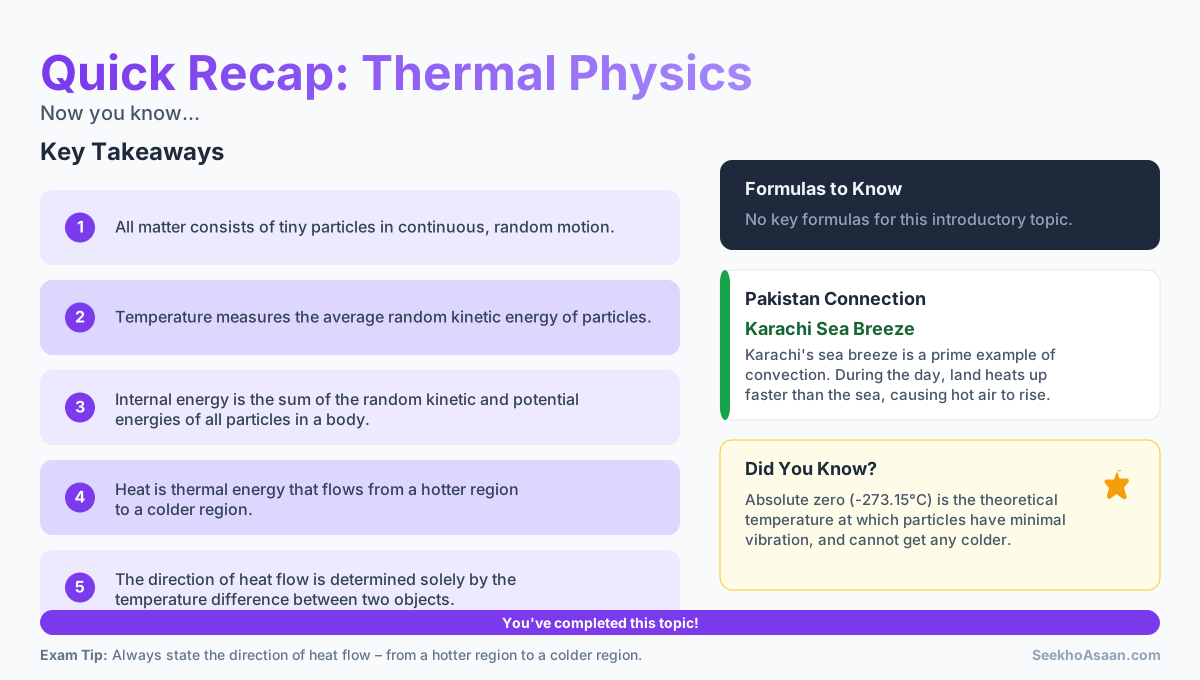
Quick revision infographic
Physics · Quick revision
Thermal Physics
Key concepts
- 01All matter consists of tiny particles (atoms or molecules) which are in a state of continuous, random motion.
- 02Temperature is a measure of the average random kinetic energy of the particles in a substance.
- 03The internal energy of a body is the sum of the random kinetic and potential energies of all its particles.
- 04Heat is the thermal energy that flows from a region of higher temperature to a region of lower temperature.
- 05The direction of heat flow is determined solely by the temperature difference between two objects.
- 06Heating a substance increases its internal energy.
Karachi's sea breeze is a perfect example of convection. During the day, land heats up faster than the sea. Hot air over the land rises (less dense), and cooler air from the sea rushes in to replace it — that's the refreshing sea breeze! At night, it reverses: land cools faster, sea air rises, and a land breeze blows toward the sea. This is why Karachi evenings near the beach feel so pleasant.
Test your knowledge.
30 explained questions. Har answer ke baad reasoning foran milegi.