Study path
Learn it, recall it, then prove it
Read the explanation and work through each example.
Close the notes and explain the main idea yourself.
Attempt the quiz, then revisit only missed concepts.

Introduction: The Nature of Waves
A wave is a fundamental concept in physics, defined as a disturbance that transfers energy from one point to another without the transfer of matter. Imagine the crowd at the Gaddafi Stadium in Lahore doing a 'Mexican wave'. The wave travels around the stadium, but each person only stands up and sits down in their own place. Similarly, in a water wave, the water molecules mostly move up and down while the wave's energy moves forward.
Types of Waves
All waves fall into two main categories based on the direction of particle vibration relative to the direction of energy transfer.
- Transverse Waves
    In a **transverse wave**, the particles of the medium vibrate at a right angle (perpendicular) to the direction in which the wave is travelling. Think of shaking a rope up and down. The wave moves horizontally, but the parts of the rope move vertically.
    *   **Key features:** They have **crests** (the highest points) and **troughs** (the lowest points).
    *   **Examples:** Light waves, all electromagnetic waves (like radio waves and X-rays), and ripples on the surface of water.
- Longitudinal Waves
    In a **longitudinal wave**, the particles of the medium vibrate back and forth in the same direction as (parallel to) the direction of wave travel. The most important example of this is sound.
    *   **Key features:** They consist of areas where particles are pushed close together, called **compressions** (regions of high pressure), and areas where they are spread apart, called **rarefactions** (regions of low pressure).
    *   **Examples:** Sound waves, and the compression and stretching of a slinky spring.
Describing Waves: Properties and The Wave Equation
To understand and quantify waves, we use several key properties:
- Amplitude (A): The maximum displacement or distance moved by a point on a vibrating body or wave measured from its equilibrium position. In simple terms, it's the 'height' of a wave. For sound, a larger amplitude means a louder sound. The SI unit is the metre (m).
- Wavelength (λ): The distance between two consecutive identical points on a wave. For a transverse wave, this is the distance from one crest to the next crest. For a longitudinal wave, it's the distance from the centre of one compression to the centre of the next. The SI unit is the metre (m).
- Frequency (f): The number of complete waves (or oscillations) that pass a point per second. For sound, a higher frequency means a higher pitch. The SI unit is the Hertz (Hz).
- Period (T): The time taken for one complete wave to pass a point. It is the inverse of frequency: T = 1/f. The SI unit is the second (s).
- Wave Speed (v): The speed at which the energy is transferred by the wave. The SI unit is metres per second (m/s).
These properties are linked by the fundamental wave equation:
v = f × λ
(Wave Speed = Frequency × Wavelength)
This equation is crucial for solving problems. For example, if a sound wave has a frequency of 500 Hz and a wavelength of 0.68 m, its speed in air would be v = 500 Hz × 0.68 m = 340 m/s.
The Science of Sound
Sound is a longitudinal wave produced by vibrating objects. These vibrations cause the particles of a medium (solid, liquid, or gas) to vibrate and pass the energy along.
- Medium is Essential: Sound cannot travel through a vacuum, like outer space, because there are no particles to vibrate. This is a key difference between sound and light.
- Speed in Different Media: The speed of sound depends on how close the particles of the medium are.
- Solids: Particles are tightly packed, so vibrations are passed on very quickly. (e.g., steel ≈ 5000 m/s)
- Liquids: Particles are less tightly packed than in solids. (e.g., water ≈ 1500 m/s)
- Gases: Particles are far apart, so sound travels slowest. (e.g., air ≈ 340 m/s)
Reflection of Sound: Echoes
An echo is the reflection of a sound wave from a surface. We hear an echo when the reflected sound reaches our ears with a sufficient time delay after the original sound (typically > 0.1 s).
This principle is used in technologies like SONAR (Sound Navigation and Ranging) to map the seabed or locate submarines. To calculate the distance to a reflecting surface, we use the formula:
Distance (d) = (Speed of sound (v) × Time for echo (t)) / 2
Exam Trap: A common mistake is forgetting to divide by 2. You must divide because the time 't' measured is for the sound to travel to the object and back again. We only want the one-way distance.
Pitch, Loudness, and Human Hearing
- Pitch: How high or low a sound is. This is determined by the wave's frequency. High frequency = high pitch (like a whistle). Low frequency = low pitch (like the beat of a dhol).
- Loudness: The intensity of the sound. This is determined by the wave's amplitude. Large amplitude = loud sound. Small amplitude = quiet sound.
Humans have a limited range of hearing, known as the audible range, which is approximately 20 Hz to 20,000 Hz (20 kHz). Sounds with frequencies above this range are called ultrasound (used by bats and in medical imaging), and those below are called infrasound.
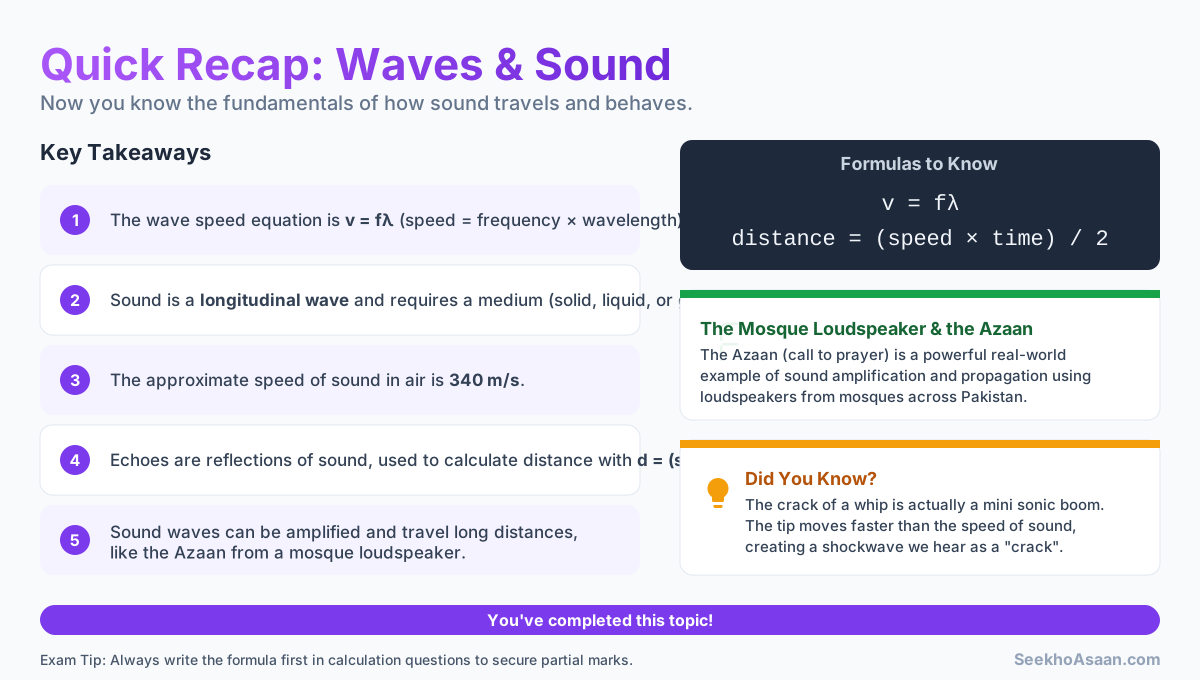
Quick revision infographic
Physics · Quick revision
Waves & Sound
Key concepts
- 01Wave speed = frequency × wavelength (v = fλ)
- 02Sound is a longitudinal wave, needs a medium
- 03Speed of sound in air ≈ 340 m/s
- 04Echoes: distance = (speed × time) / 2
Formulas to know
When the azaan plays from a mosque, sound waves travel through the air at about 340 m/s. If you hear the azaan 2 seconds after it starts from a mosque, you're about 680 metres away (340 × 2 = 680m). In cities like Lahore, you might hear the same azaan from multiple mosques at slightly different times — the delay depends on your distance from each mosque. The loudspeaker increases the amplitude of the sound waves, making the azaan louder without changing its pitch.
Test your knowledge.
29 explained questions. Har answer ke baad reasoning foran milegi.