Study path
Learn it, recall it, then prove it
Read the explanation and work through each example.
Close the notes and explain the main idea yourself.
Attempt the quiz, then revisit only missed concepts.
Introduction & Core Concept
Assalamu Alaikum, brilliant minds of Pakistan! For the next few minutes, forget about textbooks and exams. Instead, I want you to picture this: you're at a beautiful wedding reception held on the lush green lawns of the Lahore Gymkhana. The bride and groom look magnificent. But you notice something peculiar. Your uncle, wearing wide, flat khussas, is walking around effortlessly, greeting guests. Meanwhile, an auntie wearing very sharp, pencil-thin heels (stilettos) is having a terrible time. With every step, her heels sink deep into the soft grass, making it a struggle to walk.
Why does this happen? Your uncle and auntie might weigh roughly the same. The force they exert on the ground—their weight—is similar. The crucial difference lies in how that force is applied. This, in essence, is the study of Pressure.
Physics isn't just about abstract equations; it's the science of explaining our world. The concept of pressure is fundamental to understanding everything from how a syringe works, to why dams like our magnificent Tarbela Dam are built to be incredibly thick at their base, to how a cricketer's spiked shoes grip the pitch at Gaddafi Stadium.
So, what is the big-picture mental model you should have? Think of it like this:
> Force is the total punch. Pressure is the sharpness of the needle delivering that punch.
A large force spread over a large area has a low, dull impact (like a gentle push with your whole hand). The exact same force concentrated on a tiny area has a sharp, intense impact (like a poke with a needle). In this lesson, we will master this concept for solids, liquids, and gases, transforming it from a chapter in a book into a powerful tool for understanding the world around you.
Theoretical Foundation
Let's build our understanding from the ground up, like constructing a solid building. We will explore how pressure behaves in the three states of matter you know and love: solids, liquids, and gases.
1. Pressure in Solids: The Foundation
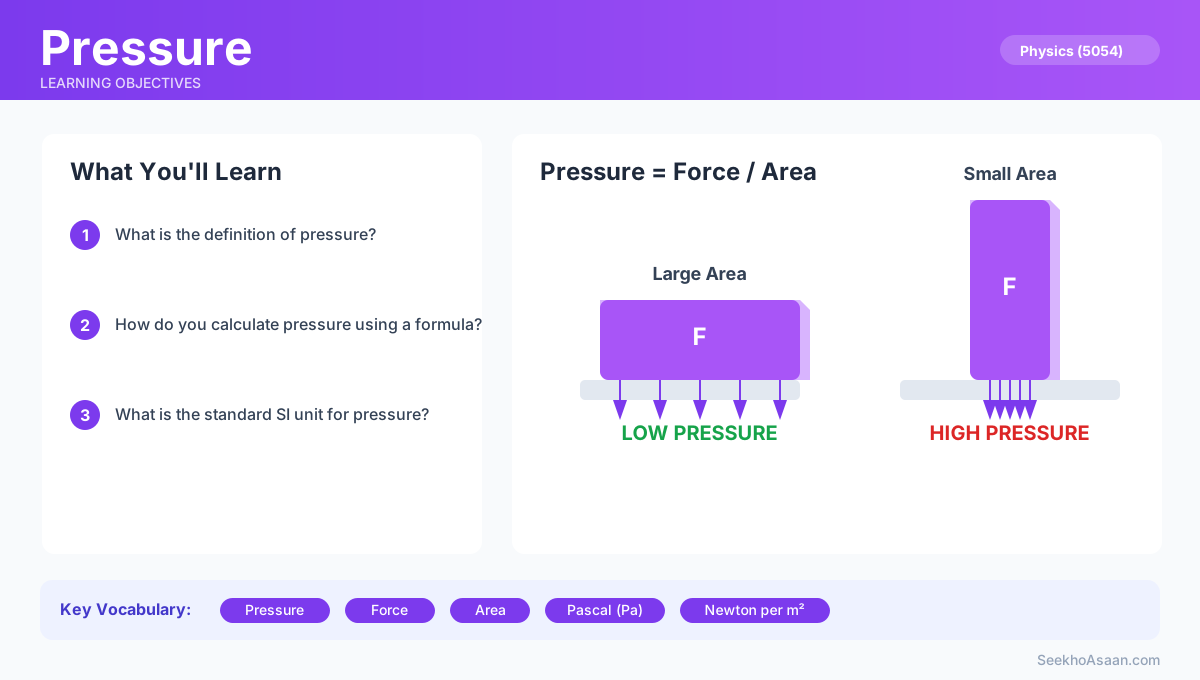
This is the most intuitive starting point. We saw it with the shoes in the garden. The formal definition of pressure is the force acting perpendicularly on a unit of surface area.
Let's break that down:
- Force (F): This is the push or pull, measured in Newtons (N). In many O Level examples, this force will simply be the weight of an object, which you can calculate using
W = mg. - Area (A): This is the surface over which the force is spread, measured in square metres (m²).
- Perpendicularly: This is a critically important word that students often overlook. It means the force we care about is the component that is at a 90° angle to the surface. Imagine you are pushing a box across the floor. The pressure on the floor is due to the box's weight (acting downwards, perpendicular to the floor), not the force you are using to push it sideways (which is parallel to the floor).
This gives us our fundamental formula: Pressure (P) = Force (F) / Area (A).
From this relationship, we can deduce two profound principles that govern almost everything related to pressure in solids:
- Pressure is directly proportional to Force (
P ∝ F): If you keep the area constant and increase the force, the pressure increases. If you put more books in your school bag, the pressure on your shoulders increases because the force (weight) has increased, while the area of the straps remains the same.
- Pressure is inversely proportional to Area (
P ∝ 1/A): If you keep the force constant and decrease the area, the pressure increases. This is the secret behind the stiletto heel, a sharp knife, a nail, or an injection needle. They all work by concentrating a modest force onto a minuscule area, creating an immense pressure capable of piercing skin, wood, or vegetables. Conversely, to reduce pressure, we increase the area. This is why tractors used on soft farmland have massive, wide tyres, and why soldiers in snowy regions wear snowshoes.
2. Pressure in Liquids: The Depths of Understanding
Liquids, like water in the Indus River or the Arabian Sea, also exert pressure. But how? Unlike a solid block, a liquid doesn't have a fixed shape. The pressure within a liquid comes from the weight of the liquid column above a certain point.
Imagine you are a fish swimming in Keenjhar Lake. The deeper you swim, the more water is on top of you. This column of water has weight, and that weight is pushing down on you from all directions. This is called hydrostatic pressure.
Let's derive the formula for this, P = hρg, from first principles, so you understand why it works, not just that it works.
- Consider a cylindrical column of water of height
hand cross-sectional areaA. - The force
Fthis column exerts on the bottom is simply its weight.F = weight = mg. - We know that
density (ρ) = mass (m) / volume (V). Therefore, we can express the mass of the water asm = ρV. - Substituting this into our force equation:
F = (ρV)g. - What is the volume
Vof this cylinder of water? It's the cross-sectional areaAmultiplied by the heighth. So,V = A × h. - Let's substitute this expression for volume back into our force equation:
F = ρ(Ah)g. - Now, we use our fundamental definition of pressure:
P = F / A. - Let's put our new expression for
Finto this pressure formula:P = (ρAhg) / A. - The
Aon the top and bottom cancel out beautifully!
This leaves us with the elegant and powerful formula for pressure in a liquid: P = hρg.
Let's analyse the profound consequences of this formula:
- Pressure increases with depth (
h): The deeper you go, the greater the pressure. This is why deep-sea submarines must have incredibly strong hulls, and why the base of the Mangla Dam is vastly thicker than its top. The pressure at the bottom is enormous. - Pressure increases with density (
ρ): Denser liquids exert more pressure at the same depth. The pressure 10 metres deep in mercury (a very dense liquid) would be far greater than the pressure 10 metres deep in water. - Pressure is independent of the shape of the container: Notice that the area
Acancelled out. This means that the pressure at a depth of 1 metre in a massive lake is the same as the pressure at a depth of 1 metre in a thin pipe, provided the liquid is the same. This often feels counter-intuitive but is a direct consequence of the derivation. It's known as the hydrostatic paradox. - Pressure at a certain depth acts equally in all directions: The weight of the water above is pushing down, but the fluid particles transmit this pressure sideways and even upwards. So, the pressure on a submarine's side window is the same as the pressure on its top surface at the same depth.
3. Pressure in Gases and Pascal's Principle
Atmospheric Pressure
We live at the bottom of a vast ocean—an ocean of air called the atmosphere. All the air above us has weight, and it exerts a pressure on us known as atmospheric pressure. At sea level (for example, on the beach in Karachi), this pressure is approximately 101,325 Pascals! We don't feel it because the pressure inside our bodies is pushing outwards with an equal force.
A simple barometer, invented by Evangelista Torricelli, demonstrates this. A long glass tube, sealed at one end, is filled with mercury and inverted into a dish of mercury. The atmospheric pressure pushing down on the mercury in the dish supports a column of mercury in the tube about 760 mm high. If the atmospheric pressure drops (e.g., before a storm), the height of the mercury column also drops.
Pascal's Principle: The Force Multiplier
This principle is a cornerstone of hydraulics and is incredibly useful. It states:
> Pressure applied to an enclosed, incompressible fluid is transmitted undiminished to every portion of the fluid and the walls of the containing vessel.
Imagine a U-shaped container filled with oil, with two pistons of different sizes, a small one with area A₁ and a large one with area A₂. If you apply a small downward force F₁ on the small piston, you create a pressure P₁ = F₁/A₁.
According to Pascal's principle, this exact same pressure P₂ = P₁ is transmitted throughout the fluid and acts on the larger piston. So, the upward force F₂ on the large piston is F₂ = P₂ × A₂.
Since P₁ = P₂, we can say: F₁/A₁ = F₂/A₂
If the large piston has an area 100 times greater than the small piston (A₂ = 100A₁), then the output force will be 100 times the input force (F₂ = 100F₁)! This is how hydraulic jacks lift heavy cars at a service station, how your car's brake system works, and how hydraulic presses shape metal. You apply a small force, and the system multiplies it into a massive force.
Key Definitions & Formulae
Here is a clean summary of the essential information for your notes and revision.
1. Pressure (General)
- Definition: The force acting normally (perpendicularly) per unit area.
- Formula:
P = F / A - Symbols:
P= PressureF= Normal ForceA= Area- Units:
- SI Unit: Pascal (Pa), which is equivalent to one Newton per square metre (N/m²).
1 kPa(kilopascal) = 1000 Pa.- Dimensional Analysis:
[P] = [F]/[A] = (MLT⁻²)/(L²) = ML⁻¹T⁻²
2. Pressure in a Fluid (Liquid or Gas)
- Definition: The pressure exerted by the weight of a column of fluid.
- Formula:
P = hρg - Symbols:
P= Gauge Pressure (pressure due to the fluid only)h= Vertical depth or height of the fluid columnρ(rho) = Density of the fluidg= Acceleration due to gravity (on Earth, approx. 9.8 m/s² or often taken as 10 m/s² in O Level questions)- Units:
hin metres (m)ρin kilograms per cubic metre (kg/m³)gin metres per second squared (m/s²)Pin Pascals (Pa)- Dimensional Analysis:
[P] = [h][ρ][g] = (L) × (ML⁻³) × (LT⁻²) = ML⁻¹T⁻². (Matches the first definition, as it must!)
3. Pascal's Principle (Hydraulics)
- Definition: Pressure is transmitted undiminished in an enclosed fluid.
- Formula:
F₁/A₁ = F₂/A₂ - Symbols:
F₁= Input force on the small pistonA₁= Area of the small pistonF₂= Output force on the large pistonA₂= Area of the large piston- Units: Forces must be in the same unit (e.g., N). Areas must be in the same unit (e.g., m² or cm²).
Worked Examples
Let's apply this theory to some practical problems, just like those you'll face in your Cambridge exams.
Example 1: The PTCL Junction Box (Pressure in Solids)
A new PTCL fiber optic junction box, made of concrete, has a mass of 500 kg. Its base is a square with sides of length 0.80 m. Calculate the pressure the box exerts on the ground. (Take g = 10 m/s²).
Solution:
- Identify the Goal: We need to calculate pressure (
P). - Identify the Formula: The relevant formula for a solid is
P = F / A. - Calculate the Force (F): The force exerted by the box is its weight.
F = weight = mgF = 500 kg × 10 m/s² = 5000 N
- Calculate the Area (A): The base is a square.
A = length × width = 0.80 m × 0.80 mA = 0.64 m²
- Substitute and Calculate Pressure (P):
P = F / A = 5000 N / 0.64 m²P = 7812.5 Pa
- Final Answer with Units and Sig Figs: The pressure exerted by the box is 7813 Pa (to 4 s.f.) or 7.8 kPa.
Example 2: A Diver in the Arabian Sea (Pressure in Liquids)
A diver is exploring a shipwreck off the coast of Karachi at a depth of 40 metres. The density of seawater is 1025 kg/m³. Calculate the pressure on the diver due to the seawater. (Take g = 9.8 m/s²).
Solution:
- Identify the Goal: We need to find the pressure (
P) due to the seawater. - Identify the Formula: The formula for pressure in a liquid is
P = hρg. - List the Known Values:
- Depth,
h = 40 m - Density,
ρ = 1025 kg/m³ - Gravity,
g = 9.8 m/s²
- Substitute and Calculate Pressure (P):
P = 40 m × 1025 kg/m³ × 9.8 m/s²P = 401,800 Pa
- Final Answer with Units: The pressure on the diver is 401,800 Pa or 401.8 kPa. (Note: This is the gauge pressure. The total or absolute pressure would be this value plus atmospheric pressure.)
Example 3: The Hydraulic Car Lift (Pascal's Principle)
At a workshop in Lahore, a mechanic uses a hydraulic lift to raise a Suzuki Alto with a mass of 750 kg. The car rests on a large piston with a radius of 15 cm. The mechanic applies force to a small piston with a radius of 2.0 cm. What is the minimum force the mechanic must apply? (Take g = 10 m/s²).
Solution:
- Identify the Goal: We need to find the input force (
F₁). - Identify the Formula: Pascal's principle gives us
F₁/A₁ = F₂/A₂. We can rearrange this toF₁ = F₂ × (A₁/A₂). - Calculate the Output Force (F₂): This is the weight of the car.
F₂ = weight = mg = 750 kg × 10 m/s² = 7500 N
- Calculate the Areas (A₁ and A₂): The pistons are circular, so we use
Area = πr². It is crucial to be consistent with units. We can work in cm² and the units will cancel out, or convert to m². Let's convert to m² to be safe.
r₁ = 2.0 cm = 0.02 mr₂ = 15 cm = 0.15 mA₁ = π × (0.02 m)² = 0.001257 m²A₂ = π × (0.15 m)² = 0.070686 m²
- Substitute and Calculate Input Force (F₁):
F₁ / 0.001257 m² = 7500 N / 0.070686 m²F₁ = (7500 N / 0.070686 m²) × 0.001257 m²F₁ = 133.3 N
- Final Answer with Units: The mechanic must apply a minimum force of 133 N (to 3 s.f.). Notice how a small force of 133 N (the weight of about 13.3 kg) can lift a massive 7500 N car!
Visual Mental Models
Sometimes, a picture is worth a thousand equations. Use these mental models to visualise pressure.
1. The "Force Vector" Model for Solids:
Imagine a brick. When it lies flat, its weight (Force) is spread over a large area. We can draw many small arrows (vectors) representing the force, but they are spread out.
    Wide Base (Low Pressure)
    +-----------------------+
    |         BRICK         |
    +-----------------------+
      ↓   ↓   ↓   ↓   ↓   ↓  (Force spread out)
Now, stand the brick on its end. The weight is the same, but the area is tiny. The force vectors are now highly concentrated.
    Narrow Base (High Pressure)
    +-------+
    |       |
    | B     |
    | R     |
    | I     |
    | C     |
    | K     |
    +-------+
      ↓↓↓↓↓  (Force concentrated)
This concentration is what we call high pressure.
2. The "Human Pyramid" Model for Liquids:
Think of water molecules as people in a human pyramid at a circus. The person at the very bottom has the weight of everyone above them pressing down. Someone in the middle row has less weight above them. The person at the very top has no one above them.
      O  <-- Top layer (Zero liquid pressure)
     O O <-- Middle layer (Medium pressure)
    O O O <-- Bottom layer (Highest pressure)
This is a simple way to remember that pressure in a liquid increases with depth (P = hρg).
3. The "Connected Pipes" Model for Pascal's Principle:
Visualise the hydraulic lift as two connected syringes, one thin and one wide, filled with water.
    Small Force F₁
         ↓
      [Piston₁]
    +-----------+
    |           |               +---------------+  [Piston₂]
    |   Fluid   |---------------|   Fluid       |     ↑
    +-----------+               +---------------+  Large Force F₂
When you push the small piston, you are pressurising the entire fluid. This pressure acts on the large piston, and because its area is much bigger, the resulting upward force is also much bigger. Force = Pressure × Area. Same pressure, bigger area, bigger force.
Common Mistakes & Misconceptions
Even the best students can fall into these traps. Let's illuminate them so you can avoid them.
- Confusing Force and Pressure.
- Mistake: "The elephant's foot exerts a lot of pressure because it's heavy."
- Why it's wrong: The elephant's weight is a large force. However, its feet have a very large area. The pressure might be less than that of a woman's stiletto heel, which has a tiny area.
- Correct Thinking: Pressure is not just about the force; it's about how concentrated that force is. Always think
F/A.
- Forgetting to Convert Units.
- Mistake: Calculating pressure using Force in Newtons and Area in cm².
P = 10 N / 5 cm² = 2 Pa. - Why it's wrong: The Pascal (Pa) is defined as N/m². You must convert cm² to m² before calculating. Remember:
1 m = 100 cm, so1 m² = (100 cm)² = 10,000 cm². So,5 cm² = 5 / 10,000 = 0.0005 m². - Correct Thinking: Before you substitute numbers into any formula, check that all values are in their standard SI units (N, m, m², kg, m³, etc.).
- Pressure in Liquids Only Acts Downwards.
- Mistake: Thinking that the pressure at the bottom of a pool only pushes on the floor.
- Why it's wrong: At any point within a fluid, pressure is exerted equally in all directions. This is because the molecules are free to move and collide with each other and the container walls, transmitting the force everywhere.
- Correct Thinking: A fish in the water feels pressure on its top, bottom, and sides simultaneously.
- Believing More Water Means More Pressure at the Bottom.
- Mistake: "Lake Superior will have more pressure at a depth of 10m than a narrow well of 10m depth, because the lake has much more water."
- Why it's wrong: The formula
P = hρgshows that pressure only depends on vertical depth (h) and density (ρ), not the total volume or width of the container. - Correct Thinking: The pressure at 10m depth is the same in both cases (assuming the same liquid). The extra water in the lake is supported by other parts of the lake bed, not by the point directly below where you are measuring.
- Using Slanted Height Instead of Vertical Depth.
- Mistake: A question shows a dam with a sloped face and gives the length of the slope. The student uses this slant length as
hinP = hρg. - Why it's wrong: The
hin the formula strictly refers to the vertical distance from the surface of the fluid down to the point of measurement. - Correct Thinking: Always identify the vertical height. If you're given a slant height and an angle, you may need to use trigonometry (SOH CAH TOA) to find the vertical component, though this is more common at A-Level.
- Ignoring Atmospheric Pressure.
- Mistake: Calculating the pressure on a submarine and stating that is the only pressure acting on it.
- Why it's wrong: The formula
P = hρggives the gauge pressure (the pressure from the fluid alone). The total or absolute pressure is the gauge pressure PLUS the atmospheric pressure pushing down on the surface of the water. - Correct Thinking: Read the question carefully. If it asks for "pressure due to the water," use
P = hρg. If it asks for "total pressure" or "absolute pressure," calculateP_total = P_atmospheric + hρg.
Exam Technique & Mark Scheme Tips
Here is a practical checklist for turning your knowledge into marks.
- Understand Command Words:
- State: Give a concise answer without explanation. "State the SI unit of pressure." Answer: "Pascal (Pa)." (1 mark)
- Describe: Say what you see or what happens. "Describe how pressure in a liquid changes with depth." Answer: "As depth increases, the pressure in the liquid increases." (1 mark)
- Explain: Give the reason why. This requires linking cause and effect using scientific principles. "Explain why a sharp knife cuts better than a blunt one." Answer: "A sharp knife has a very small surface area at its cutting edge [1 mark]. For the same applied force, this results in a very large pressure (P=F/A) [1 mark], which is sufficient to cut through the material [1 mark]."
- Calculate: This is a command to do a numerical problem. You must show your working.
- The "FSAU" Method for Calculations:
    Cambridge examiners award marks systematically. Use this four-step method to ensure you get all of them:
    *   **F**ormula: Write down the correct formula first (e.g., `P = F/A`). This often gets you the first mark, even if your final answer is wrong.
    *   **S**ubstitution: Substitute the correct values *with their units* into the formula. This gets you the second mark.
    *   **A**nswer: Calculate the final numerical answer.
    *   **U**nits: Write the correct SI unit with your answer. This is often the final, crucial mark. Forgetting it can cost you dearly.
- Watch for Examiner Traps:
- Unit Conversions: Examiners love to give you values in cm, mm, or g. They are testing if you are careful. Always convert to m, m², kg, etc., before calculating.
- Mixed-Up Areas: In hydraulic questions, they might give you the radius of one piston and the diameter of the other. Read carefully! Calculate the area for each using the correct value.
- Total vs. Gauge Pressure: As mentioned, be clear if the question is asking for pressure from the fluid only (
hρg) or the total pressure (P_atm + hρg).
- Quoting Formulae: When asked to define pressure, don't just write the formula
P = F/A. Write it in words: "Pressure is the force acting perpendicularly per unit area." The words are the definition; the formula is the mathematical representation.
- Significant Figures: A good rule of thumb is to give your final answer to 2 or 3 significant figures, unless the question specifies otherwise. This reflects the precision of the data given.
Memory Tricks & Mnemonics
Your brain loves shortcuts. Here are a few to help these concepts stick.
- The Pressure Triangle: For the main formula
P = F/A, draw a triangle. Cover the value you want to find, and the triangle shows you how to calculate it.
         F
       /   \
      /-----\
     P   x   A

    *   Cover `F`: You see `P × A`. So, `F = P × A`.
    *   Cover `P`: You see `F / A`. So, `P = F / A`.
    *   Cover `A`: You see `F / P`. So, `A = F / P`.
- Mnemonic for
P = hρg:
- "Highly Pressured Giraffes" (Height, Rho, Gravity)
- Or in an Urdu context: "Hum Par Gham" (We are under sorrow/pressure) to remember the variables
h,ρ, andg.
- Knife Analogy: To remember the
P ∝ 1/Arelationship, just think of a kitchen knife. To make it cut better (increase pressure), you don't push harder (same force), you sharpen it (decrease area).
Pakistan & Everyday Connections
Physics is not a foreign subject; it is happening all around you in Pakistan every single day.
- Tarbela and Mangla Dams: These marvels of Pakistani engineering are perfect examples of
P = hρg. The immense pressure of the water at the bottom of the reservoir means the dam wall must be incredibly thick at its base to withstand the colossal force. The force on the base isF = P × A = (hρg) × A. With a huge depth (h) and a massive area (A) of the dam face, the total force is mind-bogglingly large.
- The Pressure Cooker in Your Kitchen: Every Pakistani household has a pressure cooker for making daal or pulao quickly. How does it work? By sealing the lid, steam cannot escape. This increases the pressure inside the pot. At this higher pressure, the boiling point of water increases from 100°C to about 120°C. Cooking food at this higher temperature significantly reduces the cooking time, saving both time and gas.
- Getting a Tyre Punctured: When you drive over a small, sharp nail on a road in Karachi, it can easily puncture your car's tyre. The entire weight of the car is concentrated for a moment on the tiny, sharp point of the nail. This creates an enormous pressure (
P = F/A), far greater than the tyre's rubber can withstand, leading to a puncture. This is a perfect, if unfortunate, example of pressure in action.
Practice Problems
Test your understanding with these exam-style questions.
Question 1 (Bookwork): (a) Define pressure and state its SI unit. (b) Explain why it is easier to walk on soft sand wearing flat shoes rather than high-heeled shoes.
Answer Outline: (a) Definition in words ("Force per unit area...") and unit (Pascal/Pa). (b) Mention both shoes exert the same force (weight). Flat shoes have a larger area, resulting in lower pressure. High heels have a smaller area, resulting in higher pressure that causes sinking. Use P=F/A in your explanation.
Question 2 (Calculation - Solids): A cricket pitch roller has a mass of 1200 kg. The area of the roller in contact with the ground is 1.5 m². Calculate the pressure exerted by the roller on the pitch. (Take g = 10 N/kg).
Answer Outline:
- Calculate force (weight):
F = mg = 1200 × 10 = 12000 N. - Use
P = F/A. P = 12000 N / 1.5 m².- Calculate P and give the answer in Pascals (Pa).
Question 3 (Calculation - Liquids): The water level in the Rawal Dam is 50 m deep at its deepest point. Calculate the maximum water pressure at the base of the dam. (Density of water = 1000 kg/m³, g = 9.8 m/s²).
Answer Outline:
- Use the formula
P = hρg. - Substitute the values:
h=50,ρ=1000,g=9.8. - Calculate P and give the answer in Pascals (Pa) or kilopascals (kPa).
Question 4 (Application - Hydraulics): The hydraulic brake system of a car uses a master piston of area 4 cm² and four slave pistons (at the wheels) each of area 16 cm². If the driver applies a force of 100 N to the brake pedal (master piston), what is the total braking force produced by the four slave pistons?
Answer Outline:
- Find the pressure created by the master piston:
P = F₁/A₁ = 100 N / 4 cm². - This pressure is transmitted to each slave piston. Calculate the force on one slave piston:
F₂ = P × A₂. - The total braking force is the force from all four slave pistons. Multiply your result from step 2 by 4.
Question 5 (Conceptual Explanation): A student claims that if you have two glasses, one wide and one narrow, both filled with water to the same height, the wide glass will exert more pressure on the table because it contains more water. Explain, with reference to relevant formulae, why this student is incorrect.
Answer Outline:
- State that the student is incorrect.
- The pressure within the liquid at the base is given by
P = hρg. Explain that this depends only on height (h), not the width or volume of the container. So the pressure at the bottom of the water is the same in both glasses. - The pressure on the table is due to the total weight of the glass + water, divided by the area of the glass's base. The wide glass has more weight, but also a larger base area. The pressure on the table depends on the ratio of
Weight/Area, which is a different calculation from the internal liquid pressure. The key misconception to address is the pressure at the bottom of the liquid.
Quick revision infographic
Physics · Quick revision
Pressure
Key concepts
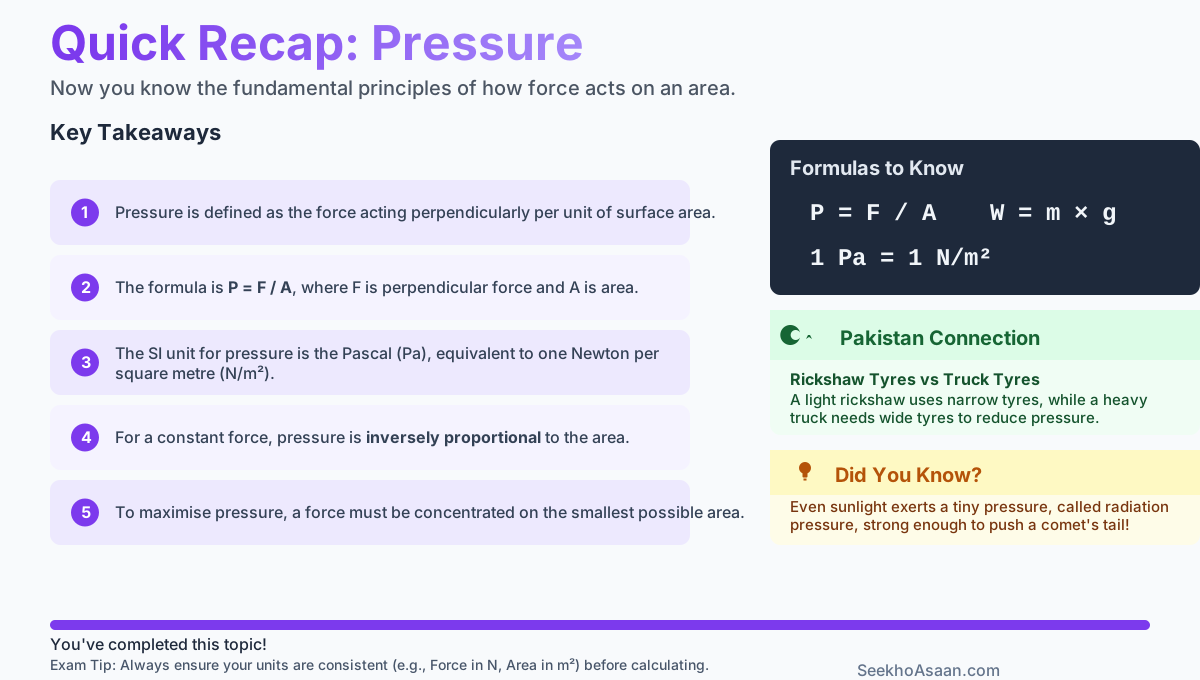
- 01Pressure is defined as the force acting perpendicularly per unit of surface area.
- 02The formula to calculate pressure is P = F/A, where F is the perpendicular force and A is the area.
- 03The standard SI unit for pressure is the Pascal (Pa), which is equivalent to one Newton per square metre (N/m²).
- 04For a constant force, pressure is inversely proportional to the area; a smaller area results in higher pressure.
- 05For a constant area, pressure is directly proportional to the force; a larger force results in higher pressure.
- 06To maximise pressure, a force must be concentrated on the smallest possible area (e.g., a needle or a knife's edge).
Formulas to know
A Suzuki Bolan (about 800 kg) has 4 narrow tyres, each with maybe 0.02 m² of contact area. Total area = 0.08 m². Pressure on road = (800×10)/0.08 = 100,000 Pa. A heavy truck (20,000 kg) with 18 tyres, each 0.05 m² contact = 0.9 m² total. Pressure = (20,000×10)/0.9 = 222,222 Pa. Even with 18 tyres, trucks still damage roads more! That's why overloaded trucks destroy Pakistani highways.
Test your knowledge.
30 explained questions. Har answer ke baad reasoning foran milegi.