Study path
Learn it, recall it, then prove it
Read the explanation and work through each example.
Close the notes and explain the main idea yourself.
Attempt the quiz, then revisit only missed concepts.

1. The Concept of Energy
Energy is the capacity or ability to do work. Think of it as the fundamental currency needed for any change to occur in the universe, from lifting a book to powering a city. The SI unit for energy is the Joule (J).
At the heart of this topic is the Principle of Conservation of Energy, a fundamental law of physics. It states that energy cannot be created or destroyed, only transferred from one form to another. The total amount of energy in an isolated system always remains constant.
2. Forms of Energy
Energy exists in various forms, and we witness their interplay constantly.
- Kinetic Energy (KE): This is the energy of motion. Any object that is moving possesses kinetic energy. A cruising PIA airplane, a cricket ball bowled by Shaheen Afridi, and flowing water in the Indus River all have KE.
- Formula: KE = ½mv²
- m = mass of the object (in kilograms, kg)
- v = velocity of the object (in metres per second, m/s)
- Key Insight: The relationship with velocity is squared. This means if you double an object's speed, you quadruple its kinetic energy, making high-speed collisions far more dangerous.
- Gravitational Potential Energy (GPE): This is the energy an object has stored due to its position in a gravitational field, essentially its height above a reference point. Lifting an object against gravity stores GPE in it.
- Formula: GPE = mgh
- m = mass of the object (kg)
- g = gravitational field strength (on Earth, approximately 10 N/kg or 9.8 m/s²)
- h = vertical height change (in metres, m)
- Application: The water stored behind Tarbela Dam possesses enormous GPE, which is the primary source for generating Pakistan's hydroelectric power.
- Other Key Forms:
- Chemical Energy: Energy stored in the bonds of atoms and molecules. Found in food, batteries, and fuels like the natural gas supplied to homes from the Sui gas fields.
- Elastic Potential Energy: Energy stored in an object when it is stretched or compressed, like a drawn bow or a compressed spring.
- Thermal Energy (Heat): The internal energy of an object due to the kinetic energy of its atoms and molecules. The hotter an object, the more its particles vibrate.
- Electrical Energy: Energy carried by moving electric charges (electrons) in a circuit.
- Nuclear Energy: Immense energy stored in the nucleus of an atom, released during nuclear fission or fusion. It powers nuclear plants like KANUPP in Karachi.
- Light & Sound Energy: Energy carried by waves.
3. Work Done: The Mechanism of Energy Transfer
In physics, Work Done has a very specific meaning. It is the energy transferred when a force successfully moves an object over a distance. If you push a wall, you might get tired, but if the wall doesn't move, no work is done on the wall.
- Formula: Work Done (W) = Force (F) × Distance (d)
- F = The force applied (in Newtons, N)
- d = The distance the object moves in the direction of the force (in metres, m)
- The unit for work done is also the Joule (J), because work is simply a measure of energy transfer. 1 Joule of work is done when a 1 Newton force moves an object by 1 meter.
Example: A construction worker in Lahore lifts a 20 kg bag of cement 1.5 m vertically. The force needed is equal to the weight of the cement (F = mg = 20 kg × 10 N/kg = 200 N). The work done is W = Fd = 200 N × 1.5 m = 300 J. This 300 J of work is converted into the GPE of the cement bag.
4. Power: The Rate of Doing Work
Power is the measure of how quickly work is done or how fast energy is transferred. Two machines can do the same amount of work, but the one that does it faster is more powerful.
- Formula: Power (P) = Work Done (W) / Time taken (t)
- Since Work Done is energy transferred (E), this can also be written as: P = E / t
- The SI unit for power is the Watt (W). One Watt is equivalent to one Joule of work done per second (1 W = 1 J/s).
Example: If the worker in Lahore lifted the 300 J cement bag in 2 seconds, his power output would be P = 300 J / 2 s = 150 W. If another worker did the same job in 4 seconds, their power output would only be P = 300 J / 4 s = 75 W.
Common Misconceptions & Exam Traps
- No Movement, No Work: Remember, holding a heavy object stationary does no work in the physics sense, even though it feels tiring. The distance moved is zero.
- Direction is Critical: In the formula W = Fd, the distance 'd' must be in the same direction as the force. If they are perpendicular, no work is done by that force.
- Vertical Height for GPE: When calculating GPE gain for an object moving up a ramp, 'h' is the direct vertical increase in height, not the distance travelled along the ramp's surface.
- Energy vs. Power: Do not use these terms interchangeably. Energy is the total capacity (Joules), while power is the rate of using that capacity (Joules per second, or Watts).
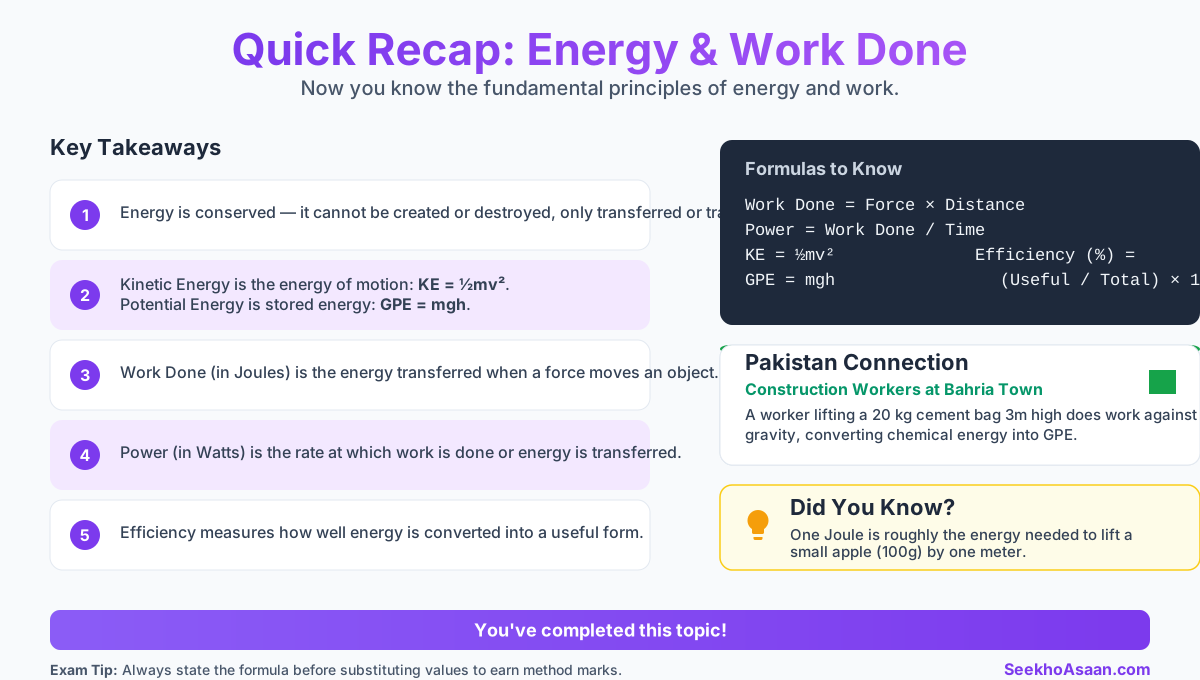
Quick revision infographic
Physics · Quick revision
Energy & Work Done
Key concepts
- 01Energy cannot be created or destroyed, only transferred
- 02KE = ½mv², GPE = mgh
- 03Work Done = Force × Distance (in Joules)
- 04Power = Work Done / Time (in Watts)
- 05Efficiency = (useful output / total input) × 100%
Formulas to know
A construction worker at Bahria Town lifts a 20 kg cement bag to a height of 3 metres. The work done against gravity is W = mgh = 20 × 10 × 3 = 600 Joules. If he does this in 4 seconds, his power output is 600/4 = 150 Watts. That's like powering one and a half light bulbs! Now imagine doing this hundreds of times a day — you can see why construction work is so exhausting.
Test your knowledge.
30 explained questions. Har answer ke baad reasoning foran milegi.