Study path
Learn it, recall it, then prove it
Read the explanation and work through each example.
Close the notes and explain the main idea yourself.
Attempt the quiz, then revisit only missed concepts.
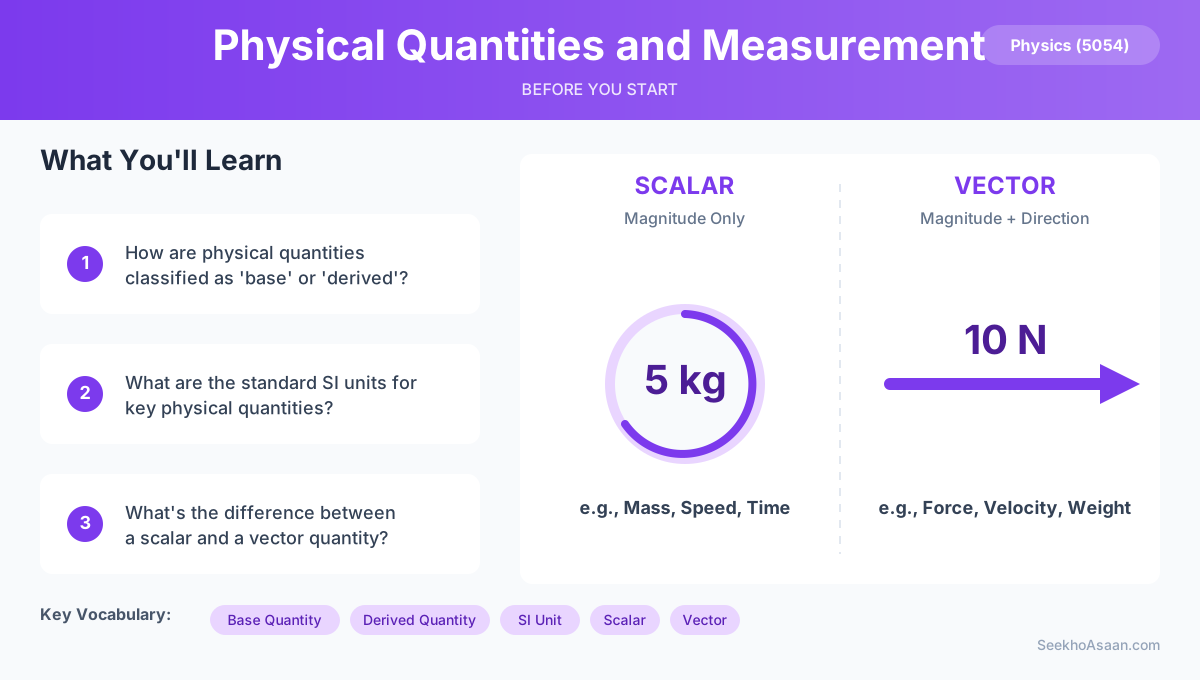
Physics is the science of measurement. To understand and describe the world around us, we must first measure it. Any measurable property of an object or a phenomenon is called a physical quantity. These quantities form the language of physics.
Base and Derived Quantities
Physical quantities are categorised into two types: base quantities and derived quantities.
Base quantities are the fundamental building blocks. They are a set of seven quantities that are independent of each other. For O Level Physics, we primarily focus on three:
- Length: The distance between two points. SI unit: metre (m).
- Mass: The amount of matter in an object. SI unit: kilogram (kg).
- Time: The duration between two events. SI unit: second (s).
Derived quantities are created by combining base quantities through multiplication or division. Examples include:
- Area: Length × Length (unit: m²)
- Volume: Length × Length × Length (unit: m³)
- Speed: Distance / Time (unit: m/s)
- Density: Mass / Volume (unit: kg/m³)
To handle very large or very small measurements, we use prefixes with SI units. Common prefixes include kilo- (k) for 1000, centi- (c) for 0.01, and milli- (m) for 0.001.
Scalars and Vectors
A crucial distinction in physics is between scalars and vectors.
- A scalar is a physical quantity that is fully described by its magnitude (size) only. Examples include distance (50 m), speed (20 m/s), mass (5 kg), and time (10 s).
- A vector is a physical quantity that requires both magnitude and direction for a complete description. Examples include displacement (50 m to the East), velocity (20 m/s North), force (10 N downwards), and acceleration (9.8 m/s² downwards).
Measuring Instruments
Accurate measurement requires appropriate instruments. For measuring length with high precision, standard rulers are insufficient. We use vernier calipers and micrometer screw gauges.
The Vernier Calipers
A vernier caliper is used to measure lengths, including external and internal diameters, to a precision of 0.1 mm (or 0.01 cm). It has a main scale (like a ruler) and a sliding vernier scale.
How to take a reading:
- Main Scale Reading (MSR): Place the object between the jaws. Read the value on the main scale that is just to the left of the zero mark on the vernier scale.
- Vernier Scale Coincidence (VSC): Look for the mark on the vernier scale that aligns perfectly with a mark on the main scale. Note this vernier scale division number.
- Calculate: The final reading is calculated using the formula:
Reading = MSR + (VSC × Least Count)
The **least count (LC)** is the smallest measurement the instrument can make, typically 0.01 cm.
The Micrometer Screw Gauge
For even greater precision, we use a micrometer screw gauge. It is ideal for measuring the diameter of a wire or the thickness of a sheet of paper, typically to a precision of 0.01 mm.
How to take a reading:
- Main Scale Reading (MSR): Place the object between the anvil and spindle. Read the main scale on the sleeve. This will show readings in millimeters and half-millimeters.
- Thimble Scale Reading (TSR): Read the value on the rotating thimble scale that aligns with the horizontal line on the main scale.
- Calculate: The final reading is calculated using the formula:
Reading = MSR + (TSR × Least Count)
The **least count (LC)** of a micrometer is typically 0.01 mm.
Zero Error
Both instruments may have a zero error, which occurs when the zero of the vernier/thimble scale does not align with the zero of the main scale when the jaws are closed.
- A positive zero error occurs when the zero is to the right and is subtracted from the observed reading.
- A negative zero error occurs when the zero is to the left and is added to the observed reading.
Corrected Reading = Observed Reading – (± Zero Error)
Mastering these fundamental concepts of quantities, units, and measurement techniques is the essential first step to succeeding in physics.
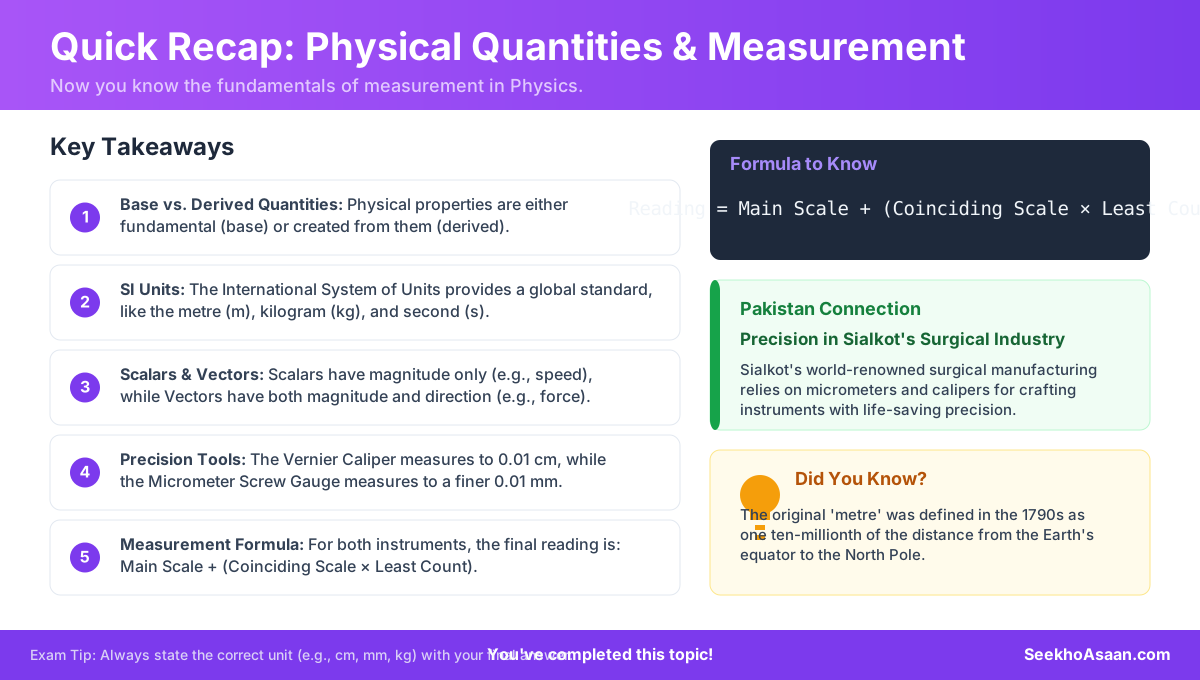
Quick revision infographic
Physics · Quick revision
Physical Quantities and Measurement
Key concepts
- 01Physical quantities are measurable properties, categorized into fundamental 'base' quantities (length, mass, time) and 'derived' quantities (area, speed, density).
- 02The International System of Units (SI) provides a standard for measurement (metre, kilogram, second).
- 03Scalars are quantities with magnitude only (e.g., speed, mass), while vectors have both magnitude and direction (e.g., velocity, force).
- 04A Vernier Caliper measures length to a precision of 0.01 cm, combining a main scale and a sliding vernier scale reading.
- 05A Micrometer Screw Gauge provides higher precision (0.01 mm) for measuring small diameters or thicknesses.
- 06The formula for both instruments is: Reading = Main Scale Reading + (Coinciding Scale Reading × Least Count).
Formulas to know
Sialkot is globally renowned for manufacturing high-quality surgical instruments. The production of a single scalpel or forceps requires extreme precision. Manufacturers use micrometer screw gauges to measure the thickness of the stainless steel sheets to within a fraction of a millimeter. Vernier calipers are used to ensure the dimensions of handles and jaws meet exact medical specifications. This application of precise measurement of the base quantity 'length' is critical for ensuring the instruments are effective, safe, and meet international quality standards, directly impacting Pakistan's export economy.
Test your knowledge.
5 explained questions. Har answer ke baad reasoning foran milegi.