Study path
Learn it, recall it, then prove it
Read the explanation and work through each example.
Close the notes and explain the main idea yourself.
Attempt the quiz, then revisit only missed concepts.
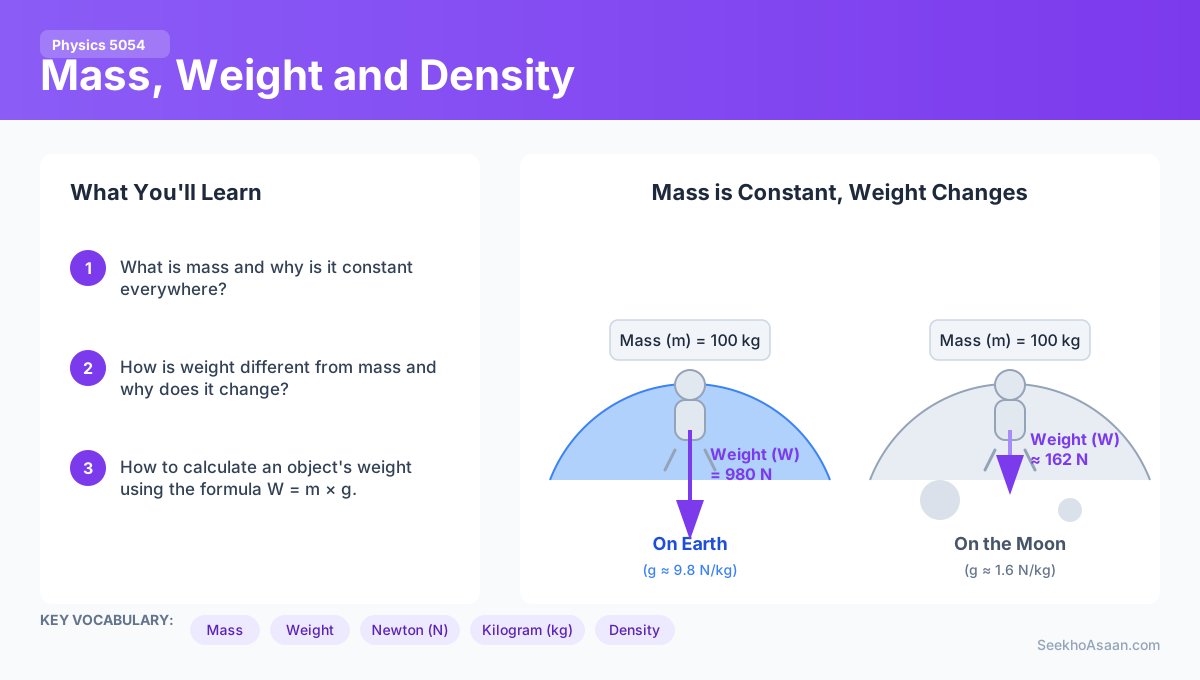
1. Understanding Mass
Mass is the measure of the amount of matter or 'stuff' in an object. It is a fundamental property of an object and is constant, meaning it does not change regardless of the object's location in the universe. For example, a 1 kg bag of sugar has a mass of 1 kg on Earth, on the Moon, or in deep space. Mass is also a measure of inertia – an object's resistance to a change in its state of motion. The more mass an object has, the harder it is to start it moving or to stop it once it is moving.
- Quantity Type: Scalar (it has magnitude only).
- SI Unit: kilogram (kg).
- Measuring Instrument: Beam balance or top-pan balance (which compares an unknown mass with a known mass).
2. Gravitational Fields and Weight
Every object with mass creates a gravitational field around it. This is a region of space where another mass will experience a force of attraction. The Earth has a significant gravitational field that pulls everything towards its center.
Weight is the force of gravity acting on an object. Unlike mass, weight is not constant; it depends on the strength of the gravitational field at the object's location. An astronaut has the same mass on Earth and on the Moon, but their weight is much less on the Moon because the Moon's gravitational field is weaker.
- Quantity Type: Vector (it has both magnitude and direction, always acting towards the center of the gravitational field, e.g., downwards on Earth).
- SI Unit: newton (N).
- Measuring Instrument: Spring balance or newton meter (which measures the stretch of a spring caused by the force).
3. The Relationship Between Mass and Weight
The strength of a gravitational field is quantified by the gravitational field strength (g), which is the gravitational force experienced per unit mass. On the surface of the Earth, g is approximately 10 N/kg (or more precisely, 9.8 N/kg). This means that every 1 kg of mass experiences a gravitational force of 10 N.
The relationship between weight, mass, and gravitational field strength is given by the formula:
Weight = mass × gravitational field strength
In symbols: W = m × g
Example: What is the weight of a person with a mass of 70 kg on Earth?
- W = m × g
- W = 70 kg × 10 N/kg
- W = 700 N
4. Understanding Density
Density is a property of a substance that describes how much matter is packed into a given space. It is defined as the mass per unit volume.
An object made of a dense material (like iron) has more mass in a certain volume compared to an object of the same size made of a less dense material (like cork).
The formula for density is:
Density = Mass / Volume
In symbols: ρ = m / V (where ρ is the Greek letter 'rho')
- SI Unit: kilograms per cubic meter (kg/m³).
- Other common units: grams per cubic centimeter (g/cm³).
- Conversion: 1 g/cm³ = 1000 kg/m³
5. Measuring Density
The method for measuring density depends on whether the object has a regular or irregular shape.
A. For a Regularly Shaped Object (e.g., a cube or cuboid):
- Measure the mass (m) of the object using a top-pan balance.
- Measure the dimensions (length, width, height) of the object using a ruler.
- Calculate the volume (V) using the appropriate formula (e.g., for a cuboid, V = length × width × height).
- Calculate the density (ρ) using the formula ρ = m / V.
B. For an Irregularly Shaped Object (e.g., a stone): Since you cannot measure its dimensions easily, you must find its volume using the displacement method.
- Measure the mass (m) of the stone using a top-pan balance.
- Pour a suitable amount of water into a measuring cylinder and record the initial volume of the water (V₁).
- Carefully and completely submerge the stone in the water. The water level will rise.
- Record the new volume of the water with the stone in it (V₂).
- Calculate the volume of the stone by finding the difference: V = V₂ - V₁.
- Calculate the density (ρ) of the stone using the formula ρ = m / V.
This method works because the volume of the submerged object is equal to the volume of the water it displaces.
Floating and Sinking: An object's density determines whether it will float or sink in a fluid. An object will float if its average density is less than the density of the fluid. It will sink if its average density is greater than the density of the fluid.
Quick revision infographic
Physics · Quick revision
Mass, Weight and Density
Key concepts
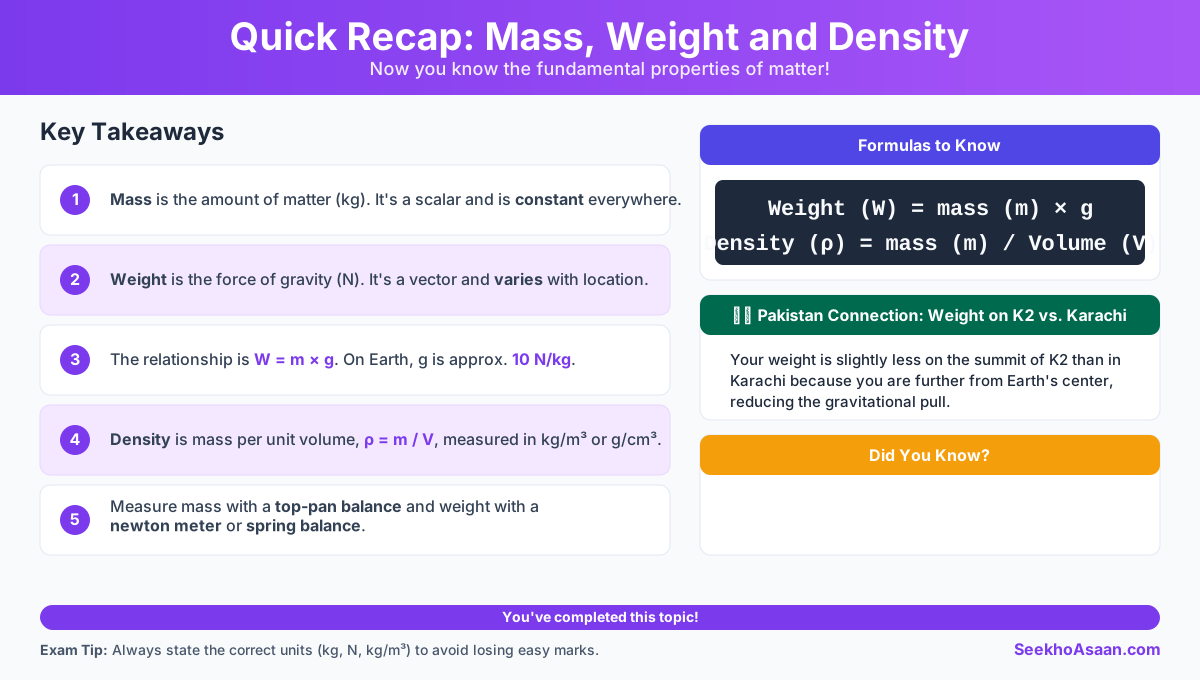
- 01Mass is the amount of matter in an object (kg), a scalar quantity that is constant everywhere.
- 02Weight is the gravitational force on an object (N), a vector quantity that varies with location.
- 03The relationship is defined by the formula: **Weight (W) = mass (m) × gravitational field strength (g)**.
- 04On Earth, the gravitational field strength (g) is approximately **10 N/kg**.
- 05Density is mass per unit volume (**ρ = m / V**), typically measured in kg/m³ or g/cm³.
- 06Mass is measured with a top-pan balance; weight is measured with a newton meter or spring balance.
Formulas to know
A mountaineer's **mass** (the amount of matter in their body) is constant, whether they are in Karachi (at sea level) or at the summit of K2, the world's second-highest peak. However, their **weight** would be slightly less at the top of K2. This is because they are further from the Earth's center, where the **gravitational field strength (g)** is marginally weaker. This real-world Pakistani example perfectly illustrates the fundamental difference between the constant nature of mass and the location-dependent nature of weight.
Test your knowledge.
5 explained questions. Har answer ke baad reasoning foran milegi.