Study path
Learn it, recall it, then prove it
Read the explanation and work through each example.
Close the notes and explain the main idea yourself.
Attempt the quiz, then revisit only missed concepts.
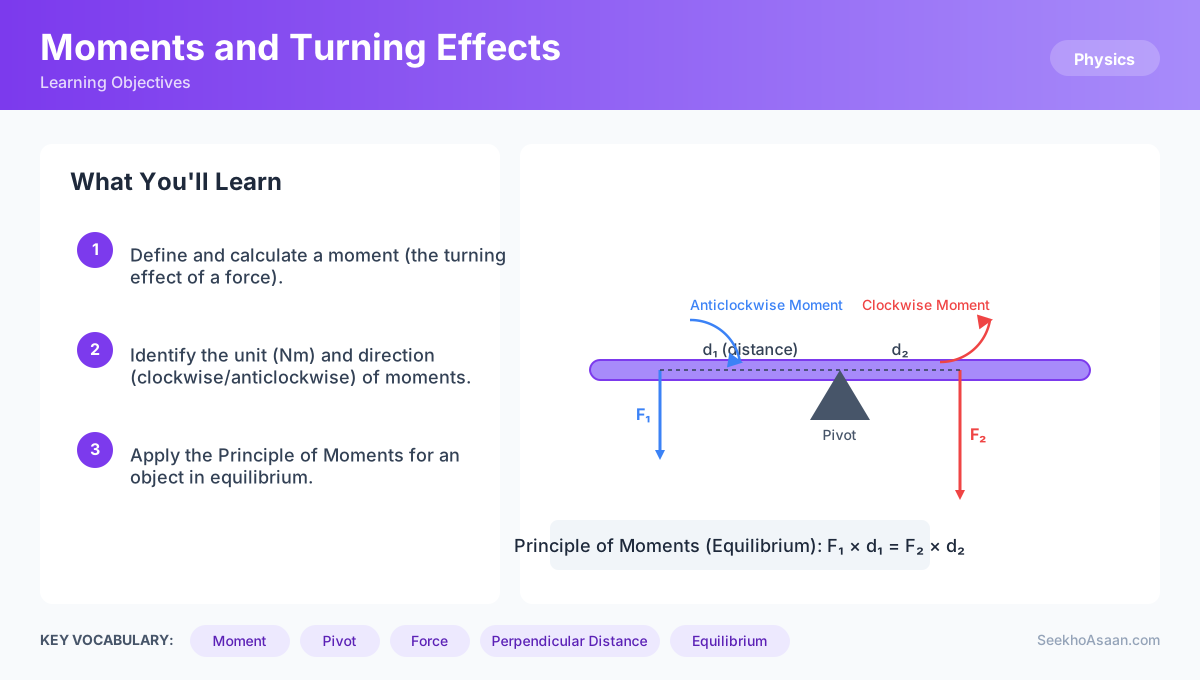
1. Introduction to Moments
Whenever you push a door open, use a spanner to tighten a nut, or play on a seesaw, you are applying a force to cause a turning effect. This turning effect of a force is called a moment. A moment is not just about the size of the force you apply; it also critically depends on where you apply that force. For any turning to occur, there must be a fixed point around which the object rotates. This point is called the pivot or fulcrum.
2. Calculating the Moment of a Force
The size of the moment is a measure of how effective a force is at causing rotation. It is calculated using a specific formula:
Moment = Force (F) × Perpendicular distance from the pivot (d)
- Force (F) is measured in Newtons (N).
- Perpendicular distance (d) is the shortest distance from the pivot to the line of action of the force, measured in metres (m).
- The unit for moment is the Newton-metre (Nm).
It is crucial to use the perpendicular distance. For example, pushing a door near its handle (far from the pivot/hinges) requires less force to create the same turning effect as pushing it near the hinges. This is because the distance from the pivot is greater.
Moments also have a direction. A moment that causes rotation in the same direction as the hands of a clock is called a clockwise moment. A moment that causes rotation in the opposite direction is called an anticlockwise moment.
3. The Principle of Moments
When an object is balanced and not rotating, it is said to be in rotational equilibrium. This occurs when the turning effects in both directions cancel each other out. This is summarised by the Principle of Moments.
The principle states that:
For an object to be in equilibrium, the sum of the clockwise moments about any pivot must be equal to the sum of the anticlockwise moments about the same pivot.
Formula: Σ Clockwise Moments = Σ Anticlockwise Moments
Worked Example: Imagine a 2-metre long uniform beam pivoted at its centre (1-metre mark). A weight of 30 N is placed 0.5 m to the left of the pivot. Where must a 20 N weight be placed on the right side to balance the beam?
- Identify the moments: The 30 N weight creates an anticlockwise moment. The 20 N weight will create a clockwise moment.
- Calculate the anticlockwise moment:
Moment_acw = Force × Distance = 30 N × 0.5 m = 15 Nm.
- Apply the Principle of Moments: For the beam to balance, the clockwise moment must also be 15 Nm.
Moment_cw = 15 Nm.
- Find the unknown distance (d):
    Moment_cw = Force × Distance
    15 Nm = 20 N × d
    d = 15 Nm / 20 N = 0.75 m.
Therefore, the 20 N weight must be placed 0.75 m to the right of the pivot.
4. Centre of Gravity (CG)
The centre of gravity (CG) of an object is the single point through which its entire weight appears to act. For a uniform, symmetrical object like a ruler or a square piece of card, the CG is at its geometric centre.
For an irregular-shaped object (an irregular lamina), the CG can be found experimentally using a plumb line:
- Make a small hole near the edge of the lamina and suspend it from a pin so it can swing freely.
- Hang a plumb line (a string with a weight at the end) from the same pin.
- Once both are stationary, trace the line of the plumb line onto the lamina.
- Repeat the process by suspending the lamina from at least one other hole.
- The point where the drawn lines intersect is the centre of gravity.
5. Stability and Equilibrium
An object's stability is its ability to return to its original position after being slightly displaced. Stability is determined by two main factors:
- The height of its centre of gravity (CG): A lower CG results in greater stability.
- The area of its base: A wider base area results in greater stability.
When an object is tilted, a vertical line drawn downwards from its CG represents the line of action of its weight. If this line falls within the base area, a restoring moment is created, and the object will return to its original position. If the tilting is so great that this line falls outside the base area, a toppling moment is created, and the object will fall over.
There are three states of equilibrium:
- Stable Equilibrium: The object has a low CG and a wide base. When displaced, its CG is raised, and it returns to its original position (e.g., a cone resting on its base).
- Unstable Equilibrium: The object has a high CG and a narrow base. When slightly displaced, its CG is lowered, and it topples (e.g., a cone balanced on its tip).
- Neutral Equilibrium: When displaced, the height of the CG does not change, and the object remains in its new position (e.g., a ball on a horizontal surface).

Quick revision infographic
Physics · Quick revision
Moments and Turning Effects
Key concepts
- 01A moment is the turning effect of a force, calculated as Moment = Force × Perpendicular Distance.
- 02The unit of moment is the Newton-metre (Nm), and its direction is either clockwise or anticlockwise.
- 03The Principle of Moments states that for equilibrium, the sum of clockwise moments equals the sum of anticlockwise moments about a pivot.
- 04The Centre of Gravity (CG) is the single point where the entire weight of an object appears to act.
- 05The CG of an irregular object can be found experimentally using a plumb line.
- 06An object is most stable when it has a low Centre of Gravity and a wide base area.
Formulas to know
The vibrantly decorated trucks common on Pakistan's highways are a classic example of stability principles in action. The elaborate, heavy structures (known as a 'Taj' or crown) and cargo are often loaded high up on the truck. This raises the vehicle's overall **centre of gravity (CG)** significantly. According to the principles of stability, a high CG makes an object less stable. When these trucks navigate the sharp turns on mountainous roads like the Karakoram Highway or the Murree Expressway, the high CG increases the risk of toppling. A sharp turn can cause the vertical line through the CG to fall outside the truck's wheelbase (its base area), creating a turning moment that can tip the entire vehicle over. Experienced drivers and loaders mitigate this risk by placing the heaviest goods at the bottom of the cargo hold, consciously trying to keep the CG as low as possible to ensure stability during their long journeys.
Test your knowledge.
5 explained questions. Har answer ke baad reasoning foran milegi.