Study path
Learn it, recall it, then prove it
Read the explanation and work through each example.
Close the notes and explain the main idea yourself.
Attempt the quiz, then revisit only missed concepts.
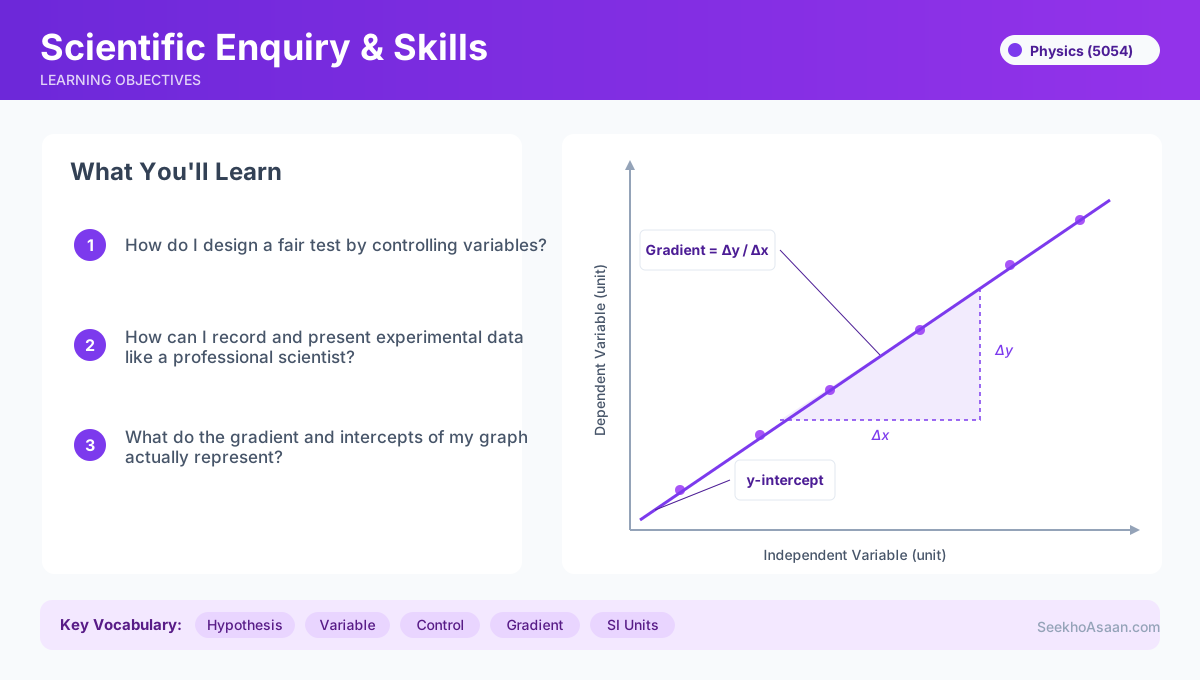
Scientific Enquiry is the cornerstone of physics, providing a structured framework for exploring the natural world. It is not just a set of instructions but a mindset that involves curiosity, critical thinking, and a systematic approach to problem-solving. Mastery of these skills is essential for success in Cambridge O Level Physics.
1. Planning an Experiment
A well-planned experiment is the foundation of a valid investigation. The process begins with a clear, testable question that is formulated into a hypothesis—a predictive statement about the relationship between variables.
Variables are the key factors in any experiment:
- The Independent Variable is the quantity that you deliberately change or manipulate to observe its effect.
- The Dependent Variable is the quantity that you measure in response to the changes in the independent variable.
- Control Variables are all other factors that could potentially influence the dependent variable. These must be kept constant throughout the experiment to ensure a fair test. For example, when investigating how the length of a pendulum affects its period, the length is the independent variable, the period is the dependent variable, and the mass of the bob and the angle of swing are control variables.
The next step is to select appropriate apparatus. The choice of instrument depends on the quantity being measured and the required precision. For instance, a micrometer screw gauge is used for measuring the diameter of a wire, while a metre rule is sufficient for measuring the length of a pendulum. Your plan must include a clear, step-by-step Method that another scientist could follow to replicate your experiment. This procedure should detail how you will change the independent variable, measure the dependent variable, and monitor the control variables. To improve the reliability of your results, the plan should include repeating measurements (at least three times for each value of the independent variable) and calculating an average.
2. Data Collection and Presentation
Careful observation and accurate measurement are critical. When taking readings from an analogue scale, it is crucial to avoid parallax error by positioning your eye directly in line with the measurement. Data must be recorded systematically in a table. The table should have columns with clear headings for each variable, including their SI units (e.g., Length / m, Time / s). All raw data should be recorded to a consistent and appropriate number of significant figures, reflecting the precision of the measuring instrument.
Once collected, data is often presented visually in a graph, which helps in identifying trends and relationships. Follow these rules for drawing a good graph:
- The independent variable is plotted on the horizontal x-axis, and the dependent variable on the vertical y-axis.
- Both axes must be labelled with the quantity and its unit.
- Choose a sensible scale that uses at least half of the graph paper and is easy to read (e.g., multiples of 1, 2, 5, or 10).
- Plot points accurately using a small 'x' or a dot in a circle (⊙).
- Draw a single, thin line or curve of best fit. This line should follow the general trend of the points, with an approximately equal number of points scattered on either side. Do not simply connect the dots.
3. Data Analysis, Conclusion, and Evaluation
Analysis involves interpreting your data to find relationships. For a straight-line graph passing through the origin, the two variables are directly proportional. The gradient (slope) of the line is a powerful analytical tool. It is calculated using a large triangle on your line of best fit: Gradient = Change in y / Change in x = Δy / Δx. The gradient often represents a significant physical quantity. For example, in a voltage-current (V-I) graph for a resistor, the gradient represents its resistance (R).
Your Conclusion should be a direct response to your initial hypothesis. State whether your results support or refute the hypothesis, and quote specific data or findings from your graph as evidence. For instance, "As the length of the pendulum increased, the period also increased. A straight-line graph of T² against L, which passed through the origin, supports the hypothesis that T² is directly proportional to L."
Evaluation is a critical reflection on your experiment. Identify potential sources of error and their effects on the results. Distinguish between:
- Random Errors: Unpredictable variations in readings (e.g., reaction time when using a stopwatch). These can be minimised by taking repeat readings and averaging.
- Systematic Errors: Consistent errors that affect all readings in the same way (e.g., a zero error on a balance). These are harder to detect but can be identified by checking the calibration of instruments.
Finally, suggest specific and realistic improvements to the experimental procedure or apparatus that would enhance the accuracy or reliability of the results. For example, using light gates and a timer instead of a stopwatch to measure a period more accurately.
4. Safety in the Laboratory
Safety is paramount. Always follow standard laboratory rules such as wearing safety goggles, tying back long hair, and not eating or drinking. For physics experiments, specific precautions are necessary: handle hot objects with tongs, ensure electrical circuits are checked by a teacher before switching on, use low voltages, and handle glassware with care to prevent breakage.
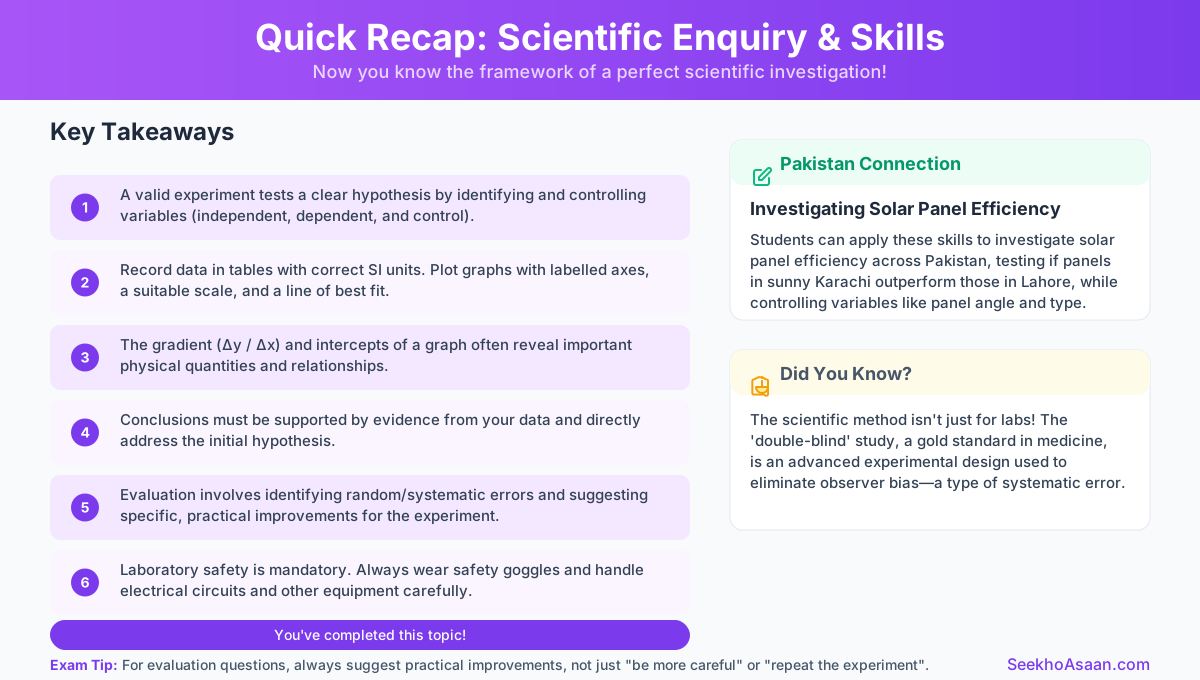
Quick revision infographic
Physics · Quick revision
Scientific Enquiry & Skills
Key concepts
- 01A valid experiment must identify and control variables (independent, dependent, control) to test a clear hypothesis.
- 02Data should be recorded in tables with SI units and presented graphically with labelled axes and a line of best fit.
- 03The gradient (Δy / Δx) and intercepts of a graph often represent important physical quantities.
- 04Conclusions must be based on evidence from the data and directly address the initial hypothesis.
- 05Evaluation involves identifying sources of random and systematic errors and suggesting specific, practical improvements.
- 06Laboratory safety procedures, like wearing goggles and handling electrical circuits carefully, are mandatory.
A student plans an experiment to test the hypothesis: "The electrical power output of a solar panel is directly proportional to the intensity of sunlight." They could set up a small solar panel connected to a voltmeter and ammeter in cities with varying climates like Karachi (coastal, humid) and Skardu (high altitude, clear sun). The **independent variable** is the light intensity (measured with a light meter), and the **dependent variable** is the power output (**P = V x I**). **Control variables** would include the angle of the panel to the sun, the ambient temperature, and using the same panel and meters for all tests. This practical investigation connects physics principles to Pakistan's growing renewable energy sector and its diverse geographical conditions. It highlights the need for precise data collection and control of variables to draw meaningful conclusions about solar energy potential across the country.
Test your knowledge.
5 explained questions. Har answer ke baad reasoning foran milegi.