Study path
Learn it, recall it, then prove it
Read the explanation and work through each example.
Close the notes and explain the main idea yourself.
Attempt the quiz, then revisit only missed concepts.
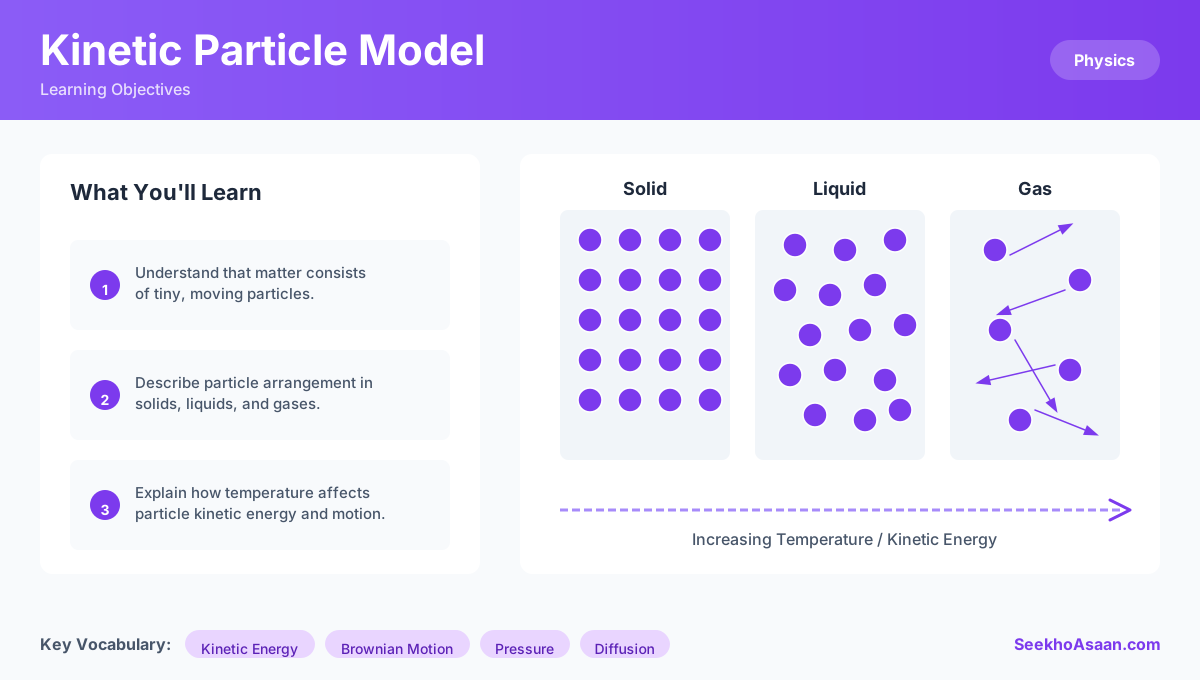
Assalam-o-Alaikum, future scientists of Pakistan! Today, we're diving into a fascinating topic that explains almost everything around us – from the water we drink to the air we breathe, and even how a pressure cooker works in your kitchen! We're talking about the Kinetic Particle Model. This model helps us understand the hidden world of tiny particles that make up all matter.
Introduction to Particles
Imagine you could zoom in incredibly close on any object – a brick, a glass of chai, or even the air during a cricket match. What would you see? Not a solid, continuous substance, but tiny, invisible particles! These particles are constantly moving, bumping into each other, and interacting. The Kinetic Particle Model is a scientific theory that helps us understand the properties of solids, liquids, and gases by considering how these tiny particles behave. 'Kinetic' means related to motion, so this model focuses on the motion of particles.
States of Matter
Everything around us exists in one of three common states: solid, liquid, or gas. The main differences between these states are due to the arrangement and movement of their particles, and the forces of attraction between them.
Solids
Think of a brick or a piece of ice. Solids have a fixed shape and a fixed volume. Why? Because their particles are:
- Arrangement: Tightly packed together in a regular, ordered pattern called a lattice. Imagine a disciplined formation of students in a school assembly.
- Movement: They can only vibrate about their fixed positions. They don't move past each other. It's like students standing in their spots, wiggling but not changing places.
- Forces of Attraction: Very strong forces of attraction hold the particles firmly in place.
Because of this strong attraction and fixed arrangement, solids resist changes in shape and volume.
Liquids
Now, think of water, cooking oil, or the lassi you enjoy. Liquids have a fixed volume but take the shape of their container. Why?
- Arrangement: Particles are still closely packed but in a random, disordered arrangement. They are not in fixed positions.
- Movement: They can slide past each other. This is why liquids can flow! Imagine students in a bazaar, close to each other but able to move around and change their immediate neighbours.
- Forces of Attraction: Weaker than in solids, but still strong enough to keep the particles close together.
This ability to slide past each other allows liquids to flow and fill containers, while the relatively strong forces keep their volume constant.
Gases
Finally, think of the air around us, or steam from a kettle. Gases have no fixed shape and no fixed volume. They will expand to fill any container they are in. Why?
- Arrangement: Particles are very far apart from each other, with large distances between them. They are in a random, disordered arrangement.
- Movement: They move randomly and rapidly in all directions, colliding with each other and with the walls of their container. Imagine a stadium full of people after a cricket match, rushing out in all directions.
- Forces of Attraction: Very weak or almost negligible forces of attraction between particles. They are essentially free to move independently.
Due to weak forces and rapid, random motion, gases are easily compressible and will always spread out to fill their container.
Phase Changes (Changes of State)
Matter can change from one state to another by adding or removing energy (usually in the form of heat). For example:
- Melting: Solid to liquid (e.g., ice to water) – particles gain enough energy to overcome some of the strong forces and slide past each other.
- Boiling/Evaporation: Liquid to gas (e.g., water to steam) – particles gain enough energy to completely overcome the forces of attraction and escape as free-moving gas particles.
- Condensation: Gas to liquid (e.g., steam to water droplets) – particles lose energy, slow down, and are pulled closer by forces of attraction.
- Freezing: Liquid to solid (e.g., water to ice) – particles lose energy, slow down, and settle into fixed positions.
- Sublimation: Solid directly to gas (e.g., dry ice) – particles gain enough energy to directly escape the solid structure.
The Kinetic Particle Model Explained
The Kinetic Particle Model makes some key assumptions:
- All matter is made up of tiny particles (atoms, molecules, or ions).
- These particles are in constant, random motion.
- There are forces of attraction between these particles.
- The space between particles is empty (a vacuum).
- The average kinetic energy of the particles is directly proportional to the absolute temperature of the substance.
This model helps us explain the properties of different states: Solids have fixed shapes because their particles vibrate in fixed positions due to strong forces. Liquids flow because their particles can slide past each other. Gases fill their containers because their particles move freely with very weak forces.
Particle Motion and Temperature
We know particles are constantly moving. But what affects their speed? Temperature!
- When you heat a substance, you are adding energy to its particles. This energy increases their kinetic energy, causing them to move faster (or vibrate more vigorously).
- Conversely, when you cool a substance, its particles lose kinetic energy and slow down.
So, higher temperature means faster-moving particles and lower temperature means slower-moving particles. This is a crucial concept for understanding gas behavior.
Brownian Motion
How do we know particles are really moving randomly? We can't see atoms or molecules directly, but we can see the effects of their motion. This evidence comes from an observation called Brownian motion, named after Scottish botanist Robert Brown.
Imagine a smoke cell experiment: you have a small glass cell containing smoke particles. When you shine a strong light through it and view it under a microscope, you'll see tiny, bright specks (the smoke particles) moving in a very jerky, zig-zag, random fashion. They are constantly changing direction and speed.
Observation: Smoke particles move randomly and erratically.
Explanation: The visible smoke particles are relatively large. They are being constantly bombarded by much smaller, invisible air molecules, which are themselves in constant, random motion. When more air molecules hit a smoke particle from one side than from the other, the smoke particle is pushed in that direction. Because the collisions are random and uneven, the smoke particle's movement appears random and erratic. It's like a football being kicked around by many invisible children.
Significance: Brownian motion provides strong experimental evidence for the existence of invisible particles and their continuous, random motion, which is a core idea of the Kinetic Particle Model.
Pressure
We often talk about pressure, like the pressure in a tire or a gas cylinder. But what exactly is it?
Pressure is defined as the force acting normally (perpendicularly) per unit area. In simple terms, it's how much push is exerted on a certain area.
- Formula:
Pressure (P) = Force (F) / Area (A) - Units: The SI unit for pressure is the Pascal (Pa), which is equivalent to one Newton per square meter (
N/m²). Other common units include atmospheres (atm) and millimeters of mercury (mmHg).
Origin of Pressure in Gases
In a gas, particles are constantly moving randomly and colliding with the walls of their container. Each time a particle collides with a wall and bounces off, it exerts a tiny force on that wall. Since there are billions of particles doing this every second, the sum of all these tiny forces spread over the container's inner surface creates a continuous, measurable pressure.
Factors Affecting Gas Pressure
Three main factors influence the pressure of a gas:
- Volume (at constant temperature and number of particles): If you decrease the volume of a gas (e.g., by pushing a piston into a cylinder), the particles have less space to move around. They will collide with the container walls more frequently, leading to an increase in pressure.
- Temperature (at constant volume and number of particles): If you increase the temperature of a gas, its particles gain kinetic energy and move faster. They will hit the container walls more frequently and with greater force. This leads to an increase in pressure.
- Number of Particles (at constant volume and temperature): If you add more gas particles into a container (e.g., pumping air into a tire), there will be more particles to collide with the walls. This increases the total force and thus increases the pressure.
Gas Laws
Scientists have studied these relationships and formulated several 'gas laws' that describe how gases behave under different conditions. For O Level Physics, we focus on two main laws, which always assume a fixed mass of gas.
1. Boyle's Law (Pressure-Volume Relationship)
Statement: For a fixed mass of gas at constant temperature, the pressure of the gas is inversely proportional to its volume.
This means if you decrease the volume, the pressure increases, and vice-versa. Mathematically:
P ∝ 1/V (at constant T and mass)
Or, in a more useful form for calculations:
P₁V₁ = P₂V₂
Where:
P₁= initial pressureV₁= initial volumeP₂= final pressureV₂= final volume
Explanation: When you reduce the volume of a gas at a constant temperature, the particles are confined to a smaller space. This means they will hit the container walls more often per unit time, resulting in a greater average force on the walls, and thus higher pressure.
Worked Example 1: Pumping a Bicycle Tire in Lahore
A mechanic in Lahore is pumping air into a bicycle tire. The air in the pump's cylinder initially has a volume of 500 cm³ at an atmospheric pressure of 1.0 x 10⁵ Pa. When the piston is pushed, the volume of the air inside the pump is reduced to 125 cm³. Assuming the temperature of the air remains constant, what is the new pressure of the air inside the pump?
Given: V₁ = 500 cm³ P₁ = 1.0 x 10⁵ Pa V₂ = 125 cm³ P₂ = ?
Using Boyle's Law: P₁V₁ = P₂V₂ (1.0 x 10⁵ Pa) * (500 cm³) = P₂ * (125 cm³) 5.0 x 10⁷ Pa cm³ = P₂ * (125 cm³) P₂ = (5.0 x 10⁷ Pa cm³) / (125 cm³) P₂ = 4.0 x 10⁵ Pa
Answer: The new pressure of the air inside the pump is 4.0 x 10⁵ Pa. This higher pressure then forces air into the tire.
2. Pressure Law (Pressure-Temperature Relationship)
Statement: For a fixed mass of gas at constant volume, the pressure of the gas is directly proportional to its absolute temperature (temperature in Kelvin).
This means if you increase the temperature, the pressure increases, and vice-versa. Mathematically:
P ∝ T (at constant V and mass)
Or, for calculations:
P₁/T₁ = P₂/T₂
Important: For this law (and Charles' Law), the temperature MUST be in Kelvin (K), not degrees Celsius (°C). To convert Celsius to Kelvin:
T(K) = T(°C) + 273
Explanation: When you increase the temperature of a gas at a constant volume, the particles gain kinetic energy and move faster. They will collide with the container walls more frequently and with greater momentum (force). This results in a larger average force on the walls and thus higher pressure.
Absolute Zero: If we extrapolate (extend) the graph of pressure versus Celsius temperature, it reaches zero pressure at -273°C. This temperature is called absolute zero (0 K), where particle motion theoretically stops.
Worked Example 2: The Pressure Cooker in a Karachi Kitchen
A pressure cooker in a Karachi kitchen contains steam at an initial pressure of 1.0 x 10⁵ Pa and an initial temperature of 27°C. The cooker is then heated, and the temperature inside rises to 127°C. Assuming the volume of the cooker remains constant, what is the new pressure inside the cooker?
Given: P₁ = 1.0 x 10⁵ Pa T₁ = 27°C T₂ = 127°C P₂ = ?
Step 1: Convert temperatures to Kelvin.
T₁(K) = 27 + 273 = 300 K T₂(K) = 127 + 273 = 400 K
Step 2: Use the Pressure Law formula.
P₁/T₁ = P₂/T₂ (1.0 x 10⁵ Pa) / (300 K) = P₂ / (400 K)
Step 3: Solve for P₂
P₂ = (1.0 x 10⁵ Pa * 400 K) / (300 K) P₂ = (4.0 x 10⁷) / 300 P₂ = 1.33 x 10⁵ Pa (approximately)
Answer: The new pressure inside the pressure cooker is approximately 1.33 x 10⁵ Pa. This higher pressure helps food cook faster at higher temperatures.
Charles' Law (Volume-Temperature Relationship)
While O Level often focuses on Boyle's and Pressure Law, it's good to know Charles' Law, which states that for a fixed mass of gas at constant pressure, the volume is directly proportional to its absolute temperature.
V ∝ T (at constant P and mass)
Or:
V₁/T₁ = V₂/T₂ (Temperature T must be in Kelvin)
Explanation: If you heat a gas at constant pressure, its particles gain kinetic energy and move faster. To maintain constant pressure (i.e., the same rate of collisions and force per unit area), the volume of the gas must expand, giving the particles more space to move, so they don't hit the walls too often.
Evaporation vs. Boiling
Both evaporation and boiling are processes where a liquid turns into a gas, but they are very different phenomena.
Evaporation
- Definition: The process by which liquid particles at the surface escape into the gaseous state. It can occur at any temperature below the boiling point.
- Mechanism: Some particles on the surface of the liquid have enough kinetic energy to overcome the attractive forces of other liquid particles and escape into the air. These are the most energetic particles.
- Location: Occurs only at the surface of the liquid.
- Bubbles: No bubbles are formed within the liquid.
- Cooling Effect: As the most energetic particles leave the liquid, the average kinetic energy of the remaining particles decreases, leading to a cooling effect on the liquid. This is why sweating cools us down, or why water feels cooler after you come out of a swimming pool.
- Rate: Affected by surface area, temperature, humidity, and airflow.
Boiling
- Definition: The process by which a liquid turns into a gas throughout the entire volume of the liquid. It occurs only at a specific temperature called the boiling point.
- Mechanism: At the boiling point, all particles throughout the liquid have enough energy to overcome the attractive forces and form bubbles of vapor within the liquid.
- Location: Occurs throughout the entire volume of the liquid.
- Bubbles: Vapor bubbles are formed within the liquid and rise to the surface.
- Cooling Effect: While the liquid is boiling, its temperature remains constant even though heat is being added (this energy is used to break intermolecular bonds – latent heat of vaporization). There isn't a significant cooling effect on the remaining liquid's temperature.
Worked Example 3: Keeping Water Cool in a Matka (Clay Pot)
In Pakistan, many households use a matka or surahi (clay pot) to keep drinking water cool without electricity, especially during hot summer days. Explain, using the Kinetic Particle Model and the concept of evaporation, how a matka keeps water cool.
Explanation:
- A
matkais made of porous clay, meaning it has tiny, invisible pores (holes) on its surface. - Some water from inside the pot seeps through these pores to the outer surface of the
matka. - On the outer surface, the most energetic water molecules gain enough kinetic energy from the surroundings (and the water itself) to escape as water vapor – this is evaporation.
- When these high-energy particles evaporate, they carry away a significant amount of latent heat energy from the water remaining in the pores and inside the pot.
- This removal of energetic particles and their associated energy lowers the average kinetic energy of the water molecules left behind, which directly translates to a drop in the temperature of the water inside the
matka.
This continuous process of evaporation from the matka's surface keeps the water inside pleasantly cool, even when the outside temperature is very high. It's a brilliant application of the cooling effect of evaporation!
By understanding the Kinetic Particle Model, we can explain countless everyday phenomena and build a strong foundation for advanced physics concepts. Keep observing the world around you, and you'll see physics everywhere!
Quick revision infographic
Physics · Quick revision
Kinetic Particle Model
Key concepts
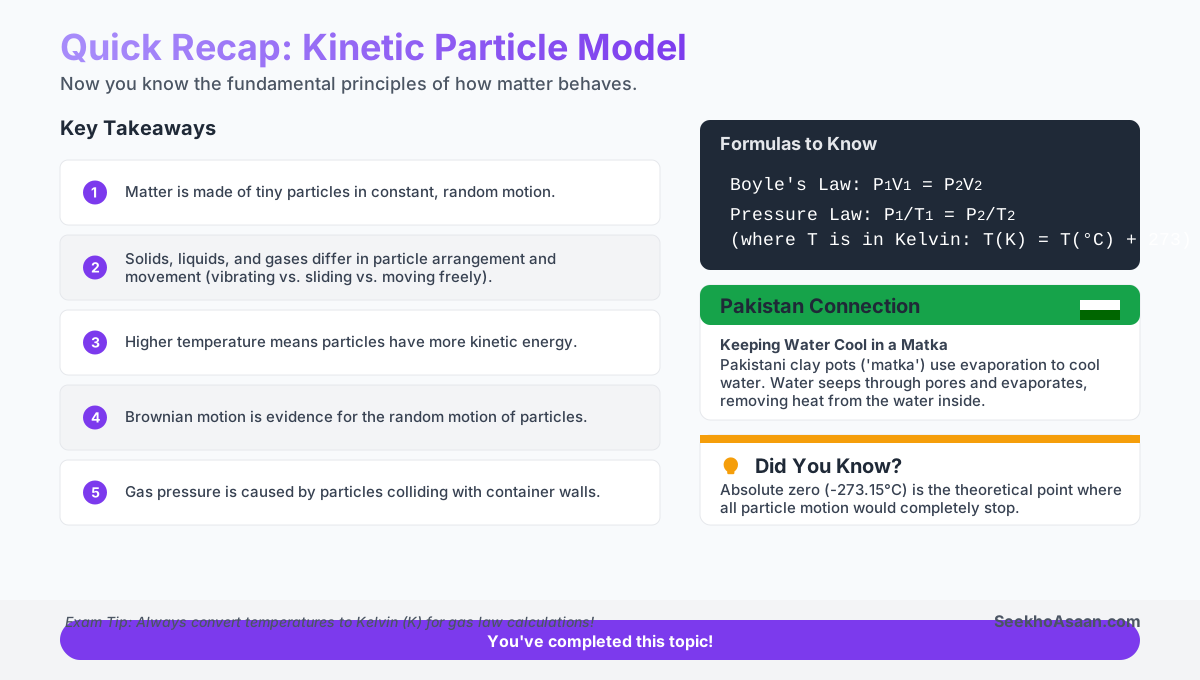
- 01Matter is made of tiny particles in constant, random motion.
- 02Solids have particles vibrating in fixed positions, liquids have particles sliding past each other, and gases have particles moving randomly and far apart.
- 03Higher temperature means particles have more kinetic energy and move faster.
- 04Brownian motion provides evidence for the constant, random motion of invisible particles.
- 05Gas pressure is caused by particles colliding with container walls.
- 06Boyle's Law: For a fixed mass of gas at constant temperature, `P₁V₁ = P₂V₂`.
Formulas to know
In Pakistan, traditional clay pots called 'matka' or 'surahi' are commonly used to cool drinking water without electricity. This works due to the cooling effect of evaporation: water seeps through the porous clay, evaporates from the outer surface, and carries away heat, lowering the temperature of the water inside.
Test your knowledge.
5 explained questions. Har answer ke baad reasoning foran milegi.