Study path
Learn it, recall it, then prove it
Read the explanation and work through each example.
Close the notes and explain the main idea yourself.
Attempt the quiz, then revisit only missed concepts.

Introduction & Core Concept
Assalam-o-Alaikum, my brilliant students, and welcome to SeekhoAsaan.com. This lesson explores one of the most fascinating and fundamental topics in all of physics: the Electromagnetic Spectrum.
Imagine you are at the Gaddafi Stadium in Lahore, watching a thrilling T20 match between Pakistan and Australia. The energy is electric. You see the bright green of the pitch, the vibrant colours of the players' kits, and the giant screen replaying a six hit by Babar Azam. You pull out your phone, connect to the stadium's Wi-Fi, and send a picture to your cousin in Karachi. At the same time, a broadcaster's camera is sending live video signals via satellite to millions of homes, and the umpire is using an infrared "Hot Spot" camera to check if the ball hit the bat.
In this single, everyday Pakistani scenario, you have just interacted with at least five different types of invisible waves: visible light (seeing the match), radio waves (for the broadcast), microwaves (for Wi-Fi and phone signals), and infrared waves (for the umpire's review).
This is the core idea of the Electromagnetic (EM) Spectrum. It is not a collection of different, unrelated things. It is one single, continuous family of waves, all born from the same fundamental physics, all travelling at the same cosmic speed limit, but with different "personalities" determined by their energy. Visible light is just the tiny, beautiful sliver of this family that our eyes happen to be able to see.
The Big-Picture Mental Model: Think of the EM spectrum like the keyboard of a grand piano. All the keys produce "sound," but the low notes on the left (like a deep bass) are fundamentally different from the high-pitched notes on the right. They travel at the same speed (the speed of sound) but have different frequencies and wavelengths. The EM spectrum is the universe's keyboard. Radio waves are the low, rumbling notes, and gamma rays are the piercingly high notes. Our eyes are only "tuned" to hear one octave in the middle — the octave we call visible light. This lesson will teach you about the entire keyboard.
Theoretical Foundation
To truly master this topic, we must move beyond simple memorisation and understand the why. What exactly is an electromagnetic wave?
The name itself gives us a clue: Electro-Magnetic. An EM wave is a disturbance made of oscillating (vibrating) electric and magnetic fields. But where does it come from?
The Genesis of an EM Wave: The source of all electromagnetic radiation is an accelerating electric charge. Imagine an electron, a tiny particle with a negative charge. If it's sitting still, it creates a static electric field around it. If it moves at a constant velocity, it creates both an electric and a magnetic field. But if you make it accelerate — that is, you shake it, vibrate it, or make it change direction — it creates a ripple in the fabric of spacetime. This ripple is an EM wave. The vibrating electron sends out waves of electric and magnetic energy, much like a pebble dropped in the Indus River sends out waves of water.
The Nature of the Wave: This is the crucial part that makes EM waves unique. The oscillating electric field and the oscillating magnetic field are:
- Perpendicular to each other: If the electric field is vibrating up and down, the magnetic field is vibrating in and out of the page.
- Perpendicular to the direction of wave travel: If the wave is moving forward, both fields are vibrating at right angles to this forward motion.
This second point is the very definition of a transverse wave. This is a non-negotiable property of all EM waves, from radio to gamma.
The Cosmic Speed Limit: c
Perhaps the most astonishing property of EM waves is that they all travel at the exact same speed in a vacuum (empty space). This speed is so fundamental to our universe that we give it its own special symbol, c. c = 300,000,000 metres per second, or 3.0 x 10⁸ m/s. This speed is absolute. It doesn't matter how fast the source is moving; the light it emits will always travel at c. This profound idea is the cornerstone of Einstein's Theory of Relativity. For your O Level exam, you must know this value by heart.
The Fundamental Relationship: Wavelength and Frequency
If all EM waves travel at the same speed, c, what makes them different? The answer lies in two interlinked properties: their wavelength (λ) and their frequency (f).
- Wavelength (λ): The distance from one wave crest to the next. Long wavelength means the crests are far apart.
- Frequency (f): The number of wave crests that pass a point every second. High frequency means the crests are tightly packed and pass by very quickly.
Imagine you and a friend are walking from one end of a cricket pitch to the other. You both have to cover the 22 yards in the same amount of time (this is your constant speed, c). You decide to take long, slow strides (long wavelength, low frequency). Your friend, however, takes very short, rapid steps (short wavelength, high frequency). You both arrive at the same time, but your "wave" properties were different.
This illustrates the inverse relationship between wavelength and frequency. If one is high, the other must be low, because their product is always constant: the speed of light. This gives us the single most important equation in this topic:
The Wave Equation: c = fλ
Energy: The Defining Characteristic
The final piece of the puzzle is energy. The energy of an EM wave is directly proportional to its frequency. A high-frequency wave is a high-energy wave. A low-frequency wave is a low-energy wave.
This can be written as E ∝ f. (At A-Level, you'll learn the full equation E = hf, where h is Planck's constant, but for now, the proportionality is what matters).
This simple rule explains everything about the properties and dangers of the spectrum:
- Radio waves have a very low frequency. They carry very little energy. That's why they pass through your body every day without causing any harm.
- Gamma rays have an incredibly high frequency. They carry immense energy. This energy is enough to knock electrons out of your atoms (a process called ionisation), damaging your DNA and causing severe harm. This is why they are so dangerous.
So, the entire EM spectrum is simply a line-up of these waves, ordered by their wavelength, frequency, and energy.
Key Definitions & Formulae
Here are the essential terms and equations you must know. Treat this section as your reference sheet.
- Electromagnetic Wave: A transverse wave consisting of oscillating electric and magnetic fields that are perpendicular to each other and to the direction of energy transfer. It does not require a medium to travel.
- Wavelength (λ): The shortest distance between two points on a wave that are in phase (e.g., from one crest to the next crest).
- Unit: metre (m). Often given in nanometres (nm,
10⁻⁹m) or centimetres (cm,10⁻²m). - Frequency (f): The number of complete oscillations or cycles that pass a given point per second.
- Unit: Hertz (Hz). 1 Hz = 1 cycle per second. Often given in kilohertz (kHz,
10³Hz), megahertz (MHz,10⁶Hz), or gigahertz (GHz,10⁹Hz). - Wave Speed (v or c): The speed at which the energy of the wave is transferred. For all EM waves in a vacuum, this is the speed of light,
c. - Value of
c:3.0 x 10⁸ m/s - Unit: metres per second (m/s)
- Period (T): The time taken for one complete wave to pass a point. It is the inverse of frequency.
- Formula:
T = 1/f - Unit: second (s)
The Master Formula:
c = fλ
c= Speed of light (3.0 x 10⁸ m/s)f= Frequency (Hz)λ= Wavelength (m)
Dimensional Analysis (A* Level Skill): Let's check if the units in the formula make sense. The unit for speed (c) is metres per second (m/s or ms⁻¹). In terms of fundamental dimensions: [L T⁻¹] (Length / Time). The unit for frequency (f) is Hertz, which is per second (s⁻¹). In terms of fundamental dimensions: [T⁻¹] (1 / Time). The unit for wavelength (λ) is metres (m). In terms of fundamental dimensions: [L] (Length).
So, f x λ gives us dimensions of [T⁻¹] x [L] = [L T⁻¹]. This is the dimension of speed. The formula is dimensionally consistent! This is a powerful way to check your work in an exam.
Worked Examples
Let's apply this theory to some practical problems, just like the ones you'll face in your Cambridge exam.
Example 1: Radio Lahore
Radio station FM 91 in Lahore broadcasts its signal at a frequency of 91.0 Megahertz (MHz). Calculate the wavelength of these radio waves.
Solution:
- Identify the knowns:
- Frequency,
f = 91.0 MHz - Speed of EM waves,
c = 3.0 x 10⁸ m/s
- Identify the unknown:
- Wavelength,
λ = ?
- State the formula:
- The relationship between speed, frequency, and wavelength is
c = fλ.
- Convert units: The frequency is in MHz, but our formula requires Hertz (Hz). The speed is in m/s, so our wavelength will be in metres (m).
Megameans10⁶.f = 91.0 x 10⁶ Hz
- Rearrange the formula: We need to find
λ, so we rearrange the equation:
λ = c / f
- Substitute the values and calculate:
λ = (3.0 x 10⁸ m/s) / (91.0 x 10⁶ Hz)λ = 3.2967... m
- State the final answer with appropriate significant figures and units:
- The data was given to 3 significant figures (91.0 and 3.00), so our answer should be too.
λ = 3.30 m
Example 2: The Karachi Traffic Signal
A traffic light at the Teen Talwar roundabout in Karachi emits red light with a wavelength of approximately 650 nanometres (nm) and green light with a wavelength of 510 nm. For both colours, state which has the higher frequency and which carries more energy per photon. Explain your reasoning.
Solution:
- Identify the core principle: The relationship between wavelength, frequency, and energy for EM waves. We know
c = fλ, so frequency is inversely proportional to wavelength (f = c/λ). We also know energy is directly proportional to frequency (E ∝ f). - Compare the wavelengths:
- Red light
λ_red = 650 nm - Green light
λ_green = 510 nm - Red light has a longer wavelength than green light.
- Determine the frequency:
- Since
fis inversely proportional toλ, the wave with the shorter wavelength will have the higher frequency. - Therefore, green light has a higher frequency than red light.
- Determine the energy:
- Since
Eis directly proportional tof, the wave with the higher frequency will have the higher energy. - Therefore, green light carries more energy per photon than red light.
- Summarise the explanation: Green light has a shorter wavelength (510 nm) compared to red light (650 nm). Because the speed of light is constant, a shorter wavelength corresponds to a higher frequency (
f = c/λ). As the energy of an EM wave is directly proportional to its frequency, the higher-frequency green light carries more energy.
Example 3: Heating a Samosa in a Microwave
A PTCL technician installs a new Wi-Fi router in a house in Islamabad. The router operates at a frequency of 2.4 GHz. A microwave oven in the kitchen operates at a very similar frequency to heat a samosa for Iftar. (a) Calculate the wavelength of the microwaves produced by the oven. (b) Explain briefly how these microwaves heat the samosa.
Solution: (a) Calculation
- Knowns:
f = 2.4 GHz,c = 3.0 x 10⁸ m/s - Unknown:
λ = ? - Formula:
c = fλ - Unit Conversion:
Gigameans10⁹.
f = 2.4 x 10⁹ Hz
- Rearrange:
λ = c / f - Substitute and Calculate:
λ = (3.0 x 10⁸ m/s) / (2.4 x 10⁹ Hz)λ = 0.125 m
- Final Answer: The wavelength of the microwaves is
0.125 m(or 12.5 cm).
(b) Explanation of Heating
- Identify the key component: The samosa, like most food, contains a significant amount of water (
H₂O). - Describe the mechanism: The microwaves produced by the oven have a frequency that is very close to the natural resonant frequency of water molecules.
- Explain resonance: This means the water molecules absorb the energy from the microwaves very efficiently, causing them to vibrate and rotate vigorously.
- Link to heat: This increased vibration is, by definition, an increase in the kinetic energy of the molecules. The average kinetic energy of molecules is what we measure as temperature. This increased molecular motion is transferred to other molecules in the food (like proteins and fats) via collisions, heating the entire samosa.
Visual Mental Models
Visualising the spectrum is key to remembering it. Here are two ways to picture it.
1. The Continuous Spectrum Diagram
Imagine a long horizontal bar. This bar represents the entire family of EM waves, arranged seamlessly from one end to the other.
(Long Wavelength, Low Frequency, Low Energy) <---------------------------------------------------> (Short Wavelength, High Frequency, High Energy)
| Radio Waves | Microwaves | Infrared | [ R O Y G B I V ] | Ultraviolet | X-Rays | Gamma Rays | ------------------------------------------------------------------------------------------------------------------------ ~10³ m ~10⁻² m ~10⁻⁵ m ~10⁻⁷ m ~10⁻⁸ m ~10⁻¹⁰ m ~10⁻¹² m
- To the Left (Radio Waves): Wavelengths are huge (metres to kilometres). Frequencies are low. Think of them as long, lazy, low-energy waves.
- In the Middle (Visible Light): This is a tiny, tiny sliver of the whole spectrum. We expand it out to see the colours of the rainbow: Red, Orange, Yellow, Green, Blue, Indigo, Violet (ROYGBIV). Red has the longest wavelength in this sliver, and violet has the shortest.
- To the Right (Gamma Rays): Wavelengths are minuscule (smaller than an atom). Frequencies are astronomically high. These are short, frantic, incredibly high-energy waves.
2. The Information Table
A structured table is an excellent tool for organised revision.
| Wave Type | Typical Wavelength | Source | Application | Dangers |
|---|---|---|---|---|
| Radio | > 10 cm | Oscillating circuits (transmitters) | Broadcasting (radio, TV), communications | Non-ionising; generally considered safe. |
| Microwave | 1 mm - 30 cm | Magnetrons, electronic devices | Cooking, mobile phones, Wi-Fi, radar | Can cause internal heating of body tissue at high intensity. |
| Infrared | 700 nm - 1 mm | Hot objects, the Sun, LEDs | Remote controls, thermal imaging, heating | Can cause skin burns at high intensity. |
| Visible | 400 nm - 700 nm | The Sun, light bulbs, lasers | Vision, photography, fibre optics | Very intense light can damage the retina. |
| Ultraviolet | 10 nm - 400 nm | The Sun, UV lamps | Sterilisation, security marking, tanning | Ionising. Can cause skin cancer, eye damage. |
| X-Rays | 0.01 nm - 10 nm | X-ray tubes (stopping fast electrons) | Medical imaging, airport security | Ionising. High exposure causes cell death/mutation. |
| Gamma Rays | < 0.01 nm | Radioactive decay, nuclear reactions | Sterilising medical gear, cancer therapy | Highly Ionising. Extremely dangerous, causes severe cell damage. |
Common Mistakes & Misconceptions
These mistakes recur often in exam practice. Beta, let's make sure you avoid them.
- Mistake: "All EM waves travel at the speed of light."
- Why it's wrong: This is only true in a vacuum. When an EM wave enters a medium like glass, water, or even the air, it slows down. This slowing down is what causes refraction.
- Correct Thinking: All EM waves travel at the same maximum speed
cin a vacuum. Their speed is less in any material medium.
- Mistake: Confusing the order of the spectrum.
- Why it's wrong: Students often mix up infrared and ultraviolet or misplace microwaves. This leads to incorrect answers about which wave has more energy or a longer wavelength.
- Correct Thinking: Use a mnemonic (see the next section) and visualise the spectrum diagram. Remember: Radio waves are long and lazy; Gamma rays are short and energetic. Visible light is in the middle, with Red next to Infrared (infra means "below" red in frequency) and Violet next to Ultraviolet (ultra means "beyond" violet in frequency).
- Mistake: "Sound waves are part of the EM spectrum."
- Why it's wrong: This is a fundamental error. Sound waves are mechanical waves; they are vibrations of particles in a medium (air, water, solids). They cannot travel in a vacuum. They are also longitudinal waves.
- Correct Thinking: EM waves are disturbances in electric and magnetic fields, are transverse, and require no medium. They are in a completely different category from sound.
- Mistake: Mixing up ionising and non-ionising radiation.
- Why it's wrong: Students write vague statements like "microwaves are dangerous." While high-intensity microwaves can cause burns, they are not dangerous in the same way as X-rays. The key difference is ionisation.
- Correct Thinking: The spectrum has a clear dividing line. Ultraviolet, X-rays, and Gamma rays have enough energy per photon to knock electrons from atoms, making them ionising. This can damage DNA and cause cancer. Radio, microwave, infrared, and visible light are non-ionising. Their main hazard is heating.
- Mistake: "Infrared is heat."
- Why it's wrong: This is a subtle but important point. Infrared radiation is not heat itself; it is a mechanism of heat transfer. All objects with a temperature above absolute zero emit IR radiation. When your skin absorbs this radiation, the molecules vibrate more, and you feel it as heat.
- Correct Thinking: Infrared is a type of electromagnetic radiation that is very efficiently absorbed by most materials, causing an increase in their internal energy, which we perceive as a rise in temperature.
- Mistake: Forgetting to convert units in calculations.
- Why it's wrong: Cambridge examiners love to give you frequencies in MHz or GHz, and wavelengths in nm or cm. If you plug these directly into
c = fλwithout converting to the base units (Hz and m), your answer will be wrong by a large factor. - Correct Thinking: Before any calculation, always check your units. Write down the conversions (
M = 10⁶,G = 10⁹,n = 10⁻⁹,c = 10⁻²) and apply them systematically before you touch your calculator.
Exam Technique & Mark Scheme Tips
Understanding the physics is half the battle; the other half is knowing how to score marks. Use this practical exam checklist.
- Know Your Command Words:
- State: Give a concise answer without explanation. E.g., "State the speed of light in a vacuum." Answer: "
3.0 x 10⁸ m/s". (1 mark) - Describe: Give a step-by-step account of what happens. E.g., "Describe the properties of an EM wave." Answer: "It is a transverse wave. It can travel through a vacuum. It travels at
3.0 x 10⁸ m/sin a vacuum." (3 marks for 3 distinct points). - Explain: Give reasons why something happens. This requires you to link cause and effect. E.g., "Explain why X-rays are more dangerous than radio waves." Answer: "X-rays have a much higher frequency than radio waves (1 mark). Therefore, they carry much more energy per photon (1 mark). This energy is sufficient to ionise atoms in body cells, which can lead to mutation or cell death (1 mark)."
- Calculate: Show your working! You get marks for the correct formula, the correct substitution, and the final answer with the correct unit. Don't just write the answer.
- Properties Questions are Common:
- Examiners frequently ask for properties common to all EM waves. Have this list ready:
- They are all transverse waves.
- They all travel at the speed of light (
3.0 x 10⁸ m/s) in a vacuum. - They can all be reflected, refracted, and diffracted.
- They all transfer energy from a source to an absorber.
- They do not require a medium for propagation.
- They also ask for properties that change across the spectrum. This is always wavelength, frequency, and energy.
- The "Show Your Working" Rule:
- For any calculation, even a simple one, always write the formula first (
c = fλ), then show the numbers you are putting in (λ = 3.0x10⁸ / 91x10⁶), and finally, the answer with units (λ = 3.30 m). You can get partial credit even if your final answer is wrong.
- Watch for Unit Traps:
- As mentioned before, be paranoid about units. If you see
nm,MHz,GHz,km, immediately convert them to standard SI units (m,Hz,s) before you calculate. This is one of the easiest ways to lose marks.
- Be Specific in Applications:
- If asked for an application of infrared, don't just say "heating." Say "in a remote control to send signals to a TV" or "in a thermal imaging camera used by firefighters." Specificity earns marks. For microwaves, "in a microwave oven to heat food" or "for mobile phone communications."
Memory Tricks & Mnemonics
Your brain loves patterns and stories. Use these to lock in the order of the spectrum.
- The Classic English Mnemonic (for increasing frequency):
- Rich Men In Venice Use Xpensive Glasses.
- Radio, Microwave, Infrared, Visible, Ultraviolet, X-ray, Gamma.
- Say this out loud ten times. It will stick.
- A Pakistani Version:
- Rana's Mobile Is Very Unusually X-tra Good.
- (Rana ka mobile bohat ajeeb, extra acha hai.) This connects it to something familiar.
- For Visible Light (increasing frequency):
- ROY G. BIV
- Red, Orange, Yellow, Green, Blue, Indigo, Violet.
- Remember that Red is next to Infrared, and Violet is next to Ultraviolet.
- The Energy/Danger Rule:
- Just remember the last three (Ultraviolet, X-ray, Gamma) are the dangerous, ionising ones. The first four are generally safe (non-ionising). The danger increases as you go to the right of the spectrum.
Pakistan & Everyday Connections
Let's ground this physics in the world right outside your window.
- WAPDA and Thermal Imaging: The Water and Power Development Authority (WAPDA) sometimes uses infrared (thermal imaging) cameras to check for overheating components in power lines and transformers. A component that is about to fail will often get very hot, glowing brightly in an IR camera. This allows engineers to fix problems before a major power outage affects your neighborhood, a very real application of detecting invisible EM waves.
- PTCL/Stormfiber Fibre Optics: When you get a high-speed fibre optic internet connection, the data is transmitted as pulses of light (visible or infrared) travelling down a thin glass fibre. This is a direct application of EM waves being used for communication. The light is guided by a principle called Total Internal Reflection (a topic we'll cover separately), allowing for incredibly fast data transfer compared to the older copper wires. This is how you can stream HD videos of cricket matches without buffering, Insha'Allah.
- Shaukat Khanum Hospital and Radiotherapy: In advanced cancer treatment centres like Shaukat Khanum Memorial Cancer Hospital in Lahore, doctors use a technique called radiotherapy. They use highly focused beams of high-energy gamma rays (or sometimes X-rays) to target and destroy cancerous cells. The energy of these waves is so high that it shreds the DNA of the cancer cells, killing them. This is a life-saving application of the most dangerous part of the EM spectrum, used with extreme precision and care.
Practice Problems
Now it's your turn to be the physicist. Attempt these exam-style questions.
Question 1 (Knowledge): List two properties that are the same for both microwaves and X-rays, and two properties that are different. [4 marks]
- Answer Outline:
- Same: Both are transverse waves; both travel at
3.0 x 10⁸ m/sin a vacuum. - Different: X-rays have a much higher frequency/energy than microwaves; X-rays have a much shorter wavelength. X-rays are ionising, microwaves are not.
Question 2 (Calculation): A mobile phone in Faisalabad sends a signal to a tower using microwaves of wavelength 15 cm. Calculate the frequency of these microwaves. [3 marks]
- Answer Outline:
- Formula:
c = fλ. Rearrange tof = c/λ. - Convert wavelength:
λ = 15 cm = 0.15 m. - Substitute:
f = (3.0 x 10⁸ m/s) / 0.15 m. - Answer:
f = 2.0 x 10⁹ Hzor2.0 GHz.
Question 3 (Application & Explanation): When you use a TV remote control, you must point it at the television. However, you can listen to a radio station in your car even when there is no direct line of sight to the radio transmitter. Using your knowledge of wave properties, explain this difference. [3 marks]
- Answer Outline:
- The remote uses infrared (IR), which has a short wavelength. The radio uses radio waves, which have a very long wavelength.
- Diffraction (the bending of waves around obstacles) is significant only when the wavelength is similar in size to the obstacle.
- Radio waves have long wavelengths (metres), so they can easily diffract around buildings and hills.
- IR has a very short wavelength, so it diffracts very little and travels in straight lines, requiring a direct line of sight.
Question 4 (Ordering & Reasoning): A student is given three sources of EM radiation: a sunbed lamp (produces UV), a traffic light (produces red light), and a mobile phone (produces microwaves). Arrange these three waves in order of increasing wavelength. [2 marks]
- Answer Outline:
- First, order by frequency/energy: UV (highest), Red light (middle), Microwaves (lowest).
- Wavelength is inversely proportional to frequency.
- Therefore, the order of increasing wavelength is: UV, Red light, Microwaves.
Question 5 (Description): Describe, with the aid of a simple diagram, what is meant by a transverse wave. [2 marks]
- Answer Outline:
- Definition: A transverse wave is one where the oscillations are perpendicular to the direction of energy transfer.
- Diagram: Draw a sine wave moving to the right (add an arrow labelled "Direction of energy transfer"). Then, add a double-headed vertical arrow at one of the crests labelled "Direction of oscillation."
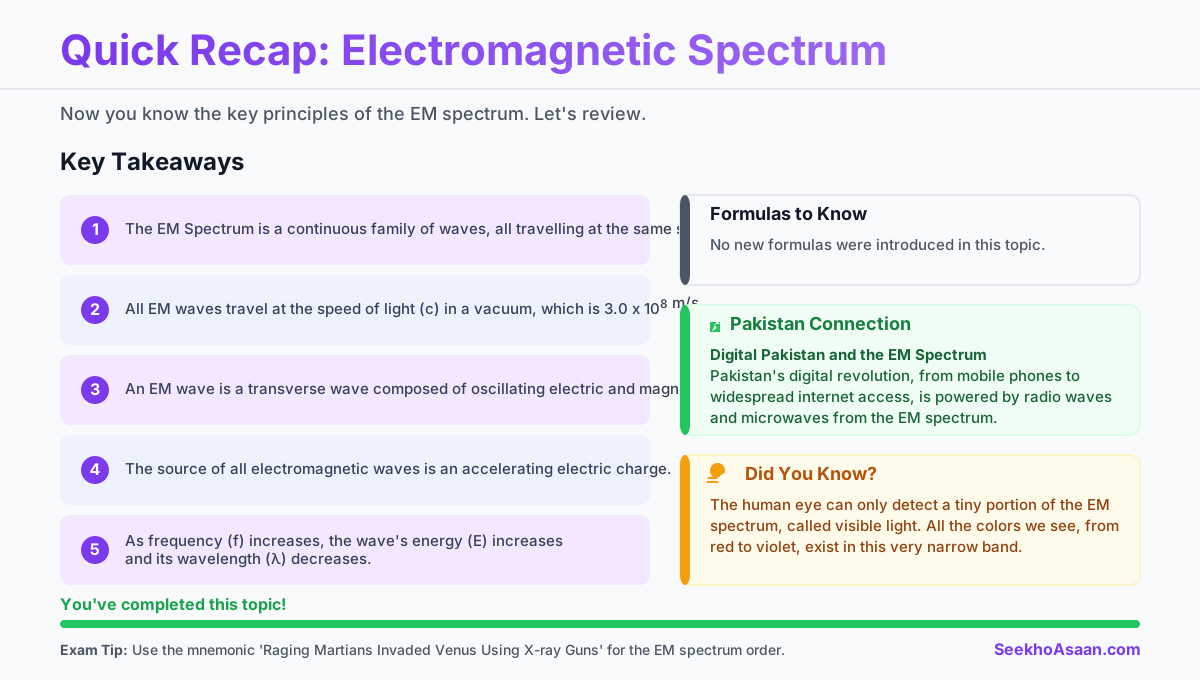
Quick revision infographic
Physics · Quick revision
Electromagnetic Spectrum
Key concepts
- 01The Electromagnetic (EM) Spectrum is a continuous family of waves, all travelling at the same speed in a vacuum.
- 02All electromagnetic waves travel at the speed of light in a vacuum, which is 3.0 x 10⁸ m/s.
- 03An electromagnetic wave is a disturbance composed of oscillating electric and magnetic fields.
- 04The source of all electromagnetic waves is an accelerating electric charge.
- 05Waves in the EM spectrum have different frequencies and wavelengths.
- 06As the frequency of an electromagnetic wave increases, its energy increases and its wavelength decreases.
Pakistan's digital revolution, from ubiquitous mobile phones in every city to widespread internet access, is entirely dependent on the electromagnetic spectrum. Mobile networks use microwaves, radio stations broadcast with radio waves, and optical fibre cables (for internet) transmit visible light, connecting millions of Pakistanis and driving economic growth.
Test your knowledge.
8 explained questions. Har answer ke baad reasoning foran milegi.