Study path
Learn it, recall it, then prove it
Read the explanation and work through each example.
Close the notes and explain the main idea yourself.
Attempt the quiz, then revisit only missed concepts.

Introduction to Electromagnetic Effects
Welcome, future engineers and scientists of Pakistan! Have you ever wondered how electricity reaches your homes from distant power plants, or how a simple ceiling fan spins to bring you comfort on a warm Karachi afternoon? The answers lie in the fascinating world of electromagnetic effects and transformers. This topic is not just about abstract physics; it's about the very technology that powers our modern lives, from your mobile charger to the massive hydroelectric dams managed by WAPDA.
In this lesson, we will explore how electricity can be generated from magnetism (electromagnetic induction), how this principle is used in powerful AC generators, and how we can use electricity and magnetism to create motion in DC motors. Finally, we'll dive into transformers, ingenious devices that efficiently change voltage, making long-distance power transmission possible across our vast country. Get ready to uncover the secrets behind the electricity that brightens your homes and fuels our progress!
Electromagnetic Induction: Making Electricity from Magnetism
Imagine you have a magnet and a coil of wire. If both are stationary, nothing happens. But what if you move the magnet near the coil, or move the coil near the magnet? Something remarkable occurs: an electric current is produced in the coil! This phenomenon is called electromagnetic induction. It's the process of inducing an electromotive force (EMF), and thus an electric current, in a conductor by changing the magnetic field passing through it.
The key here is "changing" the magnetic field. A constant magnetic field produces no induction. We need a relative movement between the conductor and the magnetic field, or a changing magnetic field produced by another source (like a changing current).
There are two fundamental laws that govern electromagnetic induction:
- Faraday's Law of Electromagnetic Induction: This law tells us about the magnitude of the induced EMF. It states that the magnitude of the induced EMF is directly proportional to the rate of change of magnetic flux linkage.
- Magnetic flux linkage is a measure of the total magnetic field lines passing through a coil. It depends on the strength of the magnetic field, the area of the coil, and the number of turns in the coil.
- In simpler terms, the faster you change the magnetic field (either by moving the magnet faster, rotating the coil faster, or changing the current in a nearby coil more rapidly), the larger the induced EMF and hence the larger the induced current.
- The formula, though often applied qualitatively at O Level, can be written as:
EMF = -N * (ΔΦ / Δt) - Where
EMFis the induced electromotive force,Nis the number of turns in the coil,ΔΦis the change in magnetic flux, andΔtis the change in time. The negative sign is explained by Lenz's Law.
- Lenz's Law: This law tells us about the direction of the induced current or EMF. It states that the induced current (or EMF) always flows in a direction that opposes the change that produced it.
- Think of it as nature's way of resisting change. If you push a North pole towards a coil, the induced current will create a North pole at that end of the coil to repel your magnet. If you pull the North pole away, the induced current will create a South pole to attract it back. This opposition ensures conservation of energy. The work you do in moving the magnet against this opposing force is converted into electrical energy in the coil.
Factors Affecting Induced EMF: The strength of the induced EMF (and current) depends on several factors:
- Strength of the magnetic field: A stronger magnet produces a stronger induced EMF.
- Rate of change of magnetic flux linkage:
- Speed of relative motion: Moving the magnet or coil faster increases the rate of change, thus increasing the induced EMF.
- Number of turns in the coil: More turns mean more conductors cutting magnetic field lines, leading to a larger induced EMF (
Nin Faraday's Law). - Area of the coil: A larger coil area can enclose more magnetic flux, contributing to a larger change in flux when moved.
Worked Example 1: Powering a Village in Punjab
A small experimental generator coil has 100 turns and is being rotated by a hand crank. When the coil is rotated slowly, an induced EMF of 0.5 V is measured. If the coil is rotated twice as fast, what will be the new induced EMF?
- Understanding the Problem: This problem directly relates to Faraday's Law. The induced EMF is proportional to the rate of change of magnetic flux linkage. Rotating the coil faster means a higher rate of change.
- Applying Faraday's Law: We know that
EMFis proportional to(ΔΦ / Δt). If the rotation speed doubles, the rate of change of magnetic flux (ΔΦ / Δt) also doubles. - Calculation:
- Initial EMF = 0.5 V
- If the rate of change of flux doubles, the EMF will also double.
- New EMF = 0.5 V * 2 = 1.0 V
- Answer: If the coil is rotated twice as fast, the new induced EMF will be 1.0 V. This principle is fundamental to how WAPDA's large hydroelectric generators, like those at Tarbela Dam, produce electricity for millions of homes across Pakistan. The faster the turbines spin, driven by the mighty Indus River, the more electricity is generated!
AC Generators: Powering Our Homes
The principle of electromagnetic induction is at the heart of how most of the electricity we use is generated. An AC generator, also known as an alternator, converts mechanical energy into electrical energy in the form of alternating current (AC).
Structure of an AC Generator: An AC generator typically consists of:
- Strong Magnets: These create a uniform magnetic field. In large power plants, these are often electromagnets.
- Coil (Armature): A rectangular coil of wire wound around a soft iron core. This coil rotates within the magnetic field.
- Slip Rings: Two separate metal rings attached to the ends of the coil. As the coil rotates, the slip rings rotate with it.
- Carbon Brushes: Stationary carbon blocks that press against the slip rings, allowing electrical contact without tangling the wires as the coil rotates. These brushes collect the induced current.
Working Principle:
- Rotation: Mechanical energy (e.g., from steam turbines, water turbines, or wind turbines) causes the coil to rotate continuously within the magnetic field.
- Changing Magnetic Flux Linkage: As the coil rotates, the number of magnetic field lines passing through it (magnetic flux linkage) continuously changes.
- When the coil is vertical, its plane is parallel to the magnetic field lines. The sides of the coil cut perpendicularly through the field lines, and the rate of change of flux linkage is maximum, resulting in maximum induced EMF.
- When the coil is horizontal, its plane is perpendicular to the magnetic field lines. No field lines are being cut at this instant (the flux linkage is maximum, but its rate of change is zero), so the induced EMF is zero.
- Induced EMF and Current: Due to this continuous change in magnetic flux linkage, an EMF is induced in the coil according to Faraday's Law.
- Alternating Current: As the coil rotates through 360 degrees:
- During the first half-rotation (0° to 180°), the current flows in one direction.
- During the second half-rotation (180° to 360°), the direction of the current reverses.
- This continuous reversal of current direction (typically 50 times per second in Pakistan, meaning 50 Hz frequency) produces alternating current (AC).
- The output voltage and current waveform is sinusoidal (a smooth wave shape).
Factors Affecting the Output of an AC Generator: To increase the induced EMF (and thus the output power) of an AC generator:
- Rotate the coil faster: Increases the rate of change of magnetic flux linkage.
- Use a stronger magnetic field: Increases the magnetic flux density.
- Increase the number of turns in the coil: Increases magnetic flux linkage and EMF (
N). - Increase the area of the coil: Increases magnetic flux linkage.
AC generators are the backbone of our national power grid, providing electricity to homes, industries, and streetlights across cities like Lahore, Rawalpindi, and Quetta.
DC Motors: The Heart of Many Appliances
While generators produce electricity from motion, DC motors do the opposite: they use electricity to produce motion. A DC motor converts electrical energy into mechanical energy, typically rotational motion. You'll find DC motors in countless everyday devices, from ceiling fans and washing machines to electric toys and hard drives.
Principle: The Motor Effect (or Force on a Current-Carrying Conductor)
The operation of a DC motor is based on the motor effect: a current-carrying conductor placed in a magnetic field experiences a force.
- This force is maximum when the current is perpendicular to the magnetic field.
- The direction of this force is given by Fleming's Left-Hand Rule.
Fleming's Left-Hand Rule: Hold your left hand with your thumb, forefinger, and middle finger mutually perpendicular (at 90 degrees to each other):
- Forefinger (First finger): Points in the direction of the Magnetic Field (Field) (North to South).
- Middle Finger (Centre finger): Points in the direction of the Current (Current) (positive to negative).
- Thumb: Points in the direction of the Force (Motion) experienced by the conductor.
Structure of a Simple DC Motor: A simple DC motor consists of:
- Strong Magnets (Stator): Permanent magnets or electromagnets that create a stationary magnetic field.
- Coil (Armature): A rectangular coil of wire wound around a soft iron core. This coil is free to rotate.
- Split-Ring Commutator: This is the crucial component that distinguishes a DC motor from an AC generator. It's a single metal ring split into two or more segments, insulated from each other. Each end of the coil is connected to a segment.
- Carbon Brushes: Stationary carbon blocks that press against the rotating commutator segments, providing electrical contact from an external DC power supply.
- DC Power Supply: Provides the direct current to the coil.
Working Principle:
- Current Flow: When current flows from the DC power supply through the carbon brushes to the split-ring commutator and into the coil.
- Forces on Coil Sides: According to the motor effect and Fleming's Left-Hand Rule, the current-carrying sides of the coil within the magnetic field experience forces.
- If current flows into the page on one side and out of the page on the other, the force on one side will be upwards, and the force on the other side will be downwards.
- Turning Effect (Torque): These two forces, acting in opposite directions on opposite sides of the coil, create a turning effect or torque, causing the coil to rotate.
- Role of the Split-Ring Commutator: As the coil rotates and reaches the vertical position (where the forces would act directly outwards/inwards, causing no further turning), the split-ring commutator comes into play. At this point, the brushes momentarily lose contact with the segments or switch contact to the opposite segments. This causes the direction of the current in the coil to reverse relative to the magnetic field.
- Continuous Rotation: Because the current direction is reversed every half-turn, the direction of the forces on the coil sides also reverses, ensuring that the turning effect always acts in the same direction, allowing the coil to rotate continuously in one direction.
Factors Affecting the Speed and Strength of a DC Motor: To make a DC motor spin faster or produce more turning power:
- Increase the current: A larger current produces a stronger force (
F = BIL). - Use a stronger magnetic field: A stronger magnetic field produces a stronger force.
- Increase the number of turns in the coil: More turns mean more conductors experiencing the force, increasing the overall turning effect.
- Increase the area of the coil: A larger coil means a greater distance between the forces, increasing the torque.
- Insert a soft iron core: This concentrates the magnetic field lines, making the field stronger.
Worked Example 2: Lahore's Efficient Ceiling Fan
A ceiling fan in a Lahore home uses a DC motor. The motor coil has 200 turns, and when it draws a current of 0.5 A, it produces a certain speed. If the owner wants to increase the fan's speed, they increase the current to 1.0 A. Assuming all other factors remain constant, how much stronger will the turning effect on the coil become?
- Understanding the Problem: The turning effect (torque) in a DC motor is proportional to the current flowing through its coil.
- Applying Motor Principle: The force on a current-carrying conductor is proportional to the current (
F ∝ I). Since the turning effect is a result of these forces, the turning effect is also proportional to the current. - Calculation:
- Initial current = 0.5 A
- New current = 1.0 A
- The current has doubled (1.0 A / 0.5 A = 2).
- Therefore, the turning effect will also double.
- Answer: The turning effect on the coil will become twice as strong, making the fan spin faster. This is why increasing the current (often by changing the fan regulator setting) makes your ceiling fan rotate at a higher speed.
Transformers: Stepping Up and Down Voltage
Imagine you've generated electricity at a power plant near Tarbela Dam. To send this power across hundreds of kilometers to cities like Karachi, you can't just send it at the voltage it's generated. Why? Because you'd lose a lot of energy as heat in the transmission lines. This is where transformers come in – ingenious devices that efficiently change AC voltage levels.
Purpose of Transformers: Transformers are used to step up (increase) or step down (decrease) an alternating voltage. They cannot work with direct current (DC) because their operation relies on a changing magnetic field.
Structure of a Transformer: A basic transformer consists of:
- Primary Coil: The coil connected to the input AC voltage source (where power enters the transformer). It has
Npturns. - Secondary Coil: The coil connected to the output load (where power leaves the transformer). It has
Nsturns. - Laminated Soft Iron Core: A closed loop of soft iron, made of thin, insulated sheets (laminations) pressed together. This core serves two crucial purposes:
- Concentrates magnetic flux: It effectively channels nearly all the magnetic field lines produced by the primary coil through the secondary coil.
- Reduces energy loss: The laminations reduce eddy currents, which are unwanted circulating currents induced in the core itself, leading to heat loss.
Working Principle: Mutual Induction
- AC in Primary: When an alternating current flows through the primary coil, it creates a continuously changing magnetic field around the primary coil.
- Magnetic Flux in Core: The soft iron core efficiently channels this changing magnetic flux through its material, linking it to the secondary coil.
- Induced EMF in Secondary: According to Faraday's Law of Electromagnetic Induction, this changing magnetic flux passing through the secondary coil induces an alternating EMF (and hence an alternating current if a load is connected) in the secondary coil. This process is called mutual induction.
Types of Transformers:
- Step-up Transformer: Has more turns in the secondary coil (
Ns > Np) than in the primary coil. It increases the voltage (Vs > Vp) but decreases the current (Is < Ip). - Step-down Transformer: Has fewer turns in the secondary coil (
Ns < Np) than in the primary coil. It decreases the voltage (Vs < Vp) but increases the current (Is > Ip).
Transformer Equations (for an Ideal Transformer): An ideal transformer is one with 100% efficiency, meaning no energy is lost.
- Voltage and Turns Ratio: The ratio of the voltages is equal to the ratio of the number of turns:
    `Vp / Vs = Np / Ns`
    Where:
    *   `Vp` = Primary voltage
    *   `Vs` = Secondary voltage
    *   `Np` = Number of turns in the primary coil
    *   `Ns` = Number of turns in the secondary coil
- Power Conservation (Ideal Transformer):
    For an ideal transformer, input power equals output power:
    `Pp = Ps`
    Since `P = VI`, we have:
    `VpIp = VsIs`
    Where:
    *   `Ip` = Primary current
    *   `Is` = Secondary current
    This equation shows that if voltage is stepped up, current must be stepped down, and vice-versa, to conserve power.
Energy Losses in Real Transformers: Real transformers are not 100% efficient due to various energy losses:
- Resistance of Coils (Copper Loss): The copper wires in both primary and secondary coils have resistance, leading to energy loss as heat (
I^2Rloss). - Eddy Currents (Iron Loss): The changing magnetic flux can induce circulating currents (eddy currents) within the soft iron core itself. These eddy currents generate heat. Laminated cores (made of thin, insulated sheets) significantly reduce eddy currents by increasing the resistance paths for these currents.
- Hysteresis Loss (Iron Loss): Energy is lost in the continuous magnetisation and demagnetisation of the soft iron core as the AC reverses direction. Using a soft iron core minimises this loss as soft iron is easily magnetised and demagnetised.
- Flux Leakage: Not all magnetic flux produced by the primary coil might link with the secondary coil; some might escape into the surroundings.
Efficiency of a Transformer: The efficiency of a transformer is defined as the ratio of output power to input power, usually expressed as a percentage: Efficiency = (Output Power / Input Power) * 100% Modern transformers can achieve efficiencies of over 99%, making them remarkably efficient devices.
Worked Example 3: Mobile Charger in a Karachi Bazaar
A shopkeeper in a bustling Karachi bazaar sells mobile phone chargers. A typical charger uses a step-down transformer to convert the 220 V mains supply to 5 V for charging. If the primary coil of the transformer has 2200 turns, how many turns should the secondary coil have? Assume the transformer is ideal.
- Understanding the Problem: We need to find the number of turns in the secondary coil (
Ns) given the primary voltage (Vp), secondary voltage (Vs), and primary turns (Np). - Applying Transformer Equation: Use the voltage and turns ratio formula:
Vp / Vs = Np / Ns. - Given Values:
Vp = 220 VVs = 5 VNp = 2200 turns- Rearranging the Formula to find Ns:
`Ns = Np * (Vs / Vp)`
- Calculation:
    `Ns = 2200 * (5 V / 220 V)`
    `Ns = 2200 * (1 / 44)`
    `Ns = 50 turns`
- Answer: The secondary coil should have 50 turns. This demonstrates how a small step-down transformer efficiently brings down the high mains voltage to a safe level for charging your mobile phone, a common sight in any Pakistani household or bazaar.
Power Transmission: Delivering Electricity Across Pakistan
Electricity generated at power stations, whether from hydroelectric dams in the north or thermal power plants near cities, needs to be delivered to consumers across vast distances. This process is called power transmission, and transformers play an absolutely critical role in making it efficient.
Why High Voltage for Long-Distance Transmission?
Imagine trying to send the entire output of a power plant at low voltage over hundreds of kilometers. The wires would have to be incredibly thick, and still, a huge amount of energy would be lost as heat. Here's why:
- Power Loss in Cables: Electrical cables have resistance (
R). When current (I) flows through them, energy is dissipated as heat. The power loss (P_loss) in the transmission cables is given by:
    `P_loss = I^2 * R`
    This formula clearly shows that power loss is proportional to the *square* of the current. Even a small reduction in current can lead to a significant reduction in power loss.
- Relationship between Power, Voltage, and Current: The total electrical power (
P) transmitted is given by:
    `P = V * I`
    Where `V` is the voltage and `I` is the current.
- Reducing Current for Efficiency: To transmit a large amount of power (
P) over long distances, we want to minimizeP_loss. To do this, we must minimizeI. FromP = VI, ifPis constant, then to reduceI, we must increaseV(voltage).
The Role of Transformers in the Power Grid: The entire electricity grid, managed by entities like WAPDA (Water and Power Development Authority) and other distribution companies in Pakistan, relies heavily on transformers for efficient power transmission:
- At the Power Station (Step-Up):
- Electricity is generated at relatively low voltages (e.g., 11 kV or 25 kV) for safety and practical reasons.
- Immediately after generation, step-up transformers are used to increase the voltage to very high levels (e.g., 132 kV, 220 kV, 500 kV) for long-distance transmission.
- This dramatically reduces the current (
P = VI), thereby minimizing theI^2Rpower loss in the high-tension transmission lines.
- Long-Distance Transmission:
- The high-voltage electricity is then carried across the country via overhead high-tension transmission lines (the tall pylons you see in rural areas and along highways).
- Near Cities/Towns (Step-Down):
- As the electricity approaches population centers, step-down transformers at grid stations reduce the voltage to safer and more manageable levels (e.g., from 500 kV to 132 kV, then to 11 kV).
- Local Distribution (Further Step-Down):
- Further step-down transformers at local substations reduce the voltage again (e.g., from 11 kV to 400 V or 230 V).
- Finally, the electricity is distributed to homes, offices, and factories at the standard mains voltage (220-240 V in Pakistan).
This multi-stage stepping up and stepping down of voltage, facilitated by transformers, ensures that a minimum amount of energy is wasted during transmission, making the delivery of electricity across our vast nation both practical and economical. It's a testament to the ingenuity of physics applied on a massive scale, keeping the lights on in homes from the snowy peaks of Gilgit-Baltistan to the warm coasts of Gwadar.
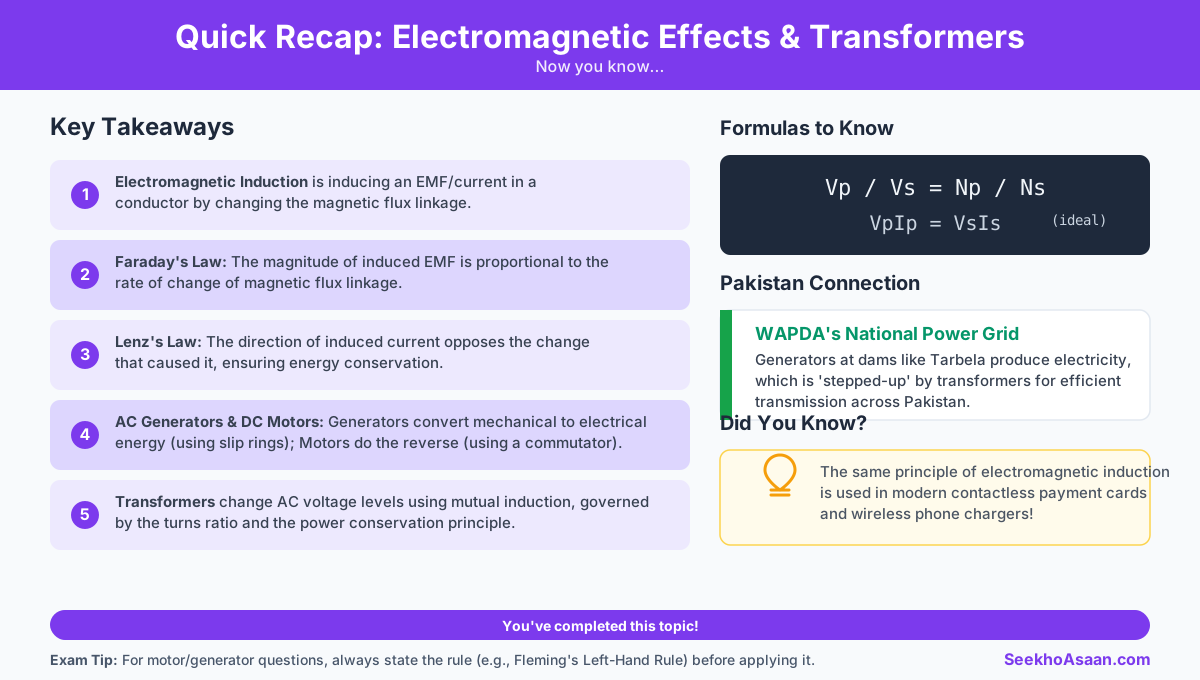
Quick revision infographic
Physics · Quick revision
Electromagnetic Effects & Transformers
Key concepts
- 01Electromagnetic induction is the process of inducing an EMF/current in a conductor by changing the magnetic flux linkage.
- 02Faraday's Law states that the magnitude of induced EMF is proportional to the rate of change of magnetic flux linkage.
- 03Lenz's Law states that the direction of induced current opposes the change that caused it, ensuring energy conservation.
- 04An AC generator converts mechanical energy into alternating electrical energy using electromagnetic induction and slip rings.
- 05A DC motor converts electrical energy (DC) into mechanical energy (rotational motion) based on the motor effect and uses a split-ring commutator for continuous rotation.
- 06Fleming's Left-Hand Rule determines the direction of force on a current-carrying conductor in a magnetic field (Motor Effect).
Formulas to know
From the towering hydroelectric dams like Tarbela to thermal power plants across Pakistan, electricity is generated using massive AC generators based on electromagnetic induction. This power is then stepped up to very high voltages by transformers for efficient long-distance transmission across WAPDA's vast national grid, finally being stepped down for safe use in our homes and industries.
Test your knowledge.
8 explained questions. Har answer ke baad reasoning foran milegi.