Study path
Learn it, recall it, then prove it
Read the explanation and work through each example.
Close the notes and explain the main idea yourself.
Attempt the quiz, then revisit only missed concepts.

1. The Earth and the Solar System
Our Solar System is a gravitationally bound system comprising the Sun and the objects that orbit it. The Sun, a star, is at the centre and contains over 99.8% of the system's total mass. Its immense gravitational field holds everything in orbit.
The largest objects orbiting the Sun are the eight planets. In order from the Sun, they are: Mercury, Venus, Earth, Mars, Jupiter, Saturn, Uranus, and Neptune. The paths these planets follow are called orbits, which are slightly elliptical (almost circular).
Beyond the planets, the Solar System also includes:
- Moons (Natural Satellites): Objects that orbit a planet. Earth has one moon, while Jupiter has over 80.
- Dwarf Planets: Such as Pluto, which orbit the Sun but haven't cleared their orbital path of other debris.
- Asteroids: Rocky objects, mostly found in the asteroid belt between Mars and Jupiter.
- Comets: Icy bodies that develop a glowing tail when they pass close to the Sun.
- Artificial Satellites: Man-made objects placed in orbit around the Earth or other celestial bodies for purposes like communication, navigation (GPS), and scientific observation.
2. The Sun as a Star and Stellar Energy
The Sun is a typical star. Stars are massive, luminous spheres of hot gas that produce their own light and heat. The energy source for the Sun and other main-sequence stars is a process called nuclear fusion occurring in their core.
Inside the core, the immense pressure and temperature (around 15 million °C) are so high that hydrogen nuclei are forced to fuse together to form helium nuclei. This process is described by the equation:
4 ¹H → ⁴He + 2e⁺ + 2ν + energy
During this fusion, a tiny amount of mass is converted into a huge amount of energy, as described by Einstein's famous equation, E = mc². This energy radiates outwards from the core, through the Sun's layers, and into space as electromagnetic radiation, including visible light and heat, sustaining life on Earth.
3. The Life Cycle of Stars
Stars are not eternal; they are born, live for billions of years, and eventually die. Their life cycle is determined by their initial mass.
a) Birth of a Star: Stars begin as part of a vast, cold cloud of gas and dust called a nebula. Gravity slowly pulls clumps of this material together. As a clump gets denser, it heats up and forms a protostar. When the core becomes sufficiently hot and dense, nuclear fusion begins, and a stable star is born. It enters the longest phase of its life, the main sequence.
b) The Main Sequence: During this phase, the outward pressure from the heat of nuclear fusion is balanced by the inward pull of gravity. Our Sun is a main sequence star and will remain so for another 5 billion years.
c) End of a Star (Low Mass): For stars with a mass similar to our Sun:
- Red Giant: When the hydrogen fuel in the core runs out, the core contracts and heats up, causing the outer layers to expand, cool, and glow red. The star becomes a red giant.
- Planetary Nebula & White Dwarf: The outer layers drift off into space, forming a planetary nebula. The hot, dense core left behind is called a white dwarf. It no longer undergoes fusion and will slowly cool over billions of years, eventually becoming a cold, dark black dwarf.
d) End of a Star (High Mass): For stars much more massive than our Sun:
- Red Supergiant: These stars evolve into much larger red supergiants.
- Supernova: When fusion ceases, the core collapses violently, triggering a cataclysmic explosion known as a supernova. This event is so bright it can outshine an entire galaxy for a short time and creates heavy elements that are scattered into space.
- Neutron Star or Black Hole: The remnant of the explosion can be an incredibly dense neutron star. If the original star was exceptionally massive, the core will collapse completely, forming a black hole—an object with a gravitational field so strong that nothing, not even light, can escape it.
4. The Expanding Universe and the Big Bang
A galaxy is a massive system of billions of stars, along with gas and dust, held together by gravity. Our galaxy is the Milky Way. When we observe light from distant galaxies, we notice a phenomenon called red-shift. This is an example of the Doppler effect for light. As a galaxy moves away from us, the wavelength of the light it emits is stretched, shifting it towards the red end of the electromagnetic spectrum.
The astronomer Edwin Hubble observed that the red-shift of a galaxy is proportional to its distance from us. This means the further away a galaxy is, the faster it is moving away. This is the key evidence for the expanding Universe—the idea that the fabric of space itself is stretching, carrying galaxies along with it.
This observation leads to the Big Bang Theory, the leading scientific model for how the universe began. It states that the universe started from an extremely hot, dense point approximately 13.8 billion years ago and has been expanding and cooling ever since. Another crucial piece of evidence for this theory is the Cosmic Microwave Background (CMB) radiation, which is the faint afterglow of the Big Bang, detected in all directions of space.
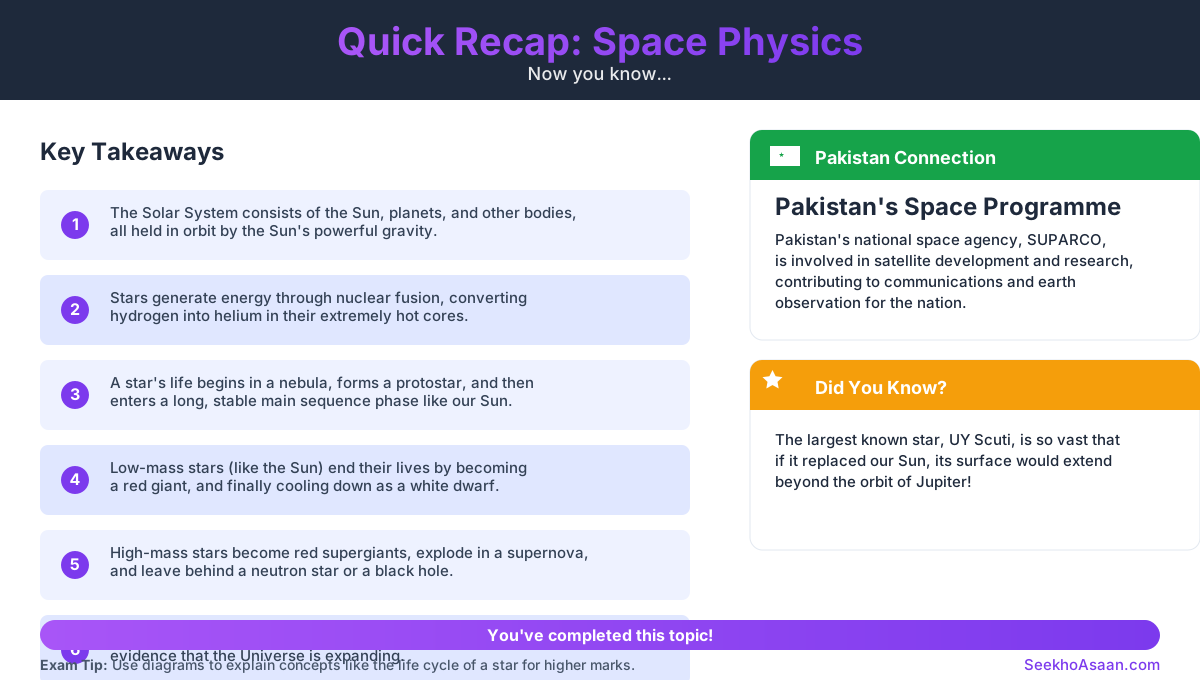
Quick revision infographic
Physics · Quick revision
Space Physics
Key concepts
- 01The Solar System consists of the Sun, planets, moons, and other bodies, all held in orbit by the Sun's gravity.
- 02Stars, like the Sun, generate vast amounts of energy through the nuclear fusion of hydrogen into helium in their cores.
- 03A star's life cycle begins in a nebula, forms a protostar, and enters a stable main sequence phase.
- 04Low-mass stars (like the Sun) end their lives by becoming a red giant, then a white dwarf.
- 05High-mass stars end as red supergiants, explode in a supernova, and leave behind a neutron star or a black hole.
- 06The red-shift of light from distant galaxies is evidence that the Universe is expanding.
Pakistan's national space agency, the Space and Upper Atmosphere Research Commission (SUPARCO), provides a direct, local context for the study of artificial satellites and their orbits. Founded in 1961, SUPARCO has been instrumental in developing Pakistan's capabilities in space science. A key example is the launch of its first satellite, **Badr-1**, in 1990, making Pakistan the first Muslim country to place an object in orbit. More recently, the **Pakistan Remote Sensing Satellite (PRSS-1)** was launched in 2018. This is an Earth observation satellite, which applies the principles of orbital mechanics studied in this chapter. It orbits the Earth in a specific, calculated path to monitor Pakistan's natural resources, assist in disaster management (like flood mapping), and support urban planning. This demonstrates the practical application of placing artificial satellites into stable orbits using gravitational principles to benefit the country.
Test your knowledge.
5 explained questions. Har answer ke baad reasoning foran milegi.