Study path
Learn it, recall it, then prove it
Read the explanation and work through each example.
Close the notes and explain the main idea yourself.
Attempt the quiz, then revisit only missed concepts.

Assalam-o-Alaikum, future engineers and scientists of Pakistan! Welcome to this exciting lesson on Magnetism & Electromagnets. From the compasses guiding our fishermen in the Arabian Sea to the powerful machinery in Karachi's industrial zones, and even the simple electric fan cooling us during Lahore's summers, magnetism plays a crucial role in our daily lives. In this lesson, we will explore the fundamental principles of magnetism, how electricity can produce magnetic effects, and how these principles are applied in essential devices like relays and loudspeakers.
Understanding Magnets and Magnetic Fields
At its core, magnetism is a fundamental force of nature, just like gravity or electricity. You've probably encountered magnets holding notes on a refrigerator or picking up small metal objects. A magnet is any material that produces a magnetic field. Not all materials are magnetic; only a few, like iron, nickel, and cobalt, are strongly attracted to magnets. These are called ferromagnetic materials. Other materials, like copper, plastic, or wood, are non-magnetic.
Every magnet, regardless of its shape or size, has two distinct regions called magnetic poles. These are the areas where the magnetic force is strongest. We label these poles as the North-seeking pole (N-pole) and the South-seeking pole (S-pole). The names come from how a compass needle aligns itself with the Earth's magnetic field, pointing towards the Earth's geographic North. An important rule of magnetism is: Like poles repel, unlike poles attract. This means two North poles will push each other away, two South poles will repel, but a North pole and a South pole will pull towards each other. Try this with two bar magnets at home!
An interesting property of magnets is that you can never have an isolated pole. If you were to cut a bar magnet in half, you wouldn't get a separate North pole and a separate South pole. Instead, each new piece would become a smaller magnet, complete with its own North and South poles. This tells us that magnetic poles always exist in pairs.
When a magnetic material, like an iron nail, is brought near a magnet, it can become temporarily magnetized. This phenomenon is called magnetic induction. The magnetic field of the permanent magnet causes the domains (tiny magnetic regions) within the iron nail to align, making the nail behave like a temporary magnet. This is why you can pick up a paperclip with an iron nail that is touching a strong magnet.
Magnetic Fields and Field Lines
A magnetic field is the region around a magnet or a current-carrying conductor where magnetic forces can be experienced. It's an invisible force, but we can visualize it using magnetic field lines. These lines are a powerful tool to understand the direction and strength of the magnetic field.
Here are the key characteristics of magnetic field lines:
- They always originate from the North pole and enter the South pole outside the magnet. Inside the magnet, they run from South to North, forming continuous closed loops.
- The direction of the magnetic field at any point is given by the direction a free North pole would move if placed at that point. This is also the direction a compass needle's North pole would point.
- The density of the field lines indicates the strength of the magnetic field. Where the lines are closer together, the field is stronger (e.g., near the poles). Where they are further apart, the field is weaker.
- Magnetic field lines never cross each other. If they did, it would imply two different directions for the magnetic field at the same point, which is impossible.
We can plot magnetic field patterns using a small compass or iron filings. When iron filings are sprinkled around a magnet, they align themselves along the magnetic field lines, revealing the invisible pattern. For a single bar magnet, the field lines emerge from the North pole, curve around, and enter the South pole, forming distinct loops. If you place two magnets near each other, the field lines will show attraction (lines connect between unlike poles) or repulsion (lines push away from each other between like poles).
Earth's Magnetic Field
Did you know our planet Earth is like a giant magnet? It has its own magnetic field, which is crucial for life. This field is believed to be generated by the movement of molten iron in the Earth's core. A compass works because its magnetized needle aligns itself with the Earth's magnetic field lines. Interestingly, the Earth's geographic North Pole is actually close to its magnetic South Pole (which is why the North pole of a compass points there), and its geographic South Pole is near its magnetic North Pole. This magnetic field protects us from harmful cosmic radiation by deflecting charged particles away from the Earth.
Magnetic Effect of Electric Current
For a long time, electricity and magnetism were thought to be separate phenomena. This changed in 1820 when Hans Christian Oersted discovered that an electric current produces a magnetic field. This discovery, known as Oersted's experiment, showed that a compass needle deflects when placed near a wire carrying an electric current. This fundamental link between electricity and magnetism is called electromagnetism.
Magnetic Field Around a Straight Current-Carrying Wire
When current flows through a straight wire, it creates a magnetic field in the form of concentric circles around the wire. The direction of this magnetic field can be determined using the Right-Hand Grip Rule (sometimes called the Right-Hand Thumb Rule):
- Imagine grasping the wire with your right hand.
- Point your thumb in the direction of the conventional current (from positive to negative).
- Your curled fingers will then indicate the direction of the magnetic field lines around the wire.
The strength of this magnetic field is stronger closer to the wire and decreases as you move further away.
Magnetic Field Around a Solenoid
A solenoid is a coil of wire wound into a cylindrical shape. When an electric current passes through a solenoid, it produces a magnetic field that is very similar to that of a bar magnet. The field lines inside the solenoid are nearly parallel and uniformly distributed, indicating a strong and uniform magnetic field. Outside the solenoid, the field lines resemble those of a bar magnet, emerging from one end (North pole) and entering the other (South pole).
The poles of a solenoid can also be determined using the Right-Hand Grip Rule:
- Curl the fingers of your right hand in the direction of the current flow around the turns of the solenoid.
- Your thumb will then point towards the North pole of the solenoid.
The strength of the magnetic field produced by a solenoid depends on several factors:
- Current (I): A larger current produces a stronger magnetic field.
- Number of turns per unit length (n): More turns packed into a given length lead to a stronger field.
- Presence of a core material: Inserting a soft iron core inside the solenoid significantly increases the strength of the magnetic field. This is because soft iron is easily magnetized and demagnetized.
Electromagnets
An electromagnet is a temporary magnet created by passing an electric current through a coil of wire, usually with a soft iron core. Unlike permanent magnets, electromagnets have several key advantages:
- Controllable strength: The strength of an electromagnet can be varied by changing the current flowing through its coil or by changing the number of turns in the coil.
- Switchable: Electromagnets can be turned on and off by simply switching the current on or off.
- Polarity reversal: The polarity (North and South poles) of an electromagnet can be reversed by changing the direction of the current.
These advantages make electromagnets incredibly useful in a vast array of applications, from doorbells to massive cranes in scrapyards.
Worked Example 1: WAPDA Circuit Breaker in Pakistan
Imagine a typical home in Defence, Lahore. The electrical system is protected by circuit breakers. A circuit breaker is a safety device that automatically cuts off the electricity supply if too much current flows through the circuit, preventing damage to appliances or even fires. Many modern circuit breakers use electromagnets.
Scenario: A house is using many high-power appliances simultaneously, leading to an excessive current (a short circuit or overload).
How the electromagnet works: Inside the circuit breaker, there's a coil of wire wrapped around a small soft iron core, creating an electromagnet. Normally, when the current is safe, the electromagnet isn't strong enough to do anything. However, if the current exceeds a certain safe limit (e.g., 30 Amperes for a main breaker):
- The large current flowing through the electromagnet's coil significantly increases its magnetic field strength.
- This strong magnetic field attracts a spring-loaded armature (a piece of soft iron).
- The armature's movement trips a mechanical latch.
- The latch releases a set of contacts, opening the circuit and instantly cutting off the power supply to the house.
This rapid response, thanks to the electromagnet, prevents electrical hazards. Once the fault is cleared, you can manually reset the breaker, allowing current to flow again. This application highlights the electromagnet's ability to respond quickly to changes in current and act as a critical safety mechanism in our homes, managed by WAPDA's power distribution.
Force on a Current-Carrying Conductor (Motor Effect)
So far, we've seen that an electric current produces a magnetic field. But what happens if we place a current-carrying conductor within an existing magnetic field? This leads us to another crucial phenomenon: the motor effect.
The motor effect states that a current-carrying conductor placed in a magnetic field experiences a force. This force is perpendicular to both the direction of the current and the direction of the magnetic field. This is the principle behind electric motors, where electrical energy is converted into mechanical energy (motion).
Fleming's Left-Hand Rule
The direction of this force can be predicted using Fleming's Left-Hand Rule:
- Extend the thumb, forefinger, and middle finger of your left hand so they are all mutually perpendicular to each other (at 90 degrees).
- Your Forefinger (the first finger) points in the direction of the Field (North to South).
- Your Middle Finger (the second finger) points in the direction of the Current (conventional current, positive to negative).
- Your Thumb will then point in the direction of the Force (or motion) experienced by the conductor.
Remember: F (Thumb) = Force/Motion, I (Middle Finger) = Current, B (Forefinger) = Magnetic Field.
The magnitude of the force (F) experienced by the conductor depends on several factors:
- Magnetic field strength (B): A stronger magnetic field produces a larger force.
- Current (I): A larger current produces a larger force.
- Length of the conductor (L): A longer section of the conductor within the magnetic field experiences a larger force.
- Angle (θ) between the current and the magnetic field: The force is maximum when the current is perpendicular to the field (θ = 90°) and zero when parallel (θ = 0°). For O Level, we usually consider the perpendicular case.
The formula for this force is F = BILsinθ. In the common perpendicular case, sinθ = sin(90°) = 1, so the formula simplifies to F = BIL.
Worked Example 2: Electric Fan Motor in Karachi
Consider an electric fan, a common appliance in many Pakistani homes, especially during Karachi's humid summers. The rotating blades of the fan are driven by an electric motor, which works on the principle of the motor effect.
Scenario: An electric fan's motor contains a coil of wire (rotor) placed within a strong magnetic field produced by permanent magnets (stator). When current flows through the coil, it experiences a force.
How the motor effect works:
- Direct current (DC) flows into the coil of the rotor, typically via carbon brushes and a commutator which reverses the current direction in the coil every half rotation, ensuring continuous rotation in one direction.
- Each side of the coil, carrying current, is situated in the magnetic field created by the permanent magnets.
- Applying Fleming's Left-Hand Rule: If current flows in one direction on one side of the coil, it experiences an upward force. On the opposite side of the coil, the current flows in the opposite direction (due to the commutator), and it experiences a downward force.
- These two forces, acting in opposite directions on different sides of the coil, create a turning effect or torque, causing the coil (and thus the fan blades) to rotate continuously.
Without the motor effect, our electric fans wouldn't turn, and our summers would be much hotter! This example demonstrates how the interaction between electricity and magnetism translates into practical mechanical motion.
Applications of Electromagnetism
Electromagnets and the motor effect are not just theoretical concepts; they are the backbone of countless modern technologies. Let's look at two crucial applications in detail: relays and loudspeakers.
Relays
A relay is an electrically operated switch. It uses a small current in one circuit to switch on or off a much larger current in another, separate circuit. Think of it as an 'amplifier' for a switch or a remote control for power.
Purpose of a Relay:
- Switching high currents with low currents: This is useful for safety (keeping high voltage/current away from the user) or when the controlling switch can only handle small currents.
- Remote control: Allowing a device to be controlled from a distance.
- Circuit isolation: Separating the control circuit from the power circuit.
How a Relay Works:
- A control circuit (low current, low voltage) is connected to a coil of wire, which forms an electromagnet.
- When a small current flows through the electromagnet's coil, it becomes magnetized.
- This electromagnet attracts a movable piece of soft iron called the armature.
- The armature pivots and closes a set of contacts in a completely separate high-current circuit.
- When the contacts close, the high-current circuit is completed, allowing a large current to flow and power a device (e.g., a motor, a heavy lamp, or an industrial machine).
- When the current in the control circuit is switched off, the electromagnet loses its magnetism, a spring pulls the armature back, and the contacts open, breaking the high-current circuit.
Worked Example 3: Automatic Street Lights in Lahore
Imagine the street lights illuminating Shahrah-e-Quaid-e-Azam (Mall Road) in Lahore. They don't need someone to manually switch them on at dusk and off at dawn. This automation often involves a relay.
Scenario: A light sensor (photocell) detects the ambient light level. When it gets dark, the sensor needs to turn on powerful street lamps that draw a large current.
How the relay works:
- The light sensor constitutes the control circuit. When the light level drops below a certain threshold (dusk), the sensor allows a small control current to flow.
- This small control current energizes the electromagnet within the relay.
- The energized electromagnet attracts its armature, causing the contacts of the relay to close.
- These contacts are part of the power circuit that supplies electricity to the street lamps. Since the lamps require a large current, it's safer and more efficient to use a relay to switch them.
- With the contacts closed, the large current flows, and the street lights turn on.
- At dawn, when the light sensor detects sufficient light, it stops the small control current. The electromagnet de-energizes, the armature returns to its original position, and the power circuit to the lamps is broken, turning them off.
This system ensures that street lights are automatically switched on and off, saving energy and requiring minimal human intervention, making our cities safer and more efficient.
Loudspeakers
A loudspeaker is a device that converts electrical audio signals into sound waves that we can hear. It's an essential component in radios, televisions, mobile phones, and public address systems in schools or mosques across Pakistan. The loudspeaker operates on the principle of the motor effect.
How a Loudspeaker Works:
- Electrical Audio Signal: A varying electrical current, representing the audio signal (music, speech, etc.), is sent from an amplifier to the loudspeaker.
- Voice Coil: This varying current flows through a coil of wire called the voice coil. The voice coil is typically made of fine copper wire wound around a cylindrical former.
- Permanent Magnet: The voice coil is positioned within the strong, fixed magnetic field of a powerful permanent magnet (often made of ferrite or neodymium).
- Motor Effect: As the varying current flows through the voice coil, and the coil is within the permanent magnet's field, it experiences a varying force due to the motor effect (
F = BIL). The direction and magnitude of this force change rapidly, matching the variations in the audio signal. - Diaphragm/Cone: The voice coil is rigidly attached to a flexible, cone-shaped membrane called the diaphragm. This diaphragm is usually made of paper, plastic, or composite materials.
- Sound Production: As the voice coil moves back and forth due to the varying force, it causes the attached diaphragm to vibrate. The vibrating diaphragm pushes and pulls the surrounding air, creating compressions and rarefactions that propagate as sound waves. The frequency and amplitude of these sound waves directly correspond to the frequency and amplitude of the original electrical audio signal.
Essentially, the loudspeaker is a transducer: it converts electrical energy into mechanical energy (vibration of the diaphragm) and then into sound energy (sound waves).
Other Applications of Electromagnetism
Beyond relays and loudspeakers, electromagnets are used in many other devices:
- Electric Bells: An electromagnet is used to repeatedly attract and release a hammer, which strikes a gong.
- Magnetic Cranes: Powerful electromagnets are used in scrapyards (like the ones sometimes seen near Gaddani Ship Breaking Yard) to lift and move heavy pieces of iron and steel. Their ability to be turned on and off makes them ideal for this purpose.
- Magnetic Resonance Imaging (MRI): Advanced medical imaging technology that uses very strong magnetic fields and radio waves to create detailed images of organs and structures inside the body.
By understanding the principles of magnetism and electromagnetism, we unlock the secrets behind countless technologies that shape our modern world, from the simplest doorbells to complex medical diagnostic tools and the power grids that light up our cities like Karachi and Lahore.
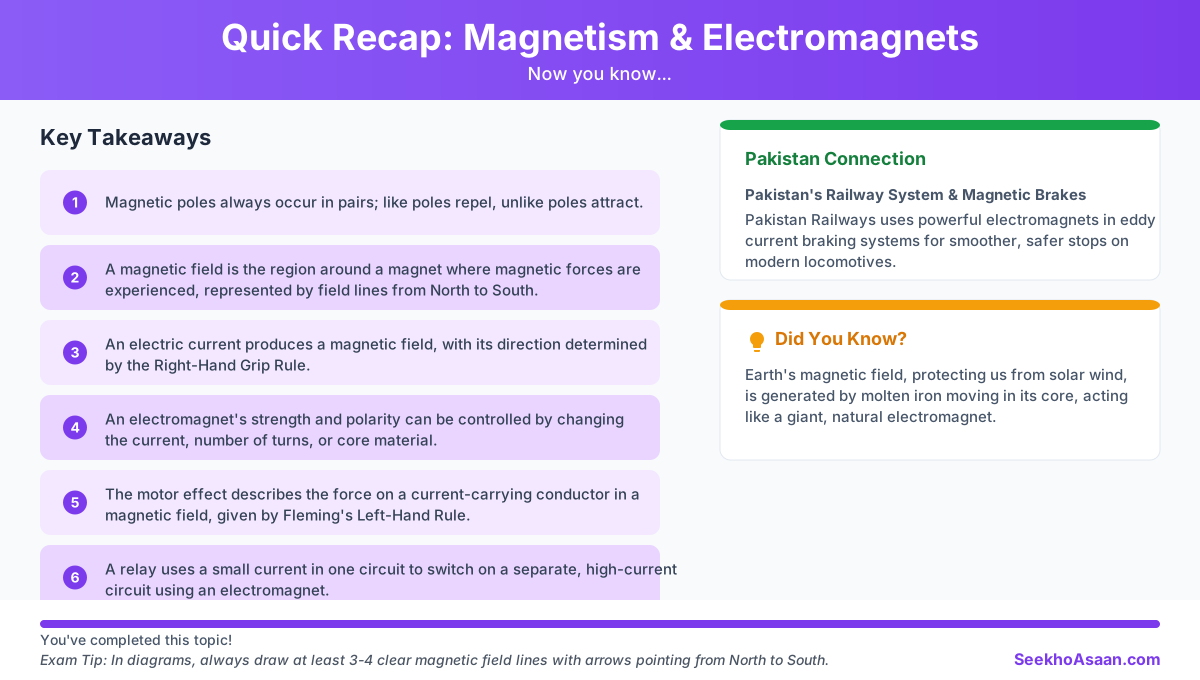
Quick revision infographic
Physics · Quick revision
Magnetism & Electromagnets
Key concepts
- 01Magnetic poles always occur in pairs; like poles repel, unlike poles attract.
- 02A magnetic field is the region around a magnet where magnetic forces are experienced, represented by field lines from North to South.
- 03An electric current produces a magnetic field around it, direction determined by the Right-Hand Grip Rule.
- 04An electromagnet is a temporary magnet whose strength and polarity can be controlled by changing the current, number of turns, or core material.
- 05The motor effect states that a current-carrying conductor in a magnetic field experiences a force, whose direction is given by Fleming's Left-Hand Rule.
- 06A relay uses a small current to activate an electromagnet, which then switches a separate, larger current circuit.
While not directly covered in detail for O Level, the principle of electromagnets is crucial for advanced applications like magnetic levitation trains (Maglev), which could be a futuristic vision for Pakistan's transportation. Even in conventional railway systems, electromagnets are sometimes used in electromagnetic brakes for more controlled and powerful stopping, ensuring safety on our railway tracks from Peshawar to Karachi.
Test your knowledge.
5 explained questions. Har answer ke baad reasoning foran milegi.