Study path
Learn it, recall it, then prove it
Read the explanation and work through each example.
Close the notes and explain the main idea yourself.
Attempt the quiz, then revisit only missed concepts.
1. Introduction to Organic Chemistry
Organic Chemistry is the study of carbon compounds. Carbon is unique because it can form strong covalent bonds with itself (catenation) and other elements, creating a vast array of molecules. Compounds containing only hydrogen and carbon are called hydrocarbons.
Many organic compounds belong to a homologous series, which is a family of compounds with:
- The same general formula.
- Similar chemical properties.
- A gradual change in physical properties (e.g., boiling point increases as chain length increases).
- The same functional group.
2. Alkanes: Saturated Hydrocarbons
Alkanes are the simplest homologous series of hydrocarbons. They are saturated, meaning they only contain single carbon-carbon (C–C) bonds.
- General Formula: CₙH₂ₙ₊₂
- First four members: Methane (CH₄), Ethane (C₂H₆), Propane (C₃H₈), Butane (C₄H₁₀).
Reactions of Alkanes: Alkanes are relatively unreactive due to the strength of the C–C and C–H bonds. Their main reactions are combustion and substitution.
- Combustion: Alkanes are excellent fuels. They burn in excess oxygen (complete combustion) to produce carbon dioxide and water, releasing large amounts of energy. For example, the combustion of methane from Pakistan's Sui gas fields:
    `CH₄(g) + 2O₂(g) → CO₂(g) + 2H₂O(l)`
    In limited oxygen (**incomplete combustion**), poisonous carbon monoxide (CO) and/or soot (C) are produced.
- Substitution: A reaction where one atom is replaced by another. Alkanes react with halogens (e.g., chlorine) in the presence of ultraviolet (UV) light. One hydrogen atom is swapped for a halogen atom.
    `CH₄(g) + Cl₂(g) --(UV light)--> CH₃Cl(g) + HCl(g)`
    *(Methane reacts with Chlorine to form Chloromethane and Hydrogen Chloride)*
Structural Isomerism: Isomers are molecules that have the same molecular formula but different structural arrangements of atoms. For example, C₄H₁₀ has two structural isomers: butane (a straight chain) and 2-methylpropane (a branched chain). They have different physical properties, such as boiling points.
3. Crude Oil and Fractional Distillation
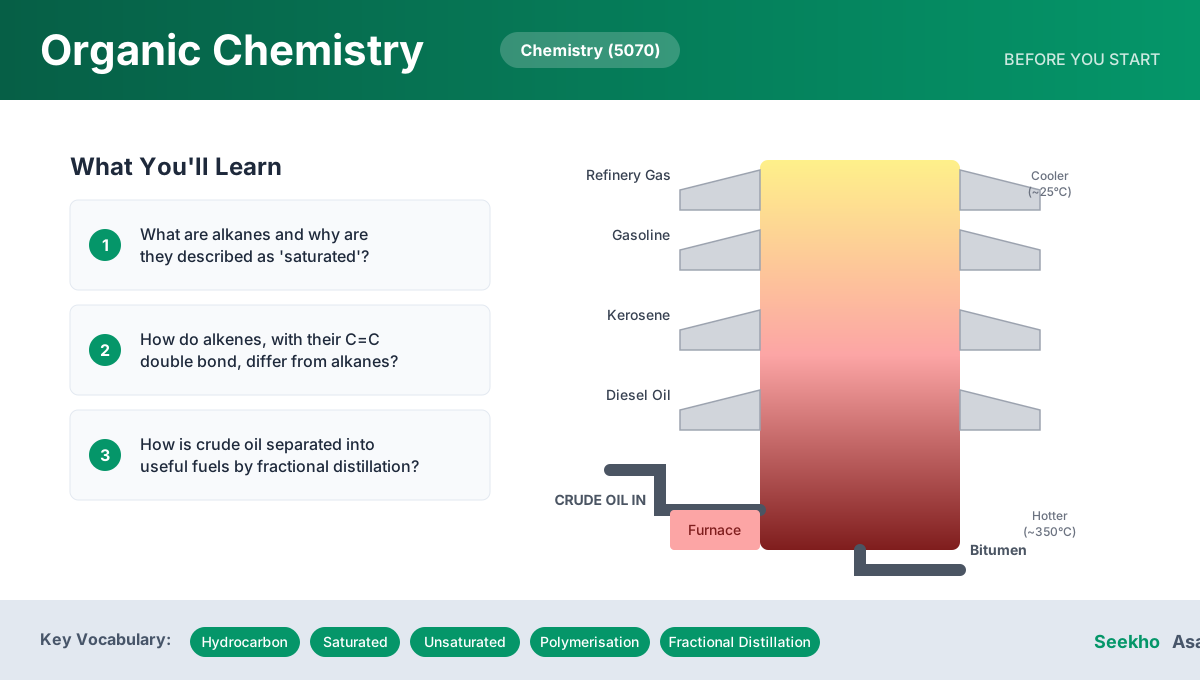
Crude oil is a finite resource and a complex mixture of hydrocarbons. It is separated into useful components called fractions by fractional distillation in refineries like the Attock Refinery in Punjab.
Process:
- Crude oil is heated to a high temperature (~350°C) to vaporise it.
- The vapour mixture enters a tall fractionating column, which is hot at the bottom and cooler at the top.
- Vapours rise and cool. Different fractions condense at different temperatures (and thus different heights) according to their boiling points.
- Long-chain hydrocarbons: High boiling points. Condense at the bottom (e.g., bitumen for roads).
- Short-chain hydrocarbons: Low boiling points. Rise to the top and are collected as gases (e.g., refinery gas for LPG).
4. Alkenes: Unsaturated Hydrocarbons
Alkenes are a homologous series of unsaturated hydrocarbons, meaning they contain at least one carbon-carbon double bond (C=C).
- General Formula: CₙH₂ₙ
- First three members: Ethene (C₂H₄), Propene (C₃H₆), Butene (C₄H₈).
The C=C double bond makes alkenes much more reactive than alkanes. They undergo addition reactions, where the double bond breaks and atoms are added across it.
Addition Reactions of Alkenes:
- With Bromine (Test for Unsaturation): When an alkene is bubbled through aqueous bromine (bromine water), the solution rapidly changes from brown to colourless. This is the chemical test to distinguish between an alkane and an alkene.
    `C₂H₄(g) + Br₂(aq) → C₂H₄Br₂(aq)`
    *(Ethene + Bromine → 1,2-dibromoethane)*
- With Hydrogen (Hydrogenation): Ethene reacts with hydrogen gas to form ethane. This requires conditions of ~200°C and a nickel catalyst. This reaction is used to convert unsaturated vegetable oils into saturated fats for making margarine.
`C₂H₄(g) + H₂(g) --(Ni catalyst, 200°C)--> C₂H₆(g)`
- With Steam (Hydration): This industrial process is used to manufacture ethanol. Ethene and steam are passed over a phosphoric(V) acid catalyst at 300°C and 60-70 atm pressure.
`C₂H₄(g) + H₂O(g) ⇌ C₂H₅OH(g)`
5. Cracking
There is a higher demand for shorter-chain hydrocarbons (like petrol) and alkenes (for plastics) than are found in crude oil. Cracking is the process of breaking down large, less useful long-chain hydrocarbon molecules into smaller, more useful ones.
- Conditions: High temperatures (~600-700°C) and a catalyst (e.g., aluminium oxide, silicon dioxide).
- Products: Always produces a smaller alkane and at least one alkene.
    `Example: C₁₀H₂₂ → C₈H₁₈ + C₂H₄`
    *(Decane → Octane + Ethene)*
6. Alcohols: Ethanol
Ethanol (C₂H₅OH) is an important alcohol with two main production methods:
- Fermentation: Glucose from sources like sugarcane (abundant in Sindh and Punjab) is broken down by enzymes in yeast in the absence of oxygen (anaerobic respiration). This batch process works best at ~37°C.
    `C₆H₁₂O₆(aq) --(yeast)--> 2C₂H₅OH(aq) + 2CO₂(g)`
    This method is sustainable as it uses a renewable resource.
- Catalytic Hydration of Ethene: As described above, this is a continuous, fast industrial process using non-renewable ethene from crude oil, producing pure ethanol.
7. Polymers and Plastics
Polymers are very large molecules made by joining many small molecules called monomers together. The process is called polymerisation.
Addition Polymerisation: This occurs with unsaturated monomers like ethene. The double bond in each monomer breaks, and they link together to form a long saturated chain. The resulting polymer is named after its monomer, e.g., ethene polymerises to form poly(ethene).
- Process: n(CH₂=CH₂) → -(CH₂-CH₂)-ₙ
- The structure
-(CH₂-CH₂)-is the repeating unit.
Poly(ethene) is a common plastic used for bags, bottles, and packaging. While useful, the non-biodegradable nature of plastics poses a significant environmental challenge, contributing to landfill and pollution problems.
Quick revision infographic
Chemistry · Quick revision
Organic Chemistry
Key concepts
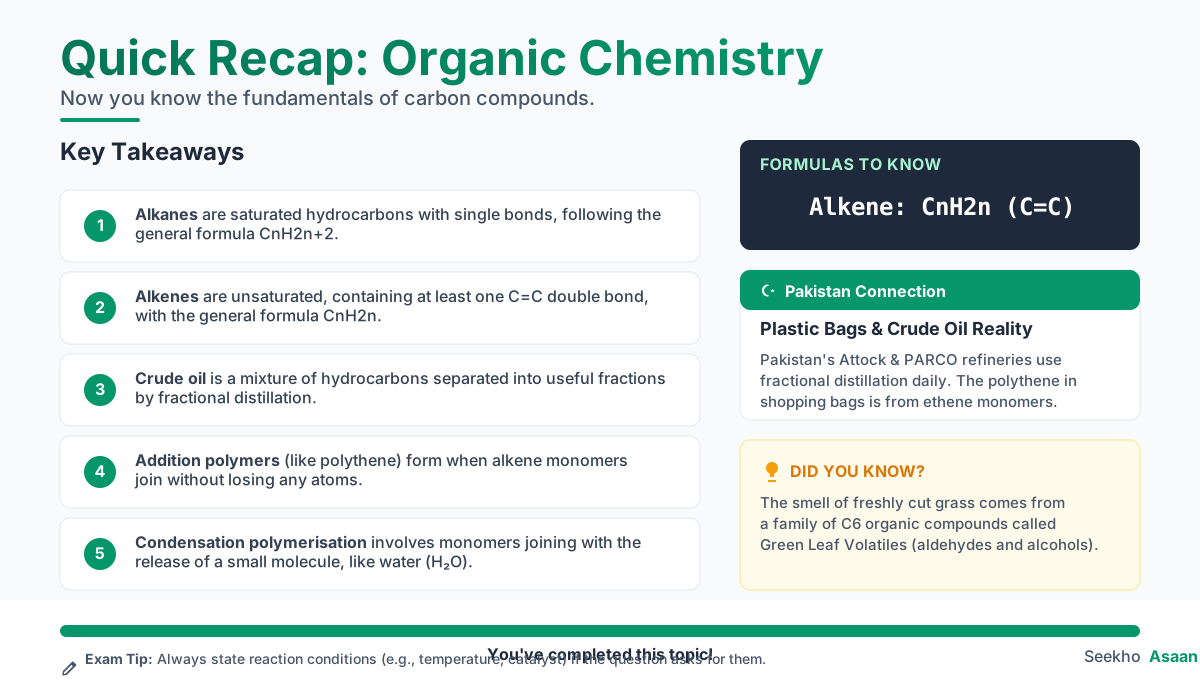
- 01Alkanes: saturated, single bonds, CnH2n+2
- 02Alkenes: unsaturated, C=C double bond, CnH2n
- 03Crude oil separated by fractional distillation
- 04Addition polymers from alkenes, condensation releases water
Formulas to know
Pakistan's Attock Refinery and PARCO fractionally distil crude oil daily. The polythene in every shopping bag is made by addition polymerisation of ethene. Pakistan's ban on thin plastic bags (2019) relates directly to the environmental persistence of these polymers — they don't biodegrade.
Test your knowledge.
30 explained questions. Har answer ke baad reasoning foran milegi.