Study path
Learn it, recall it, then prove it
Read the explanation and work through each example.
Close the notes and explain the main idea yourself.
Attempt the quiz, then revisit only missed concepts.
Introduction to the Periodic Table
The Periodic Table is a systematic arrangement of all known chemical elements, ordered by their atomic number (also called proton number, Z), which is the number of protons in an atom's nucleus. This arrangement reveals fascinating patterns, or periodicity, in the elements' properties.
- Periods: These are the horizontal rows. The period number indicates the number of occupied electron shells in an atom of the element. For example, sodium (Na) is in Period 3, so its electrons occupy three shells (2.8.1).
- Groups: These are the vertical columns. For the main group elements, the group number tells us the number of valence electrons (electrons in the outermost shell). Elements in the same group share similar chemical properties because they have the same number of valence electrons and react in similar ways.
As you move across a period from left to right (e.g., from Sodium to Argon), the character of the elements changes from metallic to non-metallic. This is because the increasing nuclear charge pulls the valence electrons more strongly, making it harder to lose them (a characteristic of metals) and easier to gain or share them (a characteristic of non-metals).
Group I – The Alkali Metals
The elements Lithium (Li), Sodium (Na), and Potassium (K) are the first three members of Group I. They are called alkali metals because they react with water to form alkaline solutions (metal hydroxides).
Physical Properties:
- They are soft metals that can be easily cut with a knife.
- They have low densities; Li, Na, and K are less dense than water and will float.
- They have low melting and boiling points which decrease down the group.
Chemical Properties & Reactivity Trend: Alkali metals are extremely reactive because they have only one valence electron. They readily lose this electron to form a stable positive ion with a +1 charge (e.g., Na⁺).
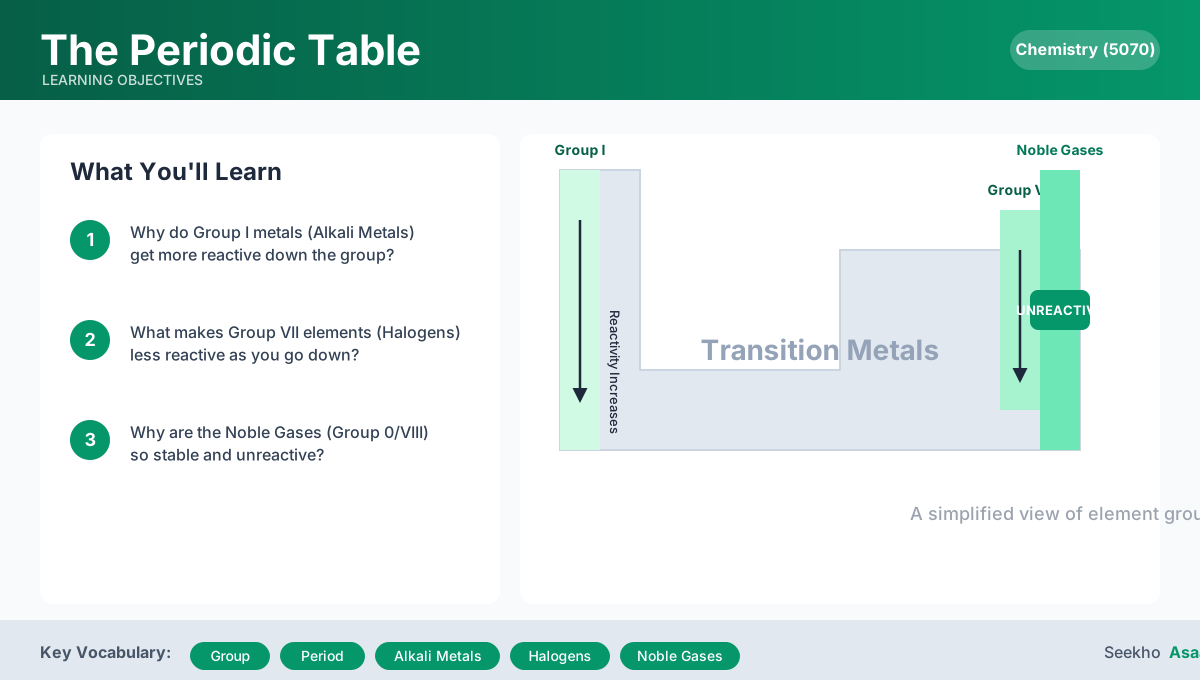
Reactivity increases down the group. This is a crucial trend to understand.
- Atomic Radius: As you go down the group, each element has an additional electron shell, so the atomic size increases.
- Shielding Effect: The inner electron shells 'shield' the outermost electron from the full attractive pull of the positive nucleus.
- Ease of Electron Loss: The combination of a larger distance and increased shielding means the valence electron is held less tightly and is easier to lose. Therefore, Potassium is more reactive than Sodium.
Reactions with Water: They react vigorously with cold water to produce a metal hydroxide and hydrogen gas. General Equation: 2M(s) + 2H₂O(l) → 2MOH(aq) + H₂(g)
- Sodium (Na): Fizzes rapidly, darts across the water surface, and melts into a silvery ball.
- Potassium (K): Reacts even more violently, producing enough heat to ignite the hydrogen gas, which burns with a characteristic lilac flame.
Group VII – The Halogens
The elements Fluorine (F), Chlorine (Cl), Bromine (Br), and Iodine (I) are in Group VII. They are known as halogens, meaning 'salt-formers', as they react with metals to form salts.
Physical Properties:
- They exist as diatomic molecules (Cl₂, Br₂, etc.).
- Their melting points, boiling points, and density increase down the group due to stronger intermolecular forces (van der Waals' forces) between larger molecules.
- Their state and colour at room temperature change down the group:
- Chlorine (Cl₂): Greenish-yellow gas
- Bromine (Br₂): Reddish-brown volatile liquid
- Iodine (I₂): Greyish-black solid that sublimes (turns directly from solid to gas) to form a violet vapour.
Chemical Properties & Reactivity Trend: Halogens are very reactive non-metals with seven valence electrons. They tend to gain one electron to form a stable negative ion with a -1 charge (a halide ion, e.g., Cl⁻).
Reactivity decreases down the group. This is the opposite of Group I.
- Atomic Radius: The atoms get larger down the group.
- Electron Attraction: The outermost shell is further from the nucleus and is shielded by more inner shells. This weakens the nucleus's ability to attract an eighth electron to complete its octet. Therefore, Chlorine is more reactive than Bromine.
Displacement Reactions: A more reactive halogen will displace a less reactive halide ion from its aqueous solution.
Cl₂(aq) + 2KBr(aq) → 2KCl(aq) + Br₂(aq)
*Observation:* The colourless potassium bromide solution turns orange-brown due to the formation of aqueous bromine.
Br₂(aq) + 2KCl(aq) → No Reaction
*Reason:* Bromine is less reactive than chlorine and cannot displace it.
Group 0 – The Noble Gases
Helium (He), Neon (Ne), and Argon (Ar) are unreactive gases. They are called noble gases or inert gases.
- Electronic Structure: They have a full outer shell of electrons (a stable duplet for He, a stable octet for others). This stable configuration means they have no tendency to lose, gain, or share electrons.
- Properties: They are colourless, odourless, monatomic (exist as single atoms), and chemically inert.
- Uses: Their inertness is key to their applications.
- Argon: Used to provide an inert atmosphere in filament lamps to prevent the hot tungsten filament from reacting with oxygen.
- Helium: Used in weather balloons and airships because it has a very low density and is non-flammable (a key advantage over hydrogen).
Transition Metals
This is the large block of elements in the middle of the Periodic Table, including elements like iron, copper, and zinc. They have a set of characteristic properties that differ significantly from Group I metals.
Characteristic Properties:
- High Densities and Melting Points: For example, iron melts at 1538 °C, whereas the alkali metal sodium melts at just 98 °C.
- Formation of Coloured Compounds: Many transition metal compounds are brightly coloured. For example, aqueous copper(II) sulfate is blue, while iron(III) salts are typically yellow or brown.
- Catalytic Activity: They and their compounds often function as catalysts, speeding up chemical reactions without being used up. Iron is the catalyst in the Haber process for making ammonia, a key component in fertilisers used in Pakistan's agricultural sector.
- Variable Oxidation States: They can form ions with different charges. For example, iron can exist as Fe²⁺ (iron(II)) or Fe³⁺ (iron(III)).
Common Exam Trap: Do not confuse the trend in physical properties (like boiling point) with the trend in reactivity. For halogens, boiling points increase down the group, but reactivity decreases.

Quick revision infographic
Chemistry · Quick revision
The Periodic Table
Key concepts
- 01Group I: reactivity increases down group
- 02Group VII: reactivity decreases down group
- 03Noble gases: full outer shells, unreactive
- 04Transition metals: coloured compounds, catalysts
The yellowish-orange glow of old street lights across Pakistan comes from sodium (Group I). Neon signs in Saddar use noble gases. The iron (transition metal) in Karachi's construction uses iron's catalytic and structural properties.
Test your knowledge.
30 explained questions. Har answer ke baad reasoning foran milegi.