Study path
Learn it, recall it, then prove it
Read the explanation and work through each example.
Close the notes and explain the main idea yourself.
Attempt the quiz, then revisit only missed concepts.
Introduction to Electrochemistry
Electrochemistry is the branch of chemistry that studies the relationship between electricity and chemical reactions. It encompasses two main types of processes:
- Electrolysis: Using electrical energy to drive a non-spontaneous chemical reaction.
- Electrochemical Cells (Voltaic/Galvanic Cells): Generating electrical energy from a spontaneous chemical reaction.
Core Concepts of Electrolysis
Electrolysis is the chemical decomposition of an ionic compound, called the electrolyte, by passing a direct electric current (DC) through it. For electrolysis to occur, the ions in the electrolyte must be mobile. This is only possible when the ionic compound is in a molten state or dissolved in a suitable solvent (usually water) to form an aqueous solution.
- Electrolyte: A compound that conducts electricity when molten or dissolved in water, and is decomposed in the process. Examples include acids, alkalis, and salts.
- Non-electrolyte: A compound that does not conduct electricity in either molten or aqueous states. Examples include sugar and ethanol.
- Conduction: In an electrolyte, charge is carried by mobile ions. This is different from metallic conduction, where charge is carried by delocalised electrons.
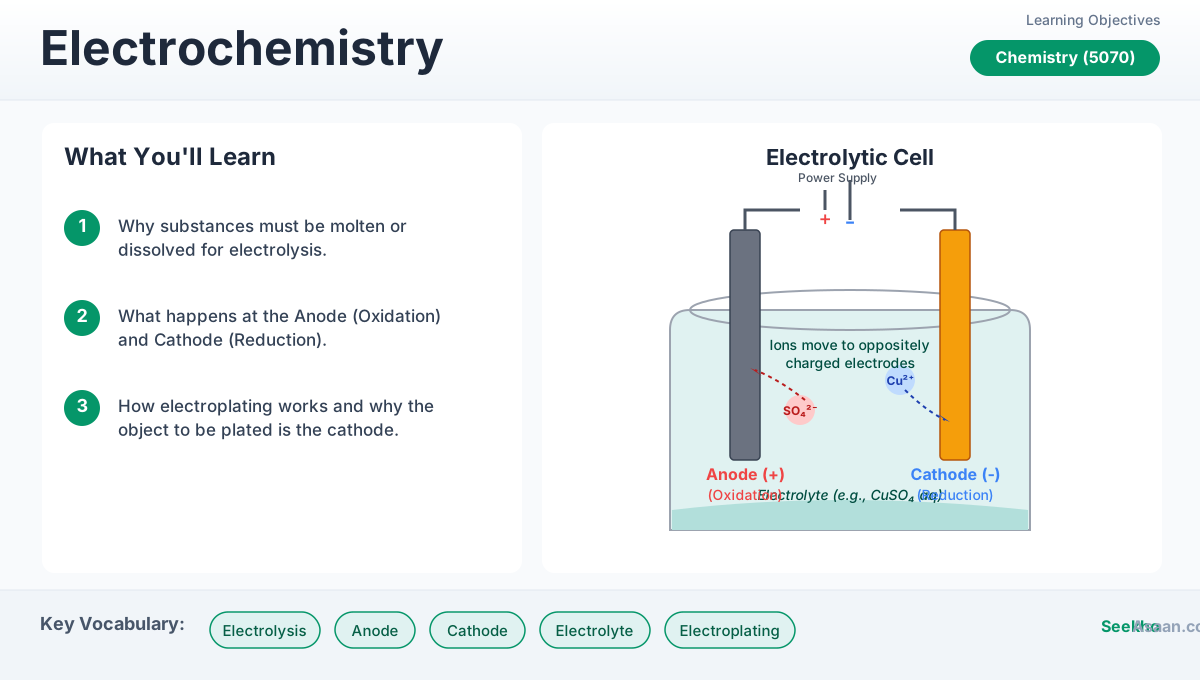
An electrolytic cell consists of:
- Electrodes: Rods (usually graphite or metal) that conduct electricity into and out of the electrolyte.
- Anode: The positive electrode. Anions (negative ions) are attracted to it. Oxidation (Loss of electrons) occurs here. Mnemonic: AN OX (Anode Oxidation).
- Cathode: The negative electrode. Cations (positive ions) are attracted to it. Reduction (Gain of electrons) occurs here. Mnemonic: RED CAT (Reduction Cathode).
- Power Supply: Provides the direct current to drive the reaction.
Predicting the Products of Electrolysis
1. Electrolysis of Molten Compounds
This is the simplest case. There are only two types of ions present: a positive cation and a negative anion.
- The cation moves to the cathode and is reduced.
- The anion moves to the anode and is oxidised.
Example: Electrolysis of molten lead(II) bromide (PbBr₂)
- Ions present: Pb²⁺(l) and Br⁻(l)
- At the Cathode (-): Lead ions gain electrons to form molten lead.
`Pb²⁺(l) + 2e⁻ → Pb(l)` (Reduction)
- At the Anode (+): Bromide ions lose electrons to form bromine gas.
`2Br⁻(l) → Br₂(g) + 2e⁻` (Oxidation)
2. Electrolysis of Aqueous Solutions
This is more complex because water molecules can also be oxidised or reduced. Therefore, there is a competition at each electrode.
At the Cathode (Negative Electrode): There's a competition between the metal cation (e.g., Na⁺) and hydrogen ions (H⁺) from the dissociation of water.
- Rule: The ion of the less reactive element is preferentially discharged. We use the reactivity series to predict this.
- If the metal is highly reactive (e.g., K, Na, Ca, Mg, Al), hydrogen is less reactive, so hydrogen gas is produced from water:
2H₂O(l) + 2e⁻ → H₂(g) + 2OH⁻(aq) - If the metal is less reactive than hydrogen (e.g., Cu, Ag, Au), the metal ion is discharged and the metal is deposited:
Cu²⁺(aq) + 2e⁻ → Cu(s)
At the Anode (Positive Electrode): There's a competition between the non-metal anion (e.g., Cl⁻, SO₄²⁻) and hydroxide ions (OH⁻) from the dissociation of water.
- Rule 1: If halide ions (Cl⁻, Br⁻, I⁻) are present in high concentration, they are preferentially discharged to form the halogen gas (Cl₂, Br₂, I₂).
`2Cl⁻(aq) → Cl₂(g) + 2e⁻`
- Rule 2: If the solution is dilute OR if complex anions like sulfate (SO₄²⁻) or nitrate (NO₃⁻) are present, hydroxide ions are discharged to produce oxygen gas.
`4OH⁻(aq) → O₂(g) + 2H₂O(l) + 4e⁻`
Exam Trap: Students often forget that in the electrolysis of aqueous solutions, water itself provides competing H⁺ and OH⁻ ions. Always consider the position of the metal in the reactivity series and the type/concentration of the anion.
Industrial Applications of Electrolysis
- Extraction of Aluminium: Aluminium is extracted from its purified ore, bauxite (Al₂O₃), by the Hall-Héroult process. Al₂O₃ has a very high melting point (~2072 °C). To save energy, it is dissolved in molten cryolite (Na₃AlF₆), which lowers the operating temperature to around 1000 °C.
- Cathode (Carbon lining):
Al³⁺(l) + 3e⁻ → Al(l) - Anode (Carbon blocks):
2O²⁻(l) → O₂(g) + 4e⁻ - Problem: The oxygen produced at the anode reacts with the hot carbon anode, burning it away as carbon dioxide (
C(s) + O₂(g) → CO₂(g)). Thus, the anodes must be replaced periodically.
- Purification of Copper (Electrolytic Refining): Impure copper can be purified to >99.9% purity.
- Anode: A large block of impure copper.
- Cathode: A thin starter sheet of pure copper.
- Electrolyte: Aqueous copper(II) sulfate (CuSO₄).
- Process: At the anode, copper atoms lose electrons and dissolve into the solution as Cu²⁺ ions. At the cathode, Cu²⁺ ions from the solution gain electrons and deposit as pure copper, making the cathode grow. More reactive metal impurities also dissolve but do not deposit, while less reactive impurities (like gold and silver) fall to the bottom as valuable anode sludge.
- Electroplating: This is the process of coating an object with a thin layer of a metal to improve its appearance or protect it from corrosion.
- Anode: The metal used for plating (e.g., Silver).
- Cathode: The object to be plated (e.g., a steel spoon).
- Electrolyte: A solution containing ions of the plating metal (e.g., silver nitrate solution).
- Process: The plating metal at the anode dissolves (e.g.,
Ag → Ag⁺ + e⁻), and its ions are deposited onto the object at the cathode (e.g.,Ag⁺ + e⁻ → Ag).
Simple Electrochemical Cells
Unlike electrolytic cells, simple cells (voltaic cells) convert chemical energy into electrical energy. They consist of two different metals (electrodes) dipped in an electrolyte.
- The more reactive metal acts as the negative electrode (anode) and is oxidised.
- The less reactive metal acts as the positive electrode (cathode).
- Electrons flow from the more reactive metal to the less reactive metal through the external circuit, generating a current.
Quick revision infographic
Chemistry · Quick revision
Electrochemistry
Key concepts
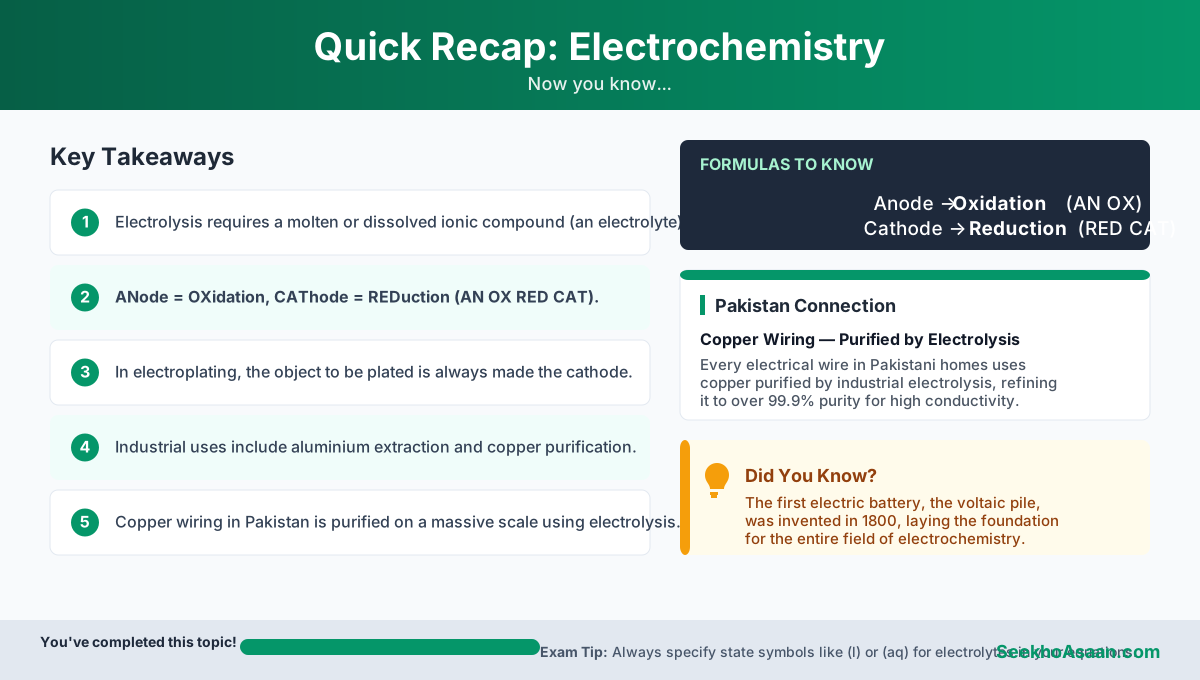
- 01Electrolysis needs molten or dissolved ionic compound
- 02Anode = oxidation, Cathode = reduction (AN OX RED CAT)
- 03Electroplating: object is cathode
- 04Industrial: aluminium extraction, copper purification
Formulas to know
Every electrical wire in Pakistani homes uses purified copper. Industrial electrolysis refines impure copper (99.5% pure anode) into ultra-pure copper (99.99% cathode) for electrical conductivity. Pakistan imports most refined copper — understanding the process helps evaluate industrial potential.
Test your knowledge.
30 explained questions. Har answer ke baad reasoning foran milegi.