Study path
Learn it, recall it, then prove it
Read the explanation and work through each example.
Close the notes and explain the main idea yourself.
Attempt the quiz, then revisit only missed concepts.
1. Simple Magnetism and Magnetic Fields
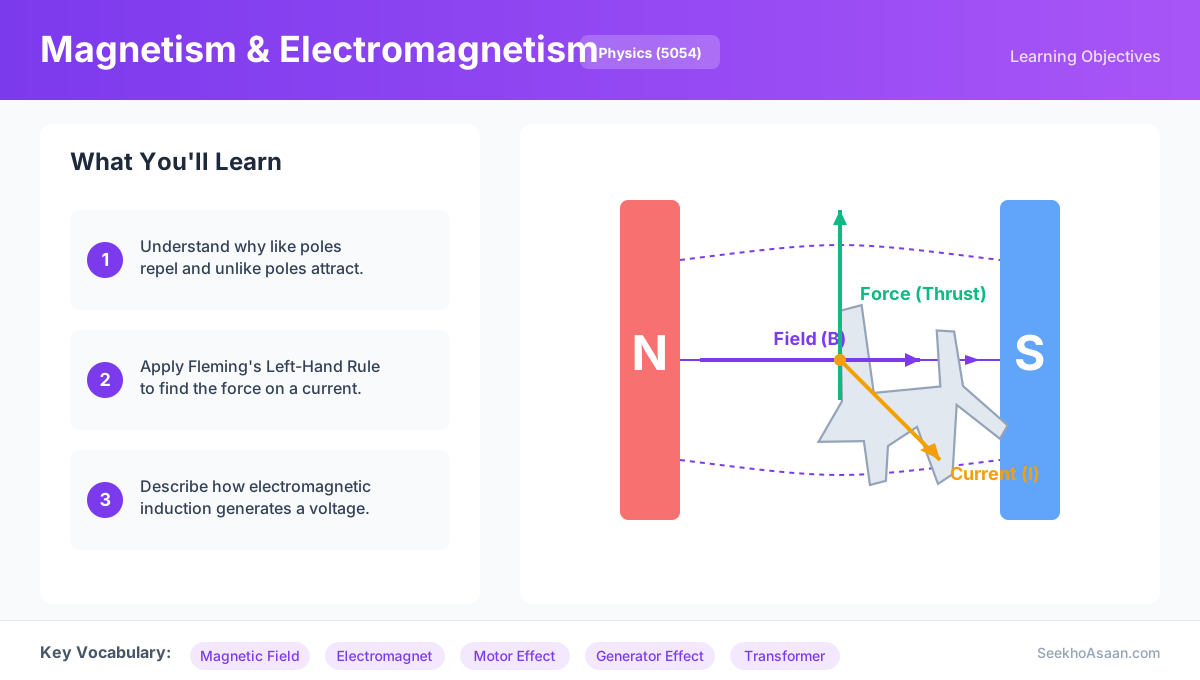
A magnet is an object that produces a magnetic field. Every magnet has two poles: a north pole and a south pole. The fundamental law of magnetism states that like poles repel (North-North or South-South) and unlike poles attract (North-South).
The region around a magnet where a magnetic force can be detected is called a magnetic field. We represent this field using magnetic field lines, which are imaginary lines that show the direction and strength of the field.
- Direction: Field lines always point from the north pole to the south pole outside the magnet.
- Strength: The closer the field lines are to each other, the stronger the magnetic field.
Materials can be classified based on their magnetic properties. Soft magnetic materials, like soft iron, are easy to magnetise but also lose their magnetism quickly. Hard magnetic materials, like steel, are harder to magnetise but retain their magnetism for a long time, making them suitable for permanent magnets.
2. Electromagnetism
Electromagnetism is the principle that an electric current produces a magnetic field. The shape of this field depends on the shape of the conductor.
- Straight Wire: The magnetic field consists of concentric circles around the wire. The direction of the field can be found using the Right-Hand Grip Rule: point your right thumb in the direction of the conventional current (positive to negative), and your fingers will curl in the direction of the magnetic field.
- Solenoid: A solenoid is a long coil of wire. When current flows through it, it creates a strong, uniform magnetic field inside the coil, similar to that of a bar magnet. You can use the Right-Hand Grip Rule here too: curl your fingers in the direction of the current in the coils, and your thumb will point towards the north pole.
An electromagnet is a temporary magnet made by wrapping a coil of wire around a soft iron core. Its magnetism can be switched on or off with the current. The strength of an electromagnet can be increased by:
- Increasing the current flowing through the coil.
- Increasing the number of turns in the coil.
- Placing a soft iron core inside the coil, which concentrates the magnetic field lines.
Applications: Electromagnets are used in scrapyard cranes, electric bells, and magnetic relays, which use a small current to switch on a circuit with a much larger current.
3. The Motor Effect
When a wire carrying an electric current is placed in a magnetic field, it experiences a force. This is known as the motor effect. The direction of this force is given by Fleming's Left-Hand Rule.
- Thumb: Direction of Motion (Force)
- First finger: Direction of the magnetic Field (North to South)
- Cond finger: Direction of the conventional Current (+ to -)
This principle is the basis of the electric motor, which converts electrical energy into mechanical energy. In a simple DC motor, a coil is placed in a magnetic field. When current flows, one side of the coil is pushed up and the other side is pushed down, causing it to rotate. A split-ring commutator is a crucial component that reverses the direction of the current in the coil every half turn, ensuring continuous rotation in the same direction.
4. Electromagnetic Induction
Electromagnetic induction is the process of generating an electromotive force (e.m.f.), or voltage, across a conductor when it is in a changing magnetic field. This can happen in two ways:
- Moving a conductor through a magnetic field (cutting field lines).
- Changing the magnetic field around a stationary conductor.
Faraday's Law of Induction states that the magnitude of the induced e.m.f. is directly proportional to the rate at which the magnetic field lines are cut. You can increase the induced e.m.f. by:
- Moving the wire or magnet faster.
- Using a stronger magnet.
- Using a coil with more turns.
This principle is used in generators, which do the opposite of motors: they convert mechanical energy into electrical energy. An AC generator uses two slip rings to produce an alternating current as the coil rotates in the magnetic field.
Common Exam Trap: Remember, induction only occurs when there is change or relative motion. A stationary wire in a constant magnetic field will have zero induced e.m.f.
5. Transformers
A transformer is a device used to change the voltage of an alternating current (AC) supply. It consists of two coils, a primary coil and a secondary coil, wound on a continuous laminated soft iron core.
Principle of Operation:
- An alternating current flows through the primary coil, producing a continuously changing magnetic field in the soft iron core.
- This changing magnetic field passes through the secondary coil.
- By electromagnetic induction, a changing e.m.f. is induced in the secondary coil.
Transformers do not work with direct current (DC) because DC does not produce a changing magnetic field.
- Step-up transformer: Has more turns on the secondary coil than the primary (Ns > Np), increasing the voltage (Vs > Vp).
- Step-down transformer: Has fewer turns on the secondary coil than the primary (Ns < Np), decreasing the voltage (Vs < Vp).
The relationship is given by the formula: Vs / Vp = Ns / Np
For an ideal (100% efficient) transformer, the power input equals the power output: Power_in = Power_out => Vp × Ip = Vs × Is
Application: Transformers are essential for power transmission. In Pakistan's national grid, electricity from power stations like the Mangla Dam is stepped up to very high voltages for efficient long-distance travel, then stepped down by a series of transformers for safe use in homes and businesses.
Quick revision infographic
Physics · Quick revision
Magnetism & Electromagnetism
Key concepts
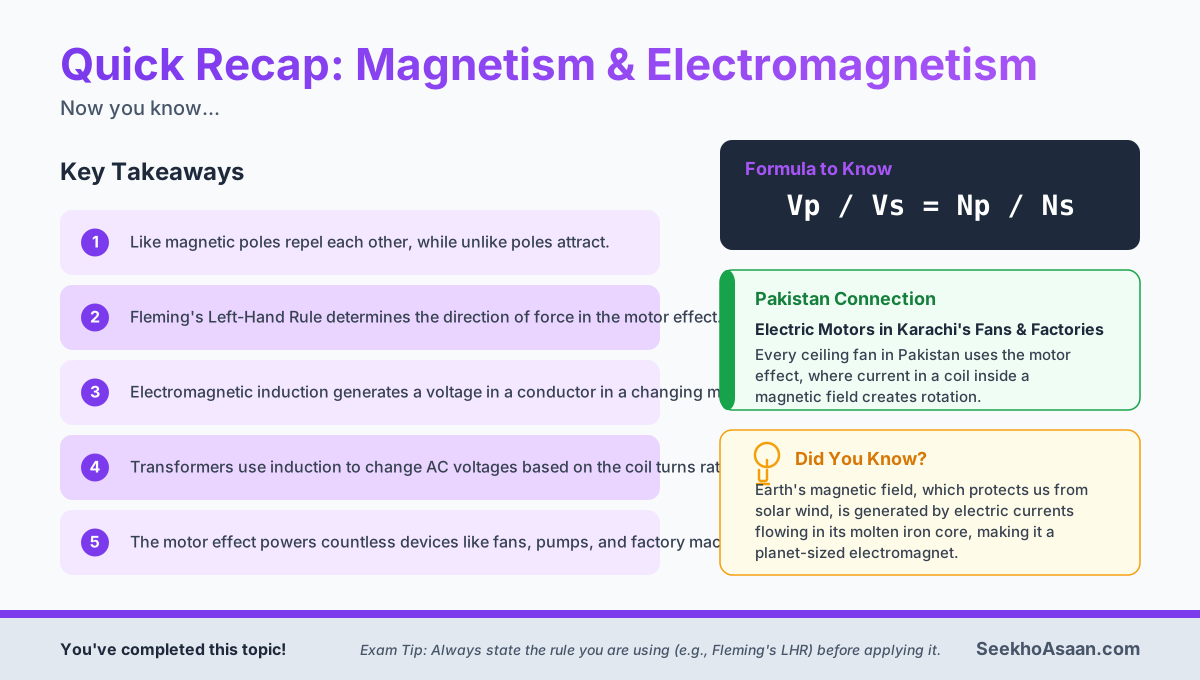
- 01Like poles repel, unlike attract
- 02Fleming's Left-Hand Rule for motor effect
- 03Electromagnetic induction generates voltage
- 04Transformers: Vp/Vs = Np/Ns
Formulas to know
Every ceiling fan in Pakistan uses the motor effect — current in a coil inside a magnetic field creates rotation. Pakistan's national grid uses step-up transformers at power stations (Tarbela, Mangla) to transmit at 500 kV, then step-down transformers near homes bring it to 220V.
Test your knowledge.
29 explained questions. Har answer ke baad reasoning foran milegi.