Study path
Learn it, recall it, then prove it
Read the explanation and work through each example.
Close the notes and explain the main idea yourself.
Attempt the quiz, then revisit only missed concepts.
Introduction to Electricity
Electricity is the flow of electric charge, a fundamental property of matter. In the context of circuits, we are primarily concerned with the movement of electrons through conductive materials like copper wires. Understanding the three core concepts – current, voltage, and resistance – is the key to mastering this topic.
1. Fundamental Quantities of Electricity
Electric Current (I)
- Definition: Electric current is the rate of flow of electric charge. It tells us how much charge passes a point in a circuit every second.
- Formula: I = Q / t, where Q is the charge in Coulombs (C) and t is the time in seconds (s).
- Unit: The SI unit for current is the Ampere (A). 1 Ampere means 1 Coulomb of charge is flowing past a point per second.
- Direction: A crucial point for exams is the difference between conventional current and electron flow.
- Conventional Current: Assumes that positive charges are flowing. Its direction is from the positive terminal to the negative terminal of the power source. This is the standard used in circuit diagrams.
- Electron Flow: The actual flow of electrons, which are negatively charged. This flow is from the negative terminal to the positive terminal.
Potential Difference (V) and Electromotive Force (e.m.f.)
- Definition: Potential Difference (p.d.), or voltage, is the work done (or energy converted) in moving a unit of positive charge from one point to another in a circuit. It is the 'push' that drives the current through a component.
- Formula: V = W / Q, where W is the work done in Joules (J) and Q is the charge in Coulombs (C).
- Unit: The SI unit is the Volt (V). A p.d. of 1 Volt means 1 Joule of work is done for every Coulomb of charge that passes.
- e.m.f.: The electromotive force (e.m.f.) is the total energy supplied by a source (like a battery or a generator at a power station like Tarbela Dam) to each Coulomb of charge. It is also measured in Volts. Think of e.m.f. as the total energy provided by the source, while p.d. is the energy used by a component.
Resistance (R)
- Definition: Resistance is a measure of the opposition to the flow of electric current. A component with high resistance will allow less current to flow for the same voltage.
- Formula: R = V / I
- Unit: The SI unit is the Ohm (Ω). A component has a resistance of 1 Ohm if a potential difference of 1 Volt across it causes a current of 1 Ampere to flow.
2. Ohm's Law and I-V Characteristics
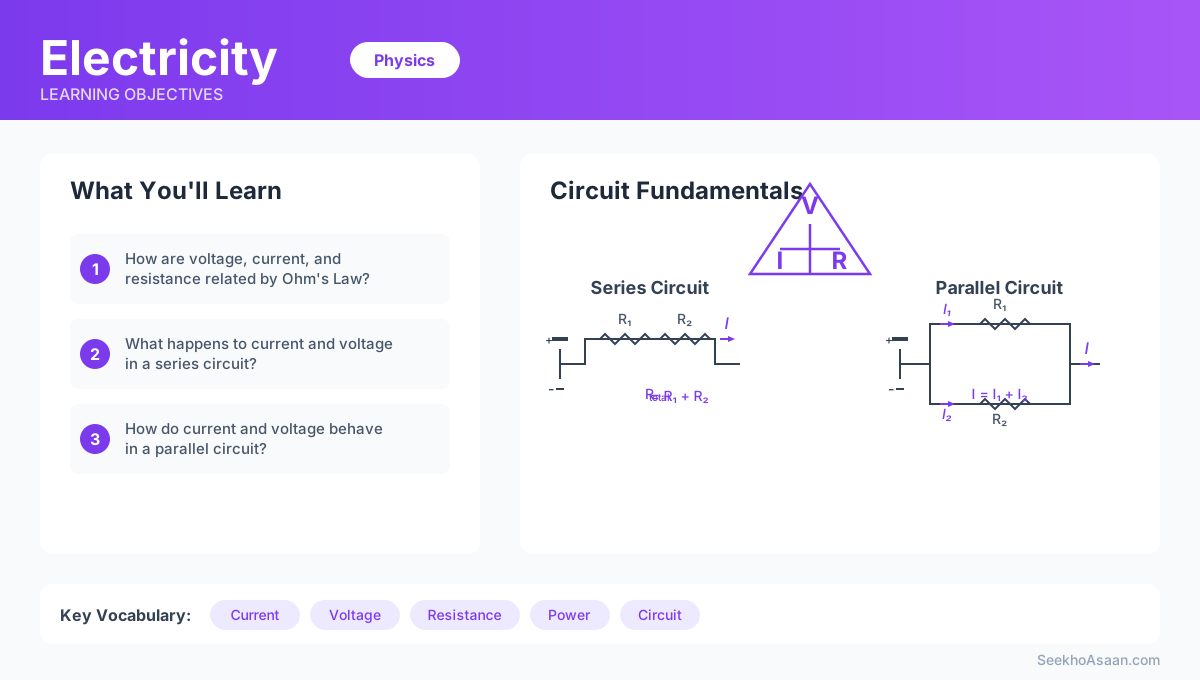
Ohm's Law is a fundamental relationship: The current flowing through a metallic conductor is directly proportional to the potential difference across its ends, provided that physical conditions (like temperature) remain constant.
- Formula: V = IR
- I-V Graphs: These graphs show how current (I) changes as voltage (V) changes for a component.
- Ohmic Conductor (e.g., a resistor): A straight line passing through the origin. The gradient (I/V) is constant, meaning the resistance (V/I) is also constant.
- Non-Ohmic Conductors:
- Filament Lamp: The graph is an S-shaped curve. As voltage increases, the current increases, but not proportionally. The filament gets hotter, causing its atoms to vibrate more, which increases its resistance. The curve becomes less steep at higher voltages.
- Semiconductor Diode: Allows current to flow easily in only one direction (forward bias). It has a very high resistance in the opposite direction (reverse bias).
3. Electric Circuits
An electric circuit is a closed loop or path that allows electric current to flow.
Measuring Instruments:
- Ammeter: Measures current. It must be connected in series in the circuit.
- Voltmeter: Measures potential difference (voltage). It must be connected in parallel across the component being measured.
Series Circuits
- Arrangement: Components are connected end-to-end, forming a single path for the current.
- Rules:
- Current: Is the same at all points in the circuit. (I_total = I₁ = I₂)
- Voltage: The total e.m.f. from the source is shared among the components. (V_total = V₁ + V₂)
- Resistance: The total resistance is the sum of individual resistances. (R_total = R₁ + R₂)
- Application: Decorative lights (like those used for weddings or Eid) are often in series. If one bulb breaks, the entire chain goes out.
Parallel Circuits
- Arrangement: Components are connected in separate branches, providing multiple paths for the current.
- Rules:
- Current: The total current from the source splits among the branches. (I_total = I₁ + I₂)
- Voltage: Is the same across each branch. (V_total = V₁ = V₂)
- Resistance: The reciprocal of the total resistance is the sum of the reciprocals of the individual resistances: 1/R_total = 1/R₁ + 1/R₂. Exam Trap: The total resistance in a parallel circuit is always less than the smallest individual resistance.
- Application: Household wiring in Pakistan is done in parallel. This allows you to turn on a fan in one room without having to turn on the lights in another, and ensures all appliances receive the full mains voltage (approx. 220V).
4. Electrical Power and Energy
- Power (P): The rate at which electrical energy is converted into other forms (e.g., light, heat, sound).
- Formulas: P = IV, P = I²R, P = V²/R
- Unit: Watt (W).
- Energy (E): The total energy converted over a period of time.
- Formula: E = P × t = VIt
- Unit: Joule (J). For electricity bills, the kilowatt-hour (kWh) is used. 1 kWh is the energy used by a 1kW appliance running for 1 hour. Utility companies like K-Electric and LESCO bill consumers based on their kWh consumption.
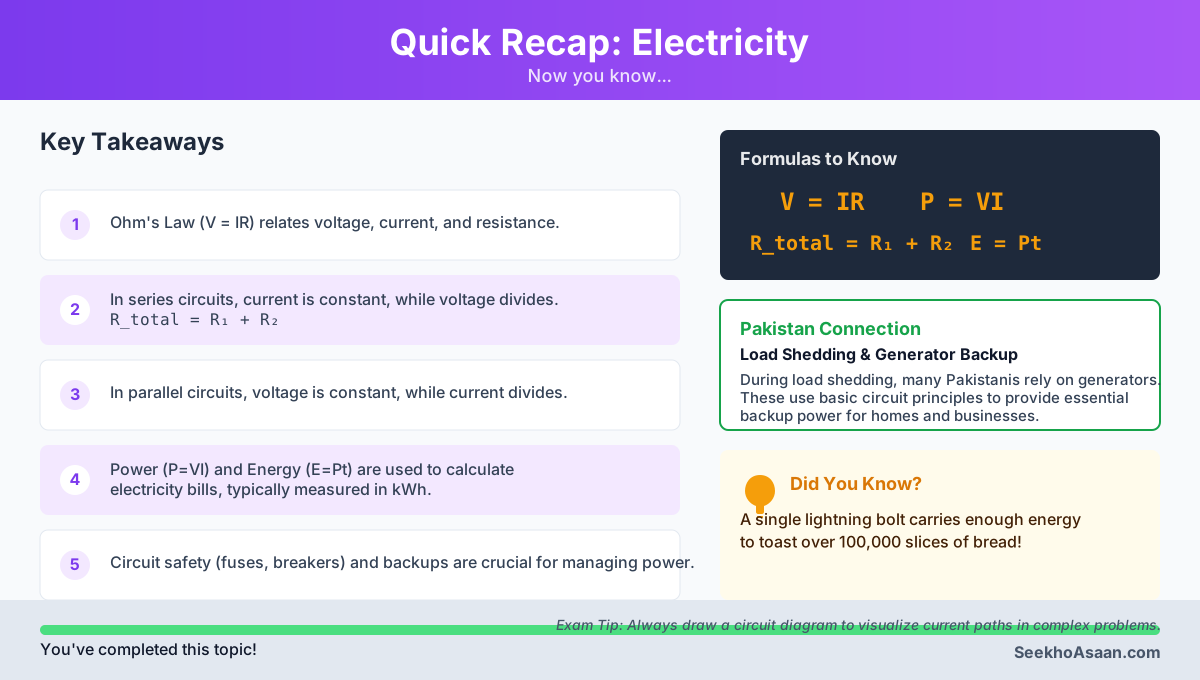
Quick revision infographic
Physics · Quick revision
Electricity
Key concepts
- 01Ohm's Law: V = IR
- 02Series: same current, voltage splits, R_total = R₁ + R₂
- 03Parallel: same voltage, current splits
- 04Power = VI, Energy = Pt, Bills in kWh
Formulas to know
When WAPDA cuts power (load shedding), many homes switch to generators. A typical home generator produces about 2-3 kW. If you run a 1500W AC, a 100W fan, and a 200W fridge (total 1800W), you're using 1.8 kW. Running this for 4 hours uses 1.8 × 4 = 7.2 kWh of energy. At K-Electric rates of about Rs 35/kWh, that costs Rs 252. But generator diesel for 4 hours might cost Rs 600+ — that's why load shedding is so expensive for families!
Test your knowledge.
31 explained questions. Har answer ke baad reasoning foran milegi.