Study path
Learn it, recall it, then prove it
Read the explanation and work through each example.
Close the notes and explain the main idea yourself.
Attempt the quiz, then revisit only missed concepts.
Stage 1 · Topic introduction video
Start with a quick definition, relevance, and learning outcomes before the full lesson.
Hook the learner with a simple definition, relevance, and learning outcomes. · 0:45 video · Beginning of the topic journey
Introduction & Core Concept
Assalam-o-Alaikum, my dear students of SeekhoAsaan. Join us on this fascinating journey into the heart of matter.
Imagine you are walking through the bustling Zainab Market in Karachi. You see a stall selling beautiful, deep blue Lapis Lazuli stones, mined from the majestic mountains of Badakhshan. Next to it, a vendor sells brilliant yellow sulphur powder, sourced from the dormant Koh-i-Sultan volcano in Balochistan. Why are these two substances so profoundly different? One is a hard, blue gemstone; the other is a brittle, yellow powder. The answer lies in their fundamental building blocks: their atoms.
The Lapis stone's colour comes from atoms of sulphur, sodium, and aluminium arranged in a specific way. The yellow powder is made only of sulphur atoms. Everything in our universe—from the water in the Indus River to the steel in the Minar-e-Pakistan, to the very air we breathe in Lahore—is constructed from about 100 different types of these fundamental particles called elements.
Why does this topic matter so much? Because understanding the atom is the key that unlocks all of chemistry. It’s like learning the Urdu alphabet before you can read the poetry of Allama Iqbal. Once you understand how an atom is structured, you will understand:
- Why some elements are metals and others are not.
- Why salt dissolves in water but oil does not.
- How a battery in your phone generates electricity.
- Why a pressure cooker cooks daal faster.
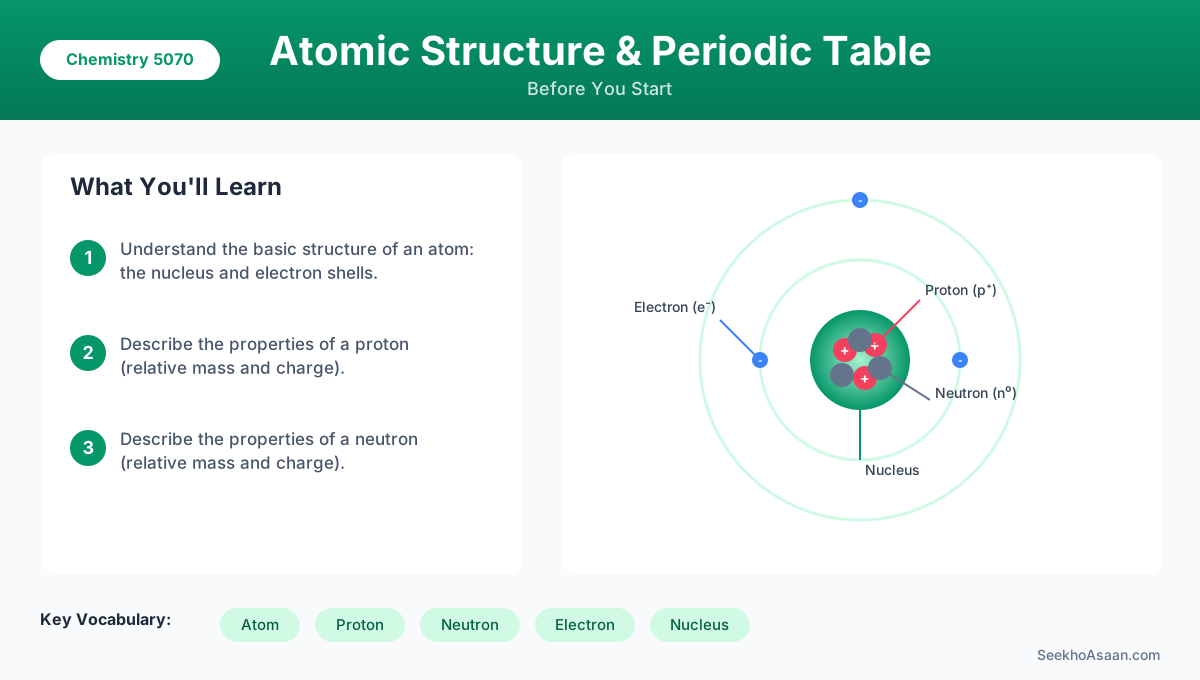
The Big-Picture Mental Model: Think of an atom as a tiny, bustling solar system. In the centre is a dense, heavy Sun, which we call the nucleus. This nucleus contains two types of particles: positively charged protons and neutral neutrons. Orbiting this nucleus, like planets, are tiny, negatively charged electrons. They don't just wander aimlessly; they are confined to specific orbits or paths called electron shells.
The master-plan for all these atomic solar systems is the Periodic Table. Think of it as a grand, perfectly organized library for every element in the universe. Each element has its own specific address (its position on the table) that tells you everything you need to know about its character and how it will behave.
In this lesson, we will dissect this "solar system," learn the language of its components, and then learn how to read the "library map" of the Periodic Table to predict the behaviour of any element.
Theoretical Foundation
Let's begin our deep dive. We'll build our understanding brick by brick, ensuring every concept is crystal clear.
The Subatomic Particles: A Closer Look
As we said, the atom is not the smallest thing there is. It is a composite object, made of three key players: protons, neutrons, and electrons. Their properties are the foundation of everything that follows.
| Particle | Relative Mass (amu) | Relative Charge | Location in Atom | Role & Significance |
|---|---|---|---|---|
| Proton (p) | 1 | +1 | Nucleus | The Atom's Identity Card. The number of protons is unique to each element. 1 proton is always Hydrogen. 8 protons is always Oxygen. Change the number of protons, and you change the element itself. |
| Neutron (n) | 1 | 0 | Nucleus | The Stabiliser. Neutrons add mass but no charge. They act like a buffer, helping to hold the positively charged protons together in the nucleus (as like charges repel). The number of neutrons can vary for an element, leading to isotopes. |
| Electron (e⁻) | ~1/1840 (negligible) | -1 | Shells/Orbitals | The Agent of Chemical Reactions. Electrons are on the "outside" of the atom. It is their movement—being lost, gained, or shared—that constitutes a chemical bond and a chemical reaction. Their mass is so small that we consider it to be zero for most O Level calculations. |
An atom in its natural state is electrically neutral. This is a crucial concept. It means the number of positive charges must exactly balance the number of negative charges. Therefore, for any neutral atom: Number of Protons = Number of Electrons
Defining an Atom: The Two Key Numbers
Every element in the Periodic Table is defined by two numbers. Understanding them is non-negotiable.
- Proton Number (Z) (also called the Atomic Number)
- This is the number of protons in the nucleus of an atom.
- It is the fundamental identifier of an element. For example, any atom with
Z = 6is a Carbon atom, period. - In the Periodic Table, elements are arranged in order of increasing proton number.
- Nucleon Number (A) (also called the Mass Number)
- This is the total count of particles inside the nucleus. The particles in the nucleus are protons and neutrons, which are collectively called nucleons.
- Therefore,
A = (Number of Protons) + (Number of Neutrons). - Why is it called the Mass Number? Because the protons and neutrons contain virtually all the mass of the atom. The electrons are too light to contribute significantly. So,
Agives us the relative mass of that specific atom.
From these two definitions, we can derive a simple but powerful formula to find the number of neutrons: Number of Neutrons = Nucleon Number (A) - Proton Number (Z)
Think about it logically: If A is the total of protons and neutrons, and Z is just the protons, then subtracting Z from A must leave you with just the neutrons.
Isotopes: The Same, But Different
Let's consider the element Chlorine (Cl). If you look it up, you'll find its proton number Z is 17. This is fixed. Every chlorine atom in the universe has 17 protons. However, nature has two common versions of chlorine atoms.
- Chlorine-35: Has 17 protons and
35 - 17 = 18neutrons. - Chlorine-37: Has 17 protons and
37 - 17 = 20neutrons.
These two forms of chlorine are called isotopes.
Definition: Isotopes are atoms of the same element (meaning they have the same number of protons) but with a different number of neutrons (and therefore a different nucleon number).
Key Properties of Isotopes:
- Identical Chemical Properties: Why? Because chemical reactions are all about electrons. Since isotopes of an element have the same number of protons, they must also have the same number of electrons to remain neutral. With the same electron arrangement, they react in exactly the same way. Chlorine-35 and Chlorine-37 will both react with sodium to form sodium chloride.
- Different Physical Properties: Why? Because physical properties like mass, density, and rate of diffusion depend on the mass of the atom. Since Chlorine-37 is heavier than Chlorine-35, it will be slightly denser and diffuse more slowly. These differences are often small but measurable.
Another famous example is Hydrogen (Z=1):
- Protium (¹H): 1 proton, 0 neutrons. (The most common form)
- Deuterium (²H): 1 proton, 1 neutron. (Heavy water, used in nuclear reactors)
- Tritium (³H): 1 proton, 2 neutrons. (Radioactive)
Electron Configuration: The Architecture of Reactivity
Electrons do not orbit the nucleus randomly. They are organized into distinct energy levels or electron shells.
The Rules of Arrangement:
- Shells have names: The shells are numbered 1, 2, 3, ... starting from the one closest to the nucleus. They are sometimes also referred to by letters: K, L, M, N... where K is the first shell (n=1).
- Lowest energy first: Electrons fill the shells starting from the one closest to the nucleus (the lowest energy level) and working outwards. You can't start filling the 3rd shell if the 2nd one is not full.
- Shell capacity: Each shell can only hold a certain maximum number of electrons.
- The 1st shell (K) can hold a maximum of 2 electrons.
- The 2nd shell (L) can hold a maximum of 8 electrons.
- The 3rd shell (M) can hold a maximum of 18 electrons. (For O Level purposes, we often treat it as holding 8 before the 4th shell begins to fill, a simplification that works for the first 20 elements).
The arrangement of electrons in these shells is called the electron configuration. We write it as a series of numbers separated by commas or periods. For example, a Sodium atom (Na) has 11 protons, and therefore 11 electrons. Its configuration would be:
- 2 electrons in the 1st shell.
- 8 electrons in the 2nd shell.
- 1 remaining electron in the 3rd shell.
So, we write the electron configuration of Sodium as 2, 8, 1.
Valence Electrons: The Stars of the Show
The electrons in the outermost, highest-energy shell are called valence electrons. In the case of Sodium (2,8,1), there is 1 valence electron.
Why are they so important? The goal of every atom (except the Noble Gases) is to achieve a full outer shell of electrons, as this is a very stable, low-energy state (the 'octet rule'). Atoms achieve this by losing, gaining, or sharing their valence electrons. Therefore, the number of valence electrons determines almost all of an element's chemical properties.
The Periodic Table: The Grand Design
The Periodic Table, developed by Dmitri Mendeleev, is a masterpiece of scientific organization. It arranges elements by increasing proton number, but its true genius lies in its structure.
- Periods (Horizontal Rows):
- There are 7 periods.
- The period number tells you how many electron shells an atom of that element has occupied.
- For example, Sodium (2,8,1) has electrons in 3 shells, so it is in Period 3. Potassium (2,8,8,1) has electrons in 4 shells, so it is in Period 4.
- Groups (Vertical Columns):
- There are 8 main groups (I to VII, and Group 0 or VIII).
- The group number tells you the number of valence electrons an atom of that element has.
- For example, Sodium (2,8,1) has 1 valence electron, so it is in Group I. Magnesium (2,8,2) has 2 valence electrons, so it is in Group II. Chlorine (2,8,7) has 7 valence electrons, so it is in Group VII.
This is an incredibly powerful predictive tool! If I tell you an element is in Period 3, Group VI, you can immediately deduce:
- It has 3 electron shells.
- It has 6 valence electrons.
- Its electron configuration must be 2, 8, 6.
- This means it has a total of 2+8+6 = 16 electrons, and therefore 16 protons. The element with Z=16 is Sulphur (S). See how it all connects?
Periodic Trends: The Patterns of Behaviour
As you move across a period or down a group, properties change in a predictable way. The "why" behind these trends always comes back to two competing forces:
- Nuclear Charge: The pull of the positive protons in the nucleus on the negative electrons. More protons = stronger pull.
- Electron Shielding: Inner shell electrons "shield" the outer valence electrons from the full pull of the nucleus. More shells = more shielding = weaker pull on the outermost electrons.
Let's analyse the key trends:
- Atomic Radius (Size of the atom):
- Across a Period (Left to Right) → DECREASES.
- Why? As you move across, you are in the same shell, so the shielding effect is relatively constant. However, the number of protons (nuclear charge) is increasing. This stronger positive pull draws all the electron shells, including the outermost one, closer to the nucleus, making the atom smaller.
- Down a Group → INCREASES.
- Why? As you move down, you are adding a completely new electron shell for each period. This new shell is further from the nucleus. This effect of adding a new shell is much more significant than the increase in nuclear charge. The increased shielding from the inner shells also weakens the nucleus's pull on the outermost electron.
- Metallic Character:
- Metallic character is defined by the tendency of an element to lose electrons and form positive ions.
- Across a Period → DECREASES.
- Why? With increasing nuclear charge and no new shells, the nucleus holds onto its valence electrons more tightly. It becomes harder to lose them. So elements on the left (like Sodium) are very metallic, while elements on the right (like Chlorine) are non-metallic (they prefer to gain electrons).
- Down a Group → INCREASES.
- Why? As you go down, the valence electron is in a shell further from the nucleus and is better shielded. The nucleus's grip on it is weaker. Therefore, it is lost much more easily, making the element more metallic and more reactive. This is why Francium is the most metallic element.
Key Definitions & Formulae
- Proton Number (Z): The number of protons in the nucleus of an atom. It defines the element. (Also known as Atomic Number).
- Nucleon Number (A): The total number of protons and neutrons in the nucleus. (Also known as Mass Number).
- Isotopes: Atoms of the same element (same proton number, Z) with different numbers of neutrons (different nucleon number, A).
- Electron Configuration: The arrangement of electrons in their shells around the nucleus (e.g., 2,8,1 for Sodium).
- Valence Electrons: The electrons in the outermost occupied electron shell of an atom. They determine the chemical properties of the element.
- Formula for Number of Neutrons:
    `Number of Neutrons = Nucleon Number (A) – Proton Number (Z)`
    *   Where:
        *   `A` = Total particles in the nucleus (protons + neutrons)
        *   `Z` = Number of protons
Worked Examples
Example 1: The Basics of Aluminium
An atom of aluminium is represented by the symbol ²⁷₁₃Al. Deduce the number of protons, neutrons, and electrons in a neutral atom of aluminium and state its electronic configuration.
Working:
- Identify A and Z: The notation
ᴬᶻXalways has the Nucleon Number (A) at the top and the Proton Number (Z) at the bottom.
- Nucleon Number (A) = 27
- Proton Number (Z) = 13
- Calculate Protons (p): The proton number is Z.
- Number of protons = 13
- Calculate Electrons (e⁻): For a neutral atom, the number of electrons must equal the number of protons.
- Number of electrons = 13
- Calculate Neutrons (n): Use the formula
n = A - Z.
- Number of neutrons = 27 - 13 = 14
- Determine Electronic Configuration: We need to arrange the 13 electrons into shells according to the rules (2 in the first, 8 in the second, etc.).
- 1st shell: 2 electrons (13 - 2 = 11 remaining)
- 2nd shell: 8 electrons (11 - 8 = 3 remaining)
- 3rd shell: 3 electrons
- Electronic Configuration = 2, 8, 3
Final Answer:
- Protons: 13
- Neutrons: 14
- Electrons: 13
- Electronic Configuration: 2, 8, 3
Example 2: A Cricket Match in Lahore
The floodlights at the Gaddafi Stadium in Lahore use a special type of lamp that contains isotopes of sodium. One common, stable isotope is Sodium-23 (²³₁₁Na). However, a less common, radioactive isotope, Sodium-24, is sometimes used in research.
(a) Deduce the number of each subatomic particle in an atom of Sodium-24. (b) An ion of Sodium-23 is formed by losing one electron. State the number of subatomic particles in this ion.
Working (a) - Sodium-24 atom:
- Identify A and Z: The name "Sodium" tells us the element. From the periodic table (or the stable isotope
²³₁₁Na), we know Sodium's proton number (Z) is 11. The number "24" in "Sodium-24" refers to the Nucleon Number (A).
- A = 24
- Z = 11
- Calculate p, n, e:
- Protons = Z = 11
- Electrons = Protons (for a neutral atom) = 11
- Neutrons = A - Z = 24 - 11 = 13
Working (b) - Sodium-23 ion (Na⁺):
- Start with the neutral atom: For
²³₁₁Na:
- Protons = 11
- Neutrons = 23 - 11 = 12
- Electrons = 11
- Consider the change: The problem states the atom loses one electron to become an ion. The nucleus (protons and neutrons) is untouched in chemical reactions.
- Protons remain = 11
- Neutrons remain = 12
- Electrons = 11 (original) - 1 (lost) = 10
- The ion: This ion has 11 positive protons and only 10 negative electrons, giving it an overall charge of +1. We write it as Na⁺.
Final Answer: (a) For Sodium-24: 11 protons, 13 neutrons, 11 electrons. (b) For the Na⁺ ion: 11 protons, 12 neutrons, 10 electrons.
Example 3: WAPDA and Power Lines
WAPDA uses both copper (Cu) and aluminium (Al) for high-voltage electricity transmission lines across Pakistan. Both are good conductors. Let's compare an atom of Aluminium (Al, Period 3, Group III) with an atom of Silicon (Si, Period 3, Group IV). Explain which has a smaller atomic radius.
Working:
- Identify Positions: Both Al and Si are in Period 3. Aluminium is in Group III, and Silicon is in Group IV. This means Silicon is to the right of Aluminium in the same period.
- Recall the Trend: The trend for atomic radius across a period is that it decreases. Therefore, Silicon should be smaller than Aluminium.
- Explain the "Why": This is the most critical part for getting full marks. We must use the concepts of nuclear charge and shielding.
- State the common factor: Both Aluminium (Z=13) and Silicon (Z=14) are in Period 3, meaning they both have 3 electron shells. The number of inner shells shielding the valence electrons is the same for both.
- State the differing factor: A Silicon atom has 14 protons in its nucleus, while an Aluminium atom has only 13.
- Connect the factors: The higher nuclear charge of Silicon (+14) pulls all the electron shells, including the outer 3rd shell, more strongly towards the nucleus compared to the weaker pull of Aluminium's nucleus (+13).
- Conclusion: This stronger attraction in Silicon results in a smaller atomic radius.
Final Answer: Silicon has a smaller atomic radius than Aluminium. This is because both elements have the same number of electron shells (3), providing a similar shielding effect. However, Silicon has a greater nuclear charge (+14) compared to Aluminium (+13). This stronger electrostatic force of attraction pulls the electron shells more tightly towards the nucleus, reducing the atomic radius.
Visual Mental Models
- The Bohr Model Atom: This is your go-to mental image.
- Draw a central circle for the nucleus. Inside, write the number of protons and neutrons (e.g.,
11p, 12n). - Draw concentric circles around the nucleus for the electron shells.
- Fill the shells with electrons (using dots or crosses) from the inside out, following the 2, 8, 8... rule.
    **ASCII Example for Sodium (Na: 11p, 12n, 11e):**
          e
          |
    e-- )--e
      /   \
    ( 11p  ) ) 2e ) 8e ) 1e
    ( 12n  ) )    )    )
      \   /
    e-- )--e
          |
          e
    *Visualise this:* The single electron in the outermost shell is far from the nucleus, weakly held, and easy to lose. This is why Sodium is a reactive metal.
- The Periodic Table as a Country Map:
- Group I & II (West Coast): The "Alkali Metals" and "Alkaline Earth Metals." Highly reactive, eager to give away their electrons. Think of them as extremely generous port cities, always exporting goods (electrons).
- Transition Metals (Central Plains): The large block in the middle. The hardworking, versatile heartland. These are your typical metals like Iron, Copper, and Gold.
- The "Staircase" (Border Region): A diagonal line separating metals from non-metals. Elements on this border (like Silicon) are metalloids or semi-conductors, with properties of both. This is Pakistan's "Silicon Valley" region.
- Group VII (East Coast): The "Halogens." Highly reactive non-metals, desperate to grab one more electron. Think of them as aggressive import hubs.
- Group 0 (Noble Peninsula): A secluded, exclusive peninsula on the far right. The "Noble Gases." They have full outer shells, are perfectly stable, and refuse to trade (react) with anyone. They are chemically inert.
Common Mistakes & Misconceptions
- Confusing Nucleon Number (A) and Neutron Number:
- Mistake: "The top number (A) is the number of neutrons."
- Why it's Wrong:
Ais the Nucleon Number, which is the sum of Protons + Neutrons. You must subtract the Proton Number (Z) from it to find the neutrons. - Correct Thinking:
Ais the total mass.Zis the identity. Mass - Identity = Neutrons.
- Believing Isotopes have Different Chemical Properties:
- Mistake: "Because Chlorine-37 is heavier, it reacts differently from Chlorine-35."
- Why it's Wrong: Chemical reactions involve the valence electrons only. The nucleus is not involved. Since all isotopes of an element have the same number of protons, they have the same number of electrons and the same electron configuration.
- Correct Thinking: Same electron configuration = Same number of valence electrons = Same chemical properties.
- Mixing up Atomic Radius Trends:
- Mistake: "Atomic radius increases across a period because you are adding more electrons."
- Why it's Wrong: While you are adding electrons, you are also adding protons. Crucially, the electrons are being added to the same shell, not a new one. The effect of the stronger nuclear pull from the extra protons is dominant.
- Correct Thinking: Across a period: Same shell (shielding constant) + More protons (stronger pull) = Smaller atom.
- Incorrectly Filling Electron Shells:
- Mistake: Writing the configuration for Potassium (19 electrons) as 2, 8, 9.
- Why it's Wrong: The third shell can hold up to 18 electrons, but it is energetically more favourable for the 19th electron to start a new, fourth shell. For O Level Chemistry, the rule is that the outermost shell cannot contain more than 8 electrons.
- Correct Thinking: Fill the third shell up to 8, then put any remaining electrons into the fourth shell. So, Potassium is 2, 8, 8, 1.
- Thinking Protons can be Lost or Gained in Reactions:
- Mistake: "When sodium forms an ion, it loses a proton."
- Why it's Wrong: Losing a proton would change the element from Sodium (11p) to Neon (10p). This is a nuclear reaction, not a chemical one, and requires immense energy (like in a star or a nuclear reactor).
- Correct Thinking: Chemical reactions are only about the transfer or sharing of electrons. The nucleus is a spectator.
- Confusing Mass Number (A) and Relative Atomic Mass (Ar):
- Mistake: "The mass number of Chlorine is 35.5."
- Why it's Wrong: The mass number (Nucleon Number) for a single atom must be a whole number, as you can't have half a proton or neutron. The value 35.5 you see on the periodic table is the Relative Atomic Mass (Ar), which is the weighted average mass of all the naturally occurring isotopes of Chlorine.
- Correct Thinking: An individual Chlorine atom can be Cl-35 or Cl-37. The average mass of all the chlorine atoms in a sample is 35.5 because about 75% are Cl-35 and 25% are Cl-37.
Exam Technique & Mark Scheme Tips
Cambridge examiners are precise. You must be too. Here is how to think like an examiner.
- Master the Command Words:
- State/Name/Give: A short, sharp answer. No explanation needed. "State the charge of a proton." Answer: "+1".
- Describe: Tell the examiner what happens. "Describe the trend in atomic radius across Period 3." Answer: "The atomic radius decreases from left to right."
- Explain: Tell the examiner why it happens. This requires scientific reasoning. "Explain the trend in atomic radius across Period 3." This requires the full answer we gave in the worked example, mentioning nuclear charge and shielding. This is where the A* grades are won and lost.
- Calculate/Determine: Show your full working.
n = A - Z, then substitute the numbers, then give the final answer with units if required.
- The "Two-Part" Isotope Definition: To get both marks for defining an isotope, you MUST mention both parts:
- (1) Atoms of the same element / same number of protons.
- (2) Different number of neutrons / different nucleon number.
- Forgetting one part will cost you a mark, guaranteed.
- Explaining Reactivity Trends Down a Group: This is a classic high-mark question. A perfect answer for why Potassium is more reactive than Sodium (Group I) has a specific structure:
- "A potassium atom is larger than a sodium atom / has one more electron shell." (1 mark)
- "The outermost electron in potassium is further from the nucleus and experiences more shielding from the inner electron shells." (1 mark)
- "Therefore, the electrostatic force of attraction between the nucleus and the valence electron is weaker in potassium." (1 mark)
- "Less energy is required to remove this electron, making potassium more reactive." (1 mark)
- Hit these four points and you cannot be denied full marks.
- Drawing Atomic Structures: Use a key if you use dots and crosses (e.g.,
x = electron). Ensure you have the correct number of protons and neutrons written in the nucleus. Double-check your electron count in each shell. These are easy marks to get right.
- Examiner Traps:
- Ions vs. Atoms: Read the question carefully. Is it asking about a
Mgatom or aMg²⁺ion? The electron count will be different. - Isotopes of the same element: They might give you information for
¹²Cand ask a question about¹⁴C. Remember the proton and electron number is the same. Only the neutron number changes. - Deducing from Group/Period: They won't always give you the element name. They'll say "An element in Group VII and Period 3..." You must work backwards from this information to find the electron configuration (2,8,7) and then the proton number (17) to identify it as Chlorine.
Memory Tricks & Mnemonics
- P.A.N.I.C.
- Protons are Always Number one (they define the element).
- Neutrons are In the Centre (nucleus) and are neutral.
- APE MAN (for calculations):
- Atomic Number = Protons = Electrons
- Mass Number - Atomic Number = Neutrons
- The Periodic Table Rules:
- The Group number is the number of valence electrons. (Group VII has 7 valence electrons).
- The Period number is the number of electron Shells. (Period 3 has 3 shells).
- Visualising Reactivity (Metals): Think of a father (the nucleus) holding a balloon (the valence electron) on a string.
- Sodium (small atom): Short string. Father holds the balloon tightly.
- Caesium (large atom): Very long string. The balloon is far away, buffeted by wind (shielding). It's easy to snatch the balloon away. Caesium is more reactive because it loses its electron more easily.
Pakistan & Everyday Connections
- The Khewra Salt Mines: The magnificent salt formations in Khewra are made of Sodium Chloride (NaCl). This is a perfect illustration of periodic trends. Sodium (Na) is from Group I on the far left—a reactive metal desperate to lose one electron. Chlorine (Cl) is from Group VII on the far right—a reactive non-metal desperate to gain one electron. They are a perfect match! The sodium atom transfers its valence electron to the chlorine atom, forming the stable ionic compound we know as salt.
- Semiconductors and Islamabad's Tech Scene: You might have heard of "Silicon Valley" in the USA. Pakistan has its own growing tech industry, with software houses in cities like Islamabad and Lahore. The heart of every computer chip, every smartphone, every piece of modern electronics is the element Silicon (Si). Look at its position on the Periodic Table: Period 3, Group IV. It sits on the "staircase" between metals and non-metals. It's a metalloid. Its atomic structure (4 valence electrons) means it's not eager to lose electrons like a metal, nor desperate to gain them like a non-metal. This unique intermediate property allows it to act as a semiconductor, the foundation of all modern electronics.
- Neon Signs in a Karachi Bazaar: The bright, glowing signs you see lighting up Tariq Road or a food street in Karachi are often filled with Noble Gases. A sign glowing with a brilliant red-orange colour is filled with Neon (Ne) gas. Neon is in Group 0 (or VIII). Its electron configuration is 2, 8. It has a full outer shell. It is perfectly stable and unreactive. To make it glow, a high voltage of electricity is passed through the gas, which excites the electrons to higher energy levels. When they fall back down, they release that energy as the bright light we see. Its inertness means it won't react with the metal electrodes and the sign will last a long time.
Practice Problems
- (Bookwork/Definition)
    (a) Define the term *isotope*.
    (b) Carbon-12 (`¹²₆C`) and Carbon-14 (`¹⁴₆C`) are two isotopes of carbon. State one similarity and one difference in the structure of their atoms.

    *   **Answer Outline:** (a) Give the two-part definition. (b) Similarity: same number of protons/electrons. Difference: different number of neutrons (6 vs 8).
- (Calculation/Deduction)
    An ion of element Y has a charge of 2+. The ion has 18 electrons and 22 neutrons.
    (a) Deduce the number of protons in this ion.
    (b) State the Nucleon Number (A) of this isotope of Y.
    (c) Write the electronic configuration of a neutral *atom* of Y.

    *   **Answer Outline:** (a) A 2+ ion has 2 more protons than electrons. Protons = 18 + 2 = 20. (b) A = protons + neutrons = 20 + 22 = 42. (c) A neutral atom has 20 electrons. Configuration = 2, 8, 8, 2.
- (Application of Trends)
    Explain, in terms of atomic structure, why Fluorine (F) is more reactive than Iodine (I). Both elements are in Group VII of the Periodic Table.

    *   **Answer Outline:** This is the non-metal version of the reactivity trend. Fluorine is smaller, has fewer shells. The incoming electron is attracted more strongly by the nucleus due to less distance and less shielding. Therefore, Fluorine gains an electron more easily.
- (Problem Solving)
The table below shows information about four elements, represented by the letters Q, R, S, and T.
| Element | Proton Number | Nucleon Number |
|---|---|---|
| Q | 3 | 7 |
| R | 9 | 19 |
| S | 12 | 24 |
| T | 17 | 35 |
    (a) Which element is in Group VII of the Periodic Table?
    (b) Which two elements are in the same period?
    (c) Which element is an unreactive metal? Justify your answer. (Trick question!)

    *   **Answer Outline:** (a) Find electron configurations. R (2,7) and T (2,8,7) are in Group VII. (b) S (2,8,2) and T (2,8,7) both have 3 shells, so they are in Period 3. (c) There are no unreactive metals listed. Q (Lithium) and S (Magnesium) are both reactive metals from Groups I and II. A Noble Gas would be unreactive, but none are listed. This tests careful reading.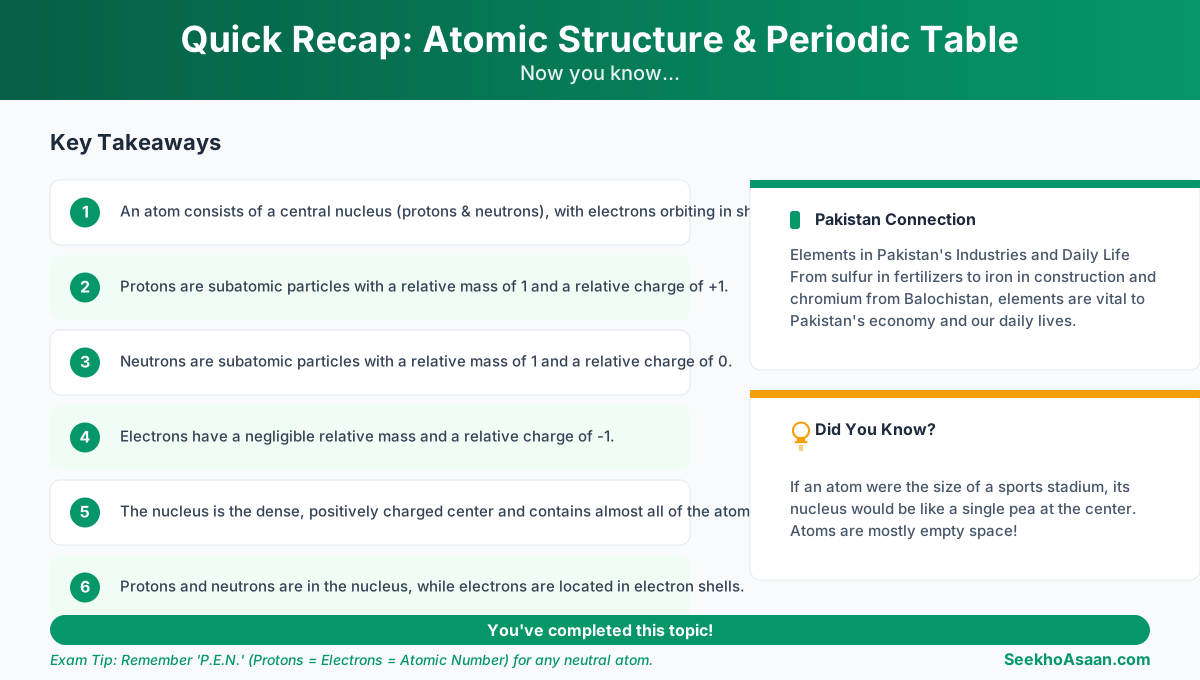
Quick revision infographic
Chemistry · Quick revision
Atomic Structure & Periodic Table
Key concepts
- 01An atom consists of a central nucleus containing protons and neutrons, with electrons orbiting the nucleus in shells.
- 02Protons are subatomic particles with a relative mass of 1 and a relative charge of +1.
- 03Neutrons are subatomic particles with a relative mass of 1 and a relative charge of 0.
- 04Electrons are subatomic particles with a negligible relative mass and a relative charge of -1.
- 05The nucleus is the dense, positively charged center of the atom and contains almost all of its mass.
- 06Protons and neutrons are located in the nucleus, while electrons are located in electron shells.
From the aluminum used in building structures in Islamabad to the chlorine purifying Karachi's water, and the natural gas (primarily methane, carbon and hydrogen) powering homes in Lahore, elements and their atomic properties are fundamental. Understanding their structure and position in the Periodic Table helps scientists and engineers select materials for various applications, ensure water safety, and even develop new technologies for a rapidly developing Pakistan.
Test your knowledge.
8 explained questions. Har answer ke baad reasoning foran milegi.