Study path
Learn it, recall it, then prove it
Read the explanation and work through each example.
Close the notes and explain the main idea yourself.
Attempt the quiz, then revisit only missed concepts.
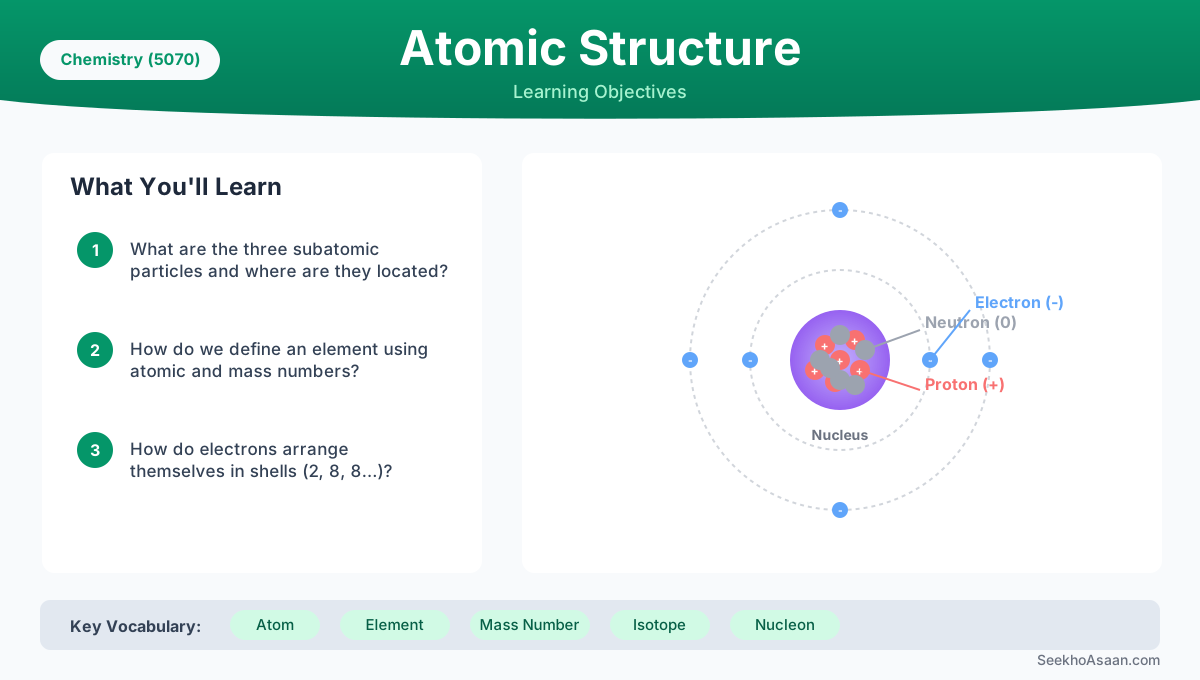
Introduction to the Atom
Atoms are the fundamental building blocks of all matter, from the air we breathe to the water we drink. While they are incredibly small (approximately 0.1 nanometres or 1 x 10⁻¹⁰ m in diameter), they are composed of even smaller subatomic particles. Understanding their structure is the key to understanding all of chemistry.
The Subatomic Particles
An atom consists of two main regions: a dense central nucleus and outer regions called electron shells or energy levels.
- The Nucleus: This is the tiny, dense core of the atom. It contains two types of particles:
- Protons (p⁺): These particles have a positive charge (+1) and a relative mass of approximately 1 atomic mass unit (amu).
- Neutrons (n⁰): These particles are neutral, having no charge (0), and have a relative mass almost identical to a proton, approximately 1 amu.
- Electron Shells: These are regions of space surrounding the nucleus where electrons are found.
- Electrons (e⁻): These particles have a negative charge (-1) and a very small mass, about 1/1840th of a proton. For O-Level calculations, their mass is often considered negligible.
| Particle | Location | Relative Charge | Relative Mass (amu) |
|---|---|---|---|
| Proton | Nucleus | +1 | 1 |
| Neutron | Nucleus | 0 | 1 |
| Electron | Shells | -1 | ~1/1840 (approx. 0) |
Defining Elements: Atomic and Mass Numbers
The identity of an element is determined solely by the number of protons in its nucleus.
- Atomic Number (Z): This is the number of protons in the nucleus of an atom. It is the unique identifier for each element. For example, any atom with 6 protons is a carbon atom (Z=6); any atom with 17 protons is a chlorine atom (Z=17).
- Mass Number (A): Also called the nucleon number, this is the total number of protons and neutrons in the nucleus. It represents the mass of that specific atom's nucleus.
We can use these numbers to find the composition of any atom:
- Number of Protons = Atomic Number (Z)
- Number of Neutrons = Mass Number (A) – Atomic Number (Z)
- Number of Electrons = Number of Protons (in a neutral atom)
Standard Notation: Elements are often represented as ᴬZX, where X is the element symbol. For example, a common form of carbon is ¹²₆C. From this, we can deduce:
- Protons (Z) = 6
- Electrons (in neutral atom) = 6
- Neutrons (A - Z) = 12 - 6 = 6
Electron Configuration
Electrons are arranged in shells around the nucleus. Each shell has a maximum capacity. For Cambridge O-Levels (elements 1-20), the filling rule is:
- 1st shell: holds a maximum of 2 electrons.
- 2nd shell: holds a maximum of 8 electrons.
- 3rd shell: holds a maximum of 8 electrons.
The arrangement of electrons is called the electron configuration. For example, for Sodium (Na), Z=11:
- Fill the 1st shell: 2 electrons (9 remaining)
- Fill the 2nd shell: 8 electrons (1 remaining)
- Place the rest in the 3rd shell: 1 electron
So, the electron configuration for Sodium is 2, 8, 1. The outermost shell is the valence shell, and the electrons in it are valence electrons. These determine the chemical reactivity of an element.
Ions: Charged Atoms
Atoms are neutral because the number of positive protons equals the number of negative electrons. However, atoms can gain or lose electrons to achieve a stable electron configuration (like a noble gas). When this happens, they become charged particles called ions.
- Cations (Positive Ions): Formed when metal atoms lose valence electrons. Example: A sodium atom (2,8,1) loses one electron to become a sodium ion, Na⁺, with a stable configuration of (2,8). It now has 11 protons but only 10 electrons, giving it a +1 charge.
- Anions (Negative Ions): Formed when non-metal atoms gain electrons. Example: A chlorine atom (2,8,7) gains one electron to become a chloride ion, Cl⁻, with a stable configuration of (2,8,8). It now has 17 protons and 18 electrons, giving it a -1 charge.
Isotopes: Variations of an Element
Isotopes are atoms of the same element that have the same number of protons but a different number of neutrons. This means they have the same Atomic Number (Z) but a different Mass Number (A).
For example, Chlorine (Z=17) exists mainly as two isotopes:
- Chlorine-35 (
³⁵₁₇Cl): 17 protons, 18 neutrons (35-17) - Chlorine-37 (
³⁷₁₇Cl): 17 protons, 20 neutrons (37-17)
Since isotopes have the same number of electrons arranged in the same configuration, they have identical chemical properties. However, their different masses give them slightly different physical properties, such as density and rates of diffusion.
Practical Applications of Isotopes:
- Carbon-14: Used in radiocarbon dating to determine the age of ancient organic artifacts, such as relics found at the Mohenjo-Daro archaeological site in Sindh.
- Cobalt-60: Emits gamma rays, used in radiotherapy to treat cancer and to sterilise medical equipment.
- Uranium-235: A fissile isotope used as fuel in nuclear power plants to generate electricity.
Common Exam Traps & Misconceptions:
- Mass Number vs. Relative Atomic Mass: Do not confuse the Mass Number (A), which is an integer for a single isotope, with the Relative Atomic Mass (Ar) on the periodic table, which is a weighted average of all isotopes and is often a decimal.
- Ions vs. Atoms: Always check if you are dealing with a neutral atom or an ion. For an ion, the number of electrons does not equal the number of protons.
- Isotope Properties: Remember, isotopes have the same chemical properties because chemical reactions involve electrons, which are identical in number and arrangement.

Quick revision infographic
Chemistry · Quick revision
Atomic Structure
Key concepts
- 01Protons (+), Neutrons (0) in nucleus; Electrons (-) in shells
- 02Atomic number = protons, Mass number = protons + neutrons
- 03Electron shells fill: 2, 8, 8...
- 04Isotopes: same protons, different neutrons
Formulas to know
Pakistan became a nuclear state in 1998 thanks to understanding atomic structure. Nuclear energy comes from the nucleus of uranium atoms. Uranium-235 (92 protons, 143 neutrons) can undergo fission — its nucleus splits into smaller atoms, releasing enormous energy. Dr. Abdul Qadeer Khan's work on isotope separation involved distinguishing Uranium-235 from Uranium-238 (same element, same 92 protons, but 238 has 3 extra neutrons). Isotopes have the same chemistry but different nuclear properties — this difference powers nuclear reactors at Karachi Nuclear Power Plant (KANUPP).
Test your knowledge.
29 explained questions. Har answer ke baad reasoning foran milegi.