Study path
Learn it, recall it, then prove it
Read the explanation and work through each example.
Close the notes and explain the main idea yourself.
Attempt the quiz, then revisit only missed concepts.

Acids, Bases, and Salts — Cambridge O Level Chemistry (5070)
1. Defining Acids, Bases, and Alkalis
The Arrhenius definitions used at O Level are:
- Acid: A substance that produces hydrogen ions (H⁺) when dissolved in water. Example: hydrochloric acid, HCl → H⁺ + Cl⁻.
- Base: A substance that neutralises an acid to form a salt and water only. Most bases are metal oxides or metal hydroxides.
- Alkali: A base that is soluble in water. Alkalis produce hydroxide ions (OH⁻) in solution. Example: sodium hydroxide, NaOH → Na⁺ + OH⁻.
Key distinction for Paper 2: Not all bases are alkalis. Copper(II) oxide is a base (it neutralises acids) but it is insoluble in water, so it is NOT an alkali.
2. The pH Scale
The pH scale runs from 0 to 14 and measures the concentration of H⁺ ions in solution.
| pH Range | Classification | Colour with Universal Indicator |
|---|---|---|
| 1–3 | Strong acid | Red/orange |
| 4–6 | Weak acid | Yellow/green |
| 7 | Neutral | Green |
| 8–10 | Weak alkali | Blue |
| 11–14 | Strong alkali | Violet/purple |
Universal Indicator is a mixture of indicators that shows a range of colours. It is used to estimate pH. A pH meter gives a more precise numerical reading.
Strong acids (HCl, H₂SO₄, HNO₃) fully dissociate in water — all the HCl molecules break into H⁺ and Cl⁻. Weak acids (ethanoic acid, citric acid) only partially dissociate.
3. Reactions of Acids
Acids react with several types of substances — you must know all four for 5070:
a) Acid + Metal (reactive metals only)
Acid + Metal → Salt + Hydrogen gas
- HCl + Mg → MgCl₂ + H₂↑
- H₂SO₄ + Zn → ZnSO₄ + H₂↑
- Test for hydrogen: burns with a squeaky pop (lighted splint)
b) Acid + Metal oxide (base)
Acid + Metal oxide → Salt + Water
- H₂SO₄ + CuO → CuSO₄ + H₂O
- HCl + Na₂O → NaCl + H₂O
c) Acid + Metal hydroxide (alkali)
Acid + Metal hydroxide → Salt + Water (neutralisation)
- HCl + NaOH → NaCl + H₂O
- H₂SO₄ + Ca(OH)₂ → CaSO₄ + 2H₂O
d) Acid + Metal carbonate
Acid + Metal carbonate → Salt + Water + Carbon dioxide gas
- HCl + CaCO₃ → CaCl₂ + H₂O + CO₂↑
- H₂SO₄ + Na₂CO₃ → Na₂SO₄ + H₂O + CO₂↑
- Test for CO₂: turns limewater milky
4. Naming Salts
Salts are formed when the hydrogen in an acid is replaced by a metal ion. The name follows a simple rule:
| Acid | Salt family | Example |
|---|---|---|
| Hydrochloric acid (HCl) | Chlorides | NaCl = sodium chloride |
| Sulphuric acid (H₂SO₄) | Sulphates | CuSO₄ = copper(II) sulphate |
| Nitric acid (HNO₃) | Nitrates | KNO₃ = potassium nitrate |
5. Preparation of Salts
The method used depends on whether the salt is soluble or insoluble.
Soluble salts from insoluble base/carbonate:
- Add excess solid base/carbonate to warm dilute acid until no more reacts (fizzing stops / solid remains).
- Filter off excess solid.
- Evaporate filtrate to concentrate solution.
- Leave to crystallise; dry crystals on filter paper.
Soluble salts from alkali (titration method):
- Use an indicator to find exact volumes of acid and alkali that neutralise each other.
- Repeat without indicator using the exact volumes.
- Evaporate to crystallise.
Insoluble salts (precipitation): Mix two solutions; the insoluble salt precipitates out. Example: Pb(NO₃)₂(aq) + 2KI(aq) → PbI₂(s) + 2KNO₃(aq)
6. Uses of Acids, Bases, and Salts in Daily Life
- Sulphuric acid (H₂SO₄): Car batteries, fertiliser production, making detergents.
- Hydrochloric acid: Cleaning metal surfaces (pickling), making PVC.
- Calcium hydroxide (slaked lime): Treating acidic soil in agriculture, water treatment.
- Sodium hydroxide: Soap making, paper manufacturing, drain cleaners.
- Sodium chloride (NaCl): Food preservation, cooking, making chlorine by electrolysis.
- Ammonium sulphate: Nitrogen fertiliser for crops.
- Calcium carbonate: Cement, glass making, neutralising acid soil.
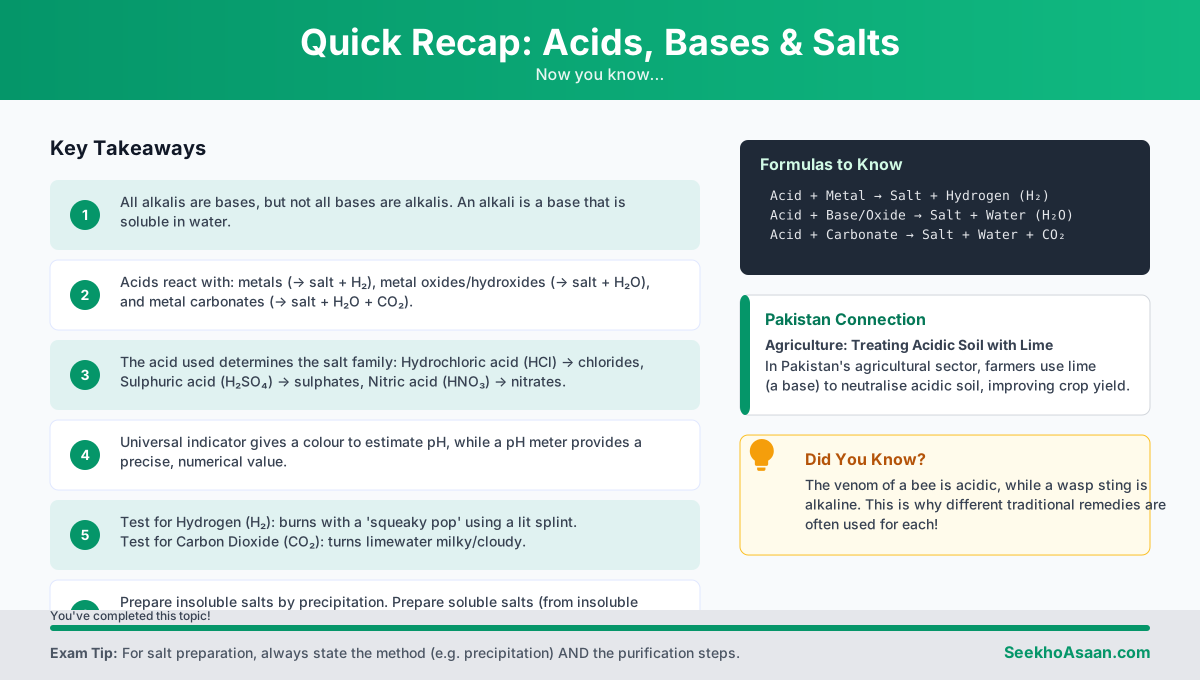
Quick revision infographic
Chemistry · Quick revision
Acids, Bases & Salts
Key concepts
- 01All alkalis are bases but not all bases are alkalis — bases that dissolve in water are alkalis.
- 02Acids react with metals (→ salt + H₂), metal oxides (→ salt + H₂O), metal hydroxides (→ salt + H₂O), and carbonates (→ salt + H₂O + CO₂).
- 03The acid used determines the salt family: HCl → chlorides, H₂SO₄ → sulphates, HNO₃ → nitrates.
- 04Universal indicator gives colour; pH meter gives precise numerical value.
- 05Test for H₂: burns with squeaky pop. Test for CO₂: turns limewater milky.
- 06Insoluble salts are made by precipitation (mixing two solutions); soluble salts from insoluble bases use excess solid + filter + evaporate + crystallise.
Formulas to know
Large parts of Pakistani farmland in Sindh, Punjab, and Khyber Pakhtunkhwa have either acidic or saline soil conditions. Farmers apply calcium hydroxide (slaked lime, Ca(OH)₂) to neutralise acid soil — this is a direct real-world application of acid-base chemistry. The lime reacts with acidic compounds in the soil, raising the pH and making it suitable for wheat, rice, and sugarcane. Calcium carbonate (limestone powder) is also applied as a slower-acting neutraliser. This links 5070 chemistry to Pakistan's largest industry: agriculture.
Test your knowledge.
30 explained questions. Har answer ke baad reasoning foran milegi.