Study path
Learn it, recall it, then prove it
Read the explanation and work through each example.
Close the notes and explain the main idea yourself.
Attempt the quiz, then revisit only missed concepts.
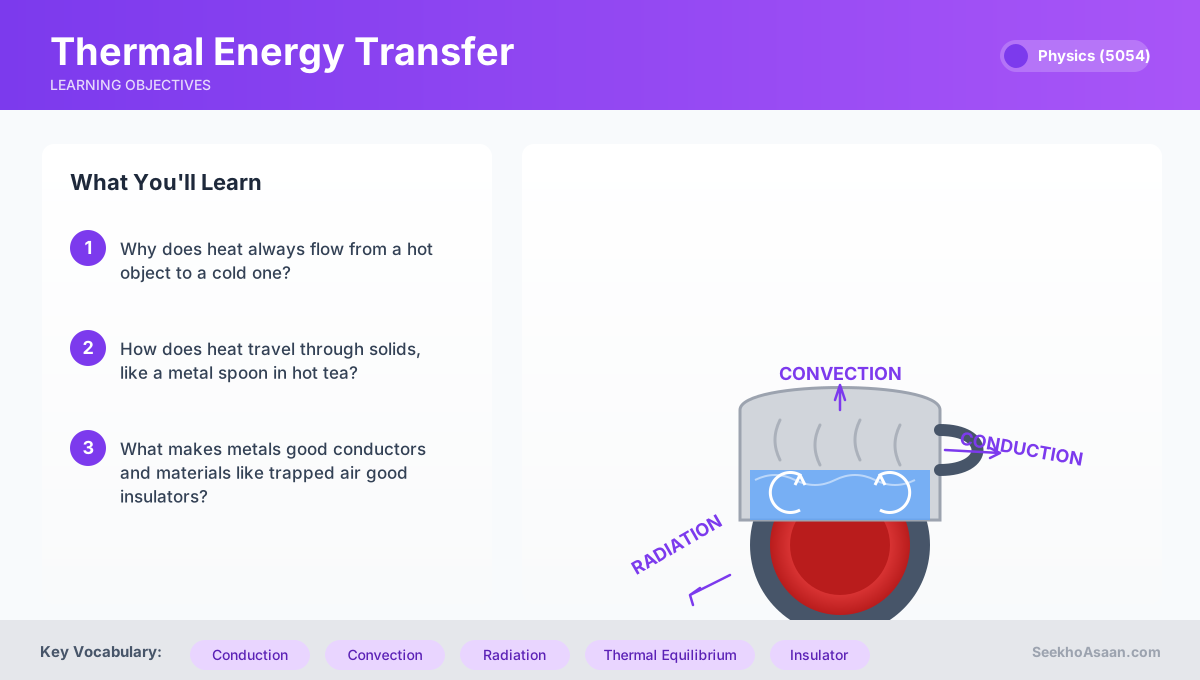
Introduction to Thermal Energy Transfer
Thermal energy, often simply called heat, is a fundamental concept in Physics that describes the internal energy of a substance associated with the random motion of its atoms and molecules. When we talk about thermal energy transfer, we are referring to the movement of this energy from a region of higher temperature to a region of lower temperature. This transfer naturally occurs until thermal equilibrium is reached, where both regions are at the same temperature.
Understanding how thermal energy moves is crucial for countless applications, from cooking food and insulating our homes to designing engines and even understanding global weather patterns. There are three primary ways by which thermal energy can be transferred:
- Conduction: Transfer through direct contact, mainly in solids.
- Convection: Transfer through the movement of fluids (liquids and gases).
- Radiation: Transfer through electromagnetic waves, even through a vacuum.
Let's dive into each of these methods in detail.
Conduction: Heat Transfer by Vibration and Free Electrons
Conduction is the process of thermal energy transfer through direct contact between particles, without the net movement of the medium itself. It is the primary method of heat transfer in solids, though it can also occur in liquids and gases.
Mechanism of Conduction
Imagine a solid material, like a metal rod. When one end of the rod is heated, the particles (atoms or molecules) at that end gain kinetic energy and start to vibrate more vigorously. These highly vibrating particles then collide with their less energetic neighbouring particles, transferring some of their kinetic energy to them. This process continues along the material, like a domino effect, transferring thermal energy from the hotter region to the colder region. The particles themselves do not move from their fixed positions, only their vibrational energy is passed along.
Role of Free Electrons in Metals
Metals are exceptionally good thermal conductors, much better than non-metals. This is primarily due to the presence of free electrons within their structure. In metals, some electrons are not bound to specific atoms but are free to move randomly throughout the metallic lattice. When a metal is heated:
- The atoms vibrate more vigorously, transferring energy as described above (lattice vibration).
- More importantly, the free electrons in the heated region gain kinetic energy. These highly energetic free electrons can then move rapidly through the metal, colliding with other electrons and vibrating atoms, and quickly transport thermal energy to cooler parts of the material. This electron movement is much faster and more efficient than energy transfer through lattice vibrations alone.
This dual mechanism (vibrating atoms and mobile free electrons) makes metals like copper, aluminium, and steel excellent conductors of heat.
Thermal Conductors and Insulators
- Thermal Conductors: Materials that allow thermal energy to transfer through them easily and quickly. Metals are the best conductors due to free electrons. Examples include copper, aluminium, iron, steel.
- Thermal Insulators: Materials that resist the flow of thermal energy, meaning they transfer heat slowly. These materials typically have few or no free electrons and their particles are less effectively linked for vibration transfer. Examples include wood, plastic, glass, rubber, wool, Styrofoam, and most importantly, air when it is trapped.
Trapped air is an excellent insulator because its particles are far apart, reducing the frequency of collisions needed for conduction. This principle is used in materials like wool (which traps air between its fibres), double-glazed windows (trapped air or argon gas between panes), and cavity wall insulation in buildings.
Applications of Conduction
- Cooking Utensils: Frying pans, saucepans, and karahis are made of metals like aluminium or steel to conduct heat efficiently from the stove to the food. Their handles are often made of plastic or wood, which are insulators, to protect hands.
- Heat Sinks: In electronics, metal heat sinks are used to conduct heat away from hot components (like microprocessors) to prevent overheating.
- Insulation in Buildings: Trapped air in materials like rock wool or fibreglass in loft insulation, or in double-glazed windows, reduces heat loss or gain by conduction (and convection).
Factors Affecting the Rate of Conduction
The rate at which thermal energy is conducted through a material depends on several factors:
- Nature of the Material: Good conductors transfer heat faster than poor conductors (insulators). This is quantified by the material's thermal conductivity.
- Cross-sectional Area (
A): A larger cross-sectional area allows more particles to transfer energy simultaneously, increasing the rate of heat transfer. The rate is directly proportional to the area. - Length/Thickness (
L): A shorter length or thinner material allows heat to travel a shorter distance, increasing the rate of transfer. The rate is inversely proportional to the length. - Temperature Difference (
ΔT): A larger temperature difference between the hot and cold ends drives a faster rate of heat transfer. The rate is directly proportional to the temperature difference.
Worked Example 1 (Conduction - Pakistani Context)
Question: A cook in a dhaba (roadside restaurant) in Peshawar is using a thick-bottomed aluminium karahi (wok) to prepare chapli kebabs. The pan has a uniform thickness of 4 mm and a base area of 0.05 m². If the bottom of the karahi (in contact with the flame) is at 200 °C and the oil in contact with the kebabs is at 180 °C, describe how heat is transferred through the karahi's base and explain why aluminium is a good choice for this cooking vessel.
Solution:
- Method of Heat Transfer: Heat is transferred through the aluminium base of the karahi primarily by conduction.
- Mechanism: The part of the karahi directly exposed to the flame heats up to 200 °C. The atoms in this region gain kinetic energy and vibrate intensely. Being a metal, aluminium also has a large number of free electrons. These free electrons at the hotter end gain significant kinetic energy and move rapidly, colliding frequently with other electrons and the vibrating atoms throughout the aluminium lattice. This allows for a very efficient and swift transfer of thermal energy from the hotter region (200 °C) through the 4 mm thick base to the oil and kebabs at 180 °C.
- Why Aluminium is a Good Choice: Aluminium is an excellent thermal conductor due to its mobile free electrons. This property ensures that heat from the stove is quickly and evenly distributed across the entire base and sides of the karahi. This even heat distribution is crucial for cooking chapli kebabs uniformly, preventing scorching in one area while others remain undercooked. If a poor conductor were used, heat would concentrate unevenly, leading to inconsistent cooking results.
Convection: Heat Transfer by Fluid Movement
Convection is the transfer of thermal energy within fluids (liquids and gases) through the actual movement of the heated particles themselves. Unlike conduction, convection involves the bulk movement of the medium.
Mechanism of Convection
Convection relies on density differences caused by temperature variations within a fluid:
- When a fluid (e.g., air or water) is heated, the particles in the heated region gain kinetic energy, move faster, and spread further apart. This causes the heated fluid to expand.
- As the fluid expands, its volume increases while its mass remains the same. This makes the heated fluid less dense than the surrounding cooler fluid.
- Due to its lower density, the warmer fluid experiences an upward buoyant force and begins to rise. Simultaneously, cooler, denser fluid from the surrounding areas sinks down to take its place.
- This cooler fluid then gets heated, becomes less dense, and rises, while more cooler fluid sinks. This continuous cycle of rising hot fluid and sinking cold fluid creates a circulating pattern known as a convection current.
Convection cannot occur in solids because particles in solids are fixed in their positions and cannot move freely to form currents. It also requires the presence of gravity to create the density differences that drive the fluid movement.
Applications of Convection
- Boiling Water: When water in a kettle is heated from the bottom, the water at the base becomes hot, less dense, and rises. Cooler water from the top sinks to replace it, creating convection currents that heat all the water.
- Domestic Heating Systems: Radiators are typically placed near the floor. The air warmed by the radiator becomes less dense and rises, spreading heat throughout the room. Cooler air then sinks to be warmed, completing the convection cycle.
- Refrigerators and Freezers: The freezing compartment is usually located at the top. It cools the air, making it denser. This cold, dense air sinks, cooling the food below. Warmer, less dense air from the bottom rises to be cooled, maintaining circulation and keeping food fresh.
- Sea and Land Breezes: This is a classic example of natural convection on a large scale. During the day, land heats up faster than the sea. The air above the land becomes hot, less dense, and rises, creating a low-pressure area. Cooler, denser air from above the sea (high-pressure area) then flows inland to replace the rising hot air, creating a sea breeze. At night, land cools faster than the sea. The sea remains relatively warmer, so air above the sea rises, and cooler air from the land flows out to sea, creating a land breeze.
- Chimneys: Hot smoke and gases from a fire rise up the chimney due to convection, drawing in fresh air at the bottom to fuel the fire.
Factors Affecting the Rate of Convection
- Temperature Difference: A larger temperature difference between the hot and cold regions of the fluid leads to greater density differences, resulting in stronger convection currents and a faster rate of heat transfer.
- Fluid Properties: The rate of convection depends on the fluid's viscosity (how easily it flows), specific heat capacity, and how its density changes with temperature.
Worked Example 2 (Convection - Pakistani Context)
Question: During a particularly hot summer day in Lahore, a family decides to install a new air conditioner. They debate whether to place it high up on the wall or low near the floor for the most effective cooling. Advise them on the best placement for effective cooling and explain your reasoning using principles of thermal energy transfer.
Solution:
- Best Placement: The air conditioner should be installed high up on the wall.
- Reasoning (Convection): Air conditioners work by releasing cool air. When the unit is placed high on the wall, it discharges this cool air. Cool air is denser than the warmer air already present in the room. Due to this higher density, the cool air naturally sinks towards the floor, spreading across the room. As the cool air sinks, it displaces the warmer, less dense air in the lower parts of the room, forcing this warm air to rise towards the ceiling. This rising warm air is then drawn into the air conditioner unit, cooled, and the cycle repeats. This continuous circulation of air, driven by density differences, establishes an efficient convection current that effectively cools the entire room. If the air conditioner were placed low, the cool air would tend to stay near the floor, and it would be much harder for the warmer air from the upper parts of the room to rise and be drawn into the unit, leading to inefficient and uneven cooling.
Radiation: Heat Transfer by Electromagnetic Waves
Radiation is the transfer of thermal energy through electromagnetic waves. Unlike conduction and convection, radiation does not require a material medium to transfer heat and can travel through a vacuum. This is how we receive heat from the Sun across the vast emptiness of space.
Mechanism of Radiation
All objects above absolute zero temperature (0 Kelvin or -273.15 °C) continuously emit and absorb thermal radiation. This radiation is primarily in the infrared region of the electromagnetic spectrum, although very hot objects can also emit visible light (e.g., a glowing filament in a bulb) or even ultraviolet radiation. When these electromagnetic waves strike an object, they can be absorbed, reflected, or transmitted.
- Emission: An object radiates thermal energy due to the vibration and oscillation of its constituent atoms and molecules. The hotter an object is, the more thermal radiation it emits.
- Absorption: When thermal radiation falls on an object, some of it is absorbed, increasing the object's internal energy and temperature.
- Reflection: Some of the incident radiation can be reflected away from the object.
Surface Properties and Radiation
The ability of a surface to emit, absorb, or reflect thermal radiation depends heavily on its characteristics, particularly its colour and texture:
- Dull, Dark (or Black) Surfaces: These are excellent absorbers and excellent emitters of thermal radiation. They absorb most of the radiation incident on them and also radiate a lot of heat when hot.
- Shiny, Light (or White) Surfaces: These are poor absorbers and poor emitters of thermal radiation. Instead, they are excellent reflectors of radiation. They reflect most of the radiation that falls on them and radiate very little heat when hot.
Applications of Radiation
- Thermos Flasks: These use several principles to minimise heat transfer. The inner surfaces are silvered and shiny to reduce heat transfer by radiation. A vacuum between the double walls prevents conduction and convection, while the stopper prevents convection.
- Solar Water Heaters: The collector panels of solar water heaters are often painted dull black. This ensures maximum absorption of solar radiation, efficiently heating the water inside.
- Firefighters' Suits: The outer layers of these suits are often shiny silver. This reflective surface minimises the absorption of intense thermal radiation from fires, protecting the firefighter.
- Car Radiators: These are typically painted black to efficiently radiate heat from the engine coolant into the surrounding air.
- Cooking Ovens: Ovens heat food partly by radiation from the hot walls and elements, in addition to convection from circulating hot air.
- Greenhouse Effect: The Earth's surface absorbs solar radiation and re-emits it as infrared radiation. Certain gases in the atmosphere (like carbon dioxide and water vapour) absorb this infrared radiation and re-radiate it, warming the planet.
Factors Affecting the Rate of Radiation
- Surface Temperature: The rate of thermal radiation emission increases dramatically with an increase in an object's surface temperature. Hotter objects radiate much more energy.
- Surface Area (
A): A larger surface area allows more radiation to be emitted or absorbed. The rate is directly proportional to the surface area. - Surface Colour and Texture: Dull, dark surfaces emit and absorb more radiation than shiny, light surfaces. Rough surfaces tend to radiate/absorb more effectively than smooth ones.
- Nature of the Surface (Emissivity): This is a property of the material's surface itself, indicating how effectively it radiates energy compared to a perfect emitter.
Worked Example 3 (Radiation - Pakistani Context)
Question: On a particularly bright and hot afternoon during a cricket match in Multan, you notice that some cricketers prefer to wear light-coloured uniforms, while others wear dark colours. Explain, with reference to thermal energy transfer, why wearing light-coloured clothing would be more advantageous for staying cool in the intense heat.
Solution:
- Method of Heat Transfer: The most significant source of heat from the sun on a bright day is thermal radiation, primarily in the form of infrared and visible light.
- Explanation of Colour Choice:
- Light-coloured (e.g., white) and shiny surfaces are poor absorbers of thermal radiation but excellent reflectors. When the intense solar radiation falls upon light-coloured clothing, a substantial portion of this radiation is reflected away from the cricketer's body. This minimises the amount of thermal energy absorbed by the uniform and subsequently transferred to the player's body.
- In contrast, dark-coloured surfaces are excellent absorbers of thermal radiation. If a cricketer wears a dark uniform, it will absorb a large amount of the sun's energy, converting it into internal energy and significantly increasing the temperature of the uniform and, by extension, the player's body. This would make the player feel much hotter and contribute to quicker dehydration.
Therefore, wearing light-coloured clothing is highly advantageous for staying cool in Multan's intense heat, as it effectively reduces heat gain through radiation by reflecting the sun's energy.
Comparing Conduction, Convection, and Radiation
Understanding the distinct characteristics of each method of thermal energy transfer is vital. Here's a summary of their key differences:
| Feature | Conduction | Convection | Radiation |
|---|---|---|---|
| Mechanism | Vibration of particles and free electron movement. | Actual movement of heated fluid (liquid/gas) particles. | Electromagnetic waves (primarily infrared). |
| Medium Required? | Yes (solid, liquid, or gas). | Yes (liquid or gas). | No (can travel through a vacuum). |
| Speed | Generally slow (except in metals), depending on material. | Moderate, depends on fluid properties and temperature difference. | Fastest (at the speed of light), instantaneous effect. |
| Particle Movement? | No net movement of particles, just energy transfer. | Actual bulk movement of fluid particles. | No particle involvement in transfer itself. |
| Typical Medium | Solids | Liquids and gases | Vacuum, air, transparent materials |
Applications and Importance of Thermal Energy Transfer
The principles of thermal energy transfer are applied everywhere around us, impacting technology, environment, and daily life:
- Energy Efficiency and Insulation: In a country like Pakistan, where energy costs (e.g., WAPDA electricity) can be significant, effective insulation in homes and buildings is crucial. Double-glazed windows, cavity wall insulation, and insulated roofs prevent heat loss in winter (reducing heating bills) and heat gain in summer (reducing cooling bills). These techniques primarily rely on trapping air, a good insulator, to reduce conduction and convection, and using reflective surfaces to reduce radiation.
- Cooking and Food Preservation: From the metallic base of a pressure cooker (conduction) to the circulating hot air in a baking oven (convection) and the microwave's electromagnetic waves (radiation), heat transfer principles are fundamental to how we prepare food. Refrigerators and freezers use convection to keep food cool.
- Solar Energy: Pakistan has abundant sunshine. Solar water heaters and solar panels harness solar radiation (thermal and light energy) to provide hot water and electricity, respectively. Their dark, absorptive surfaces are designed to maximise heat absorption.
- Personal Comfort: Our choice of clothing depends heavily on thermal transfer. Woolen clothes trap air for insulation in winter, reducing heat loss by conduction and convection. Light-coloured clothes reflect radiation in summer to keep us cool.
- Industrial Processes: Heat exchangers, boilers, and cooling towers in industries all rely on controlling and directing thermal energy transfer for various processes.
By understanding these fundamental methods, we can design more efficient technologies, build better homes, and make informed decisions about energy use, contributing to a more sustainable future for Pakistan.
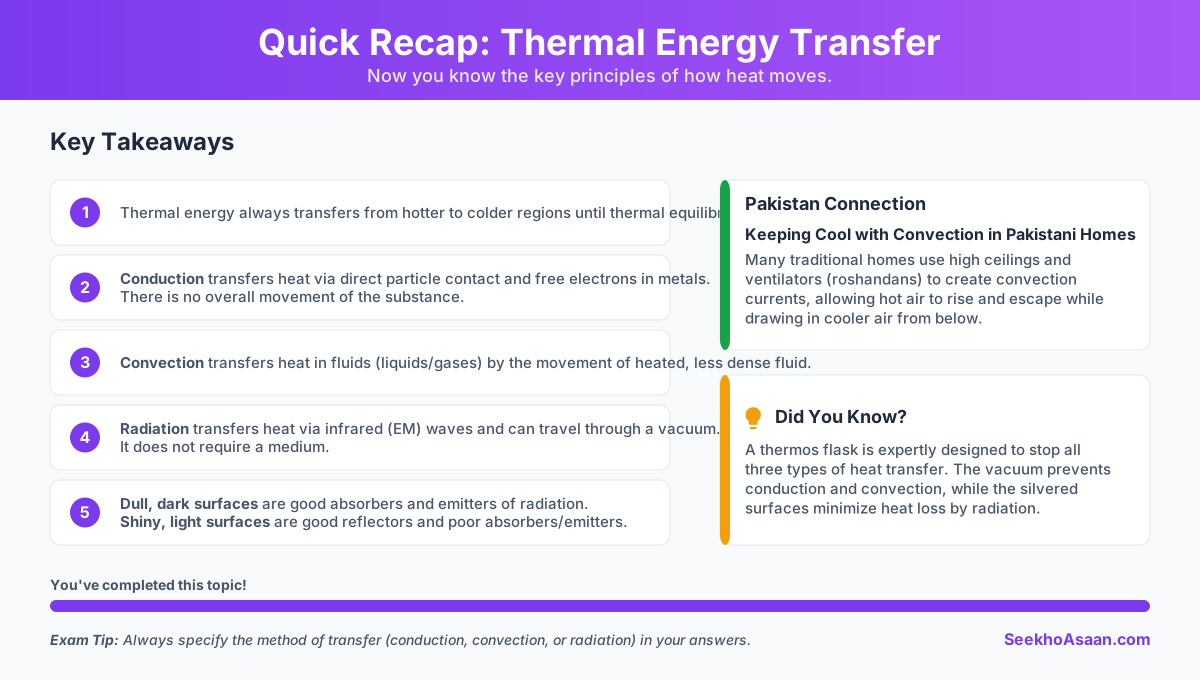
Quick revision infographic
Physics · Quick revision
Thermal Energy Transfer
Key concepts
- 01Thermal energy transfers from hotter to colder regions until thermal equilibrium is reached.
- 02Conduction transfers heat through direct particle contact and free electron movement (in metals), without bulk mass movement.
- 03Metals are excellent thermal conductors due to mobile free electrons; insulators like trapped air resist heat transfer.
- 04Convection transfers heat in fluids (liquids/gases) by the actual movement of heated, less dense fluid particles, forming convection currents.
- 05Radiation transfers heat via electromagnetic waves (infrared), requires no medium, and can travel through a vacuum.
- 06Dull, dark surfaces are excellent absorbers and emitters of thermal radiation; shiny, light surfaces are good reflectors and poor absorbers/emitters.
Many traditional and modern Pakistani homes, especially in hotter regions like Sindh and Punjab, incorporate architectural features like high ceilings and cross-ventilation. These designs leverage the principle of natural convection, allowing hot, less dense air to rise and escape, while cooler, denser air is drawn in from lower openings, naturally regulating indoor temperatures and reducing reliance on artificial cooling.
Test your knowledge.
8 explained questions. Har answer ke baad reasoning foran milegi.