Study path
Learn it, recall it, then prove it
Read the explanation and work through each example.
Close the notes and explain the main idea yourself.
Attempt the quiz, then revisit only missed concepts.

1. The Nature of Electric Charge
All matter is made of atoms, which contain positively charged protons, neutral neutrons, and negatively charged electrons. An object is electrically neutral when it has an equal number of protons and electrons. Static electricity is the study of the phenomena associated with electric charges at rest.
An object becomes charged when there is an imbalance of charge, which occurs when it either gains or loses electrons. Protons are fixed in the nucleus and are not transferred in static charging.
- Positive Charge: An object becomes positively charged when it loses electrons.
- Negative Charge: An object becomes negatively charged when it gains electrons.
The fundamental laws governing these charges are simple: like charges repel each other, and unlike charges attract each other. The SI unit for electric charge is the Coulomb (C).
2. Charging Processes
Materials are classified as conductors or insulators based on their ability to allow charge to flow. Conductors (like metals) have free-moving electrons, while insulators (like plastic, glass, and rubber) do not.
a) Charging by Friction (for Insulators): When two different insulating materials are rubbed together, friction can cause electrons to be transferred from one surface to the other. This process is known as the triboelectric effect. For example, rubbing a polythene rod with a woollen cloth causes electrons to move from the cloth to the rod. The polythene rod gains electrons and becomes negatively charged, while the woollen cloth loses an equal number of electrons and becomes positively charged. This demonstrates the principle of conservation of charge: charge is not created or destroyed, only transferred.
b) Charging by Induction (for Conductors): This method charges a conductor without any physical contact. The steps are as follows:
- Bring a charged object (e.g., a negative rod) near a neutral, insulated conductor (e.g., a metal sphere).
- The free electrons within the conductor are repelled by the negative rod and move to the far side of the sphere. This leaves the side of the sphere closer to the rod with a net positive charge. This separation of charges is called induced charge.
- While the rod is held in place, earth the sphere by connecting it to the ground with a wire. The repelled electrons now have a path to flow away from the sphere into the Earth, which acts as a vast reservoir of charge.
- Remove the earth connection first.
- Finally, remove the charged rod. The excess positive charge, which was held by the attraction of the rod, now spreads out evenly over the surface of the sphere, leaving it with a net positive charge.
3. Electric Fields
An electric field is a region of space around a charged object in which another electric charge will experience an electrostatic force. We can visualise these invisible fields using electric field lines.
Key properties of electric field lines:
- They show the direction of the force that would act on a small positive test charge placed in the field.
- Lines point away from positive charges and towards negative charges.
- The density of the lines (how close they are to each other) represents the strength of the electric field. Closer lines indicate a stronger field.
- Field lines never cross each other.
For an isolated point charge, the field lines radiate outwards (for positive) or inwards (for negative). Between two unlike charges, the lines curve from the positive to the negative charge. Between two like charges, the lines curve away from each other, showing repulsion.
4. Dangers and Applications of Static Electricity
The build-up of static charge can be both a hazard and a useful tool.
Dangers:
- Lightning: A dramatic example of electrostatic discharge. Friction between water droplets and ice crystals in clouds separates charges, creating a massive potential difference. When this difference is large enough, a huge current flows between the cloud and the ground, or between clouds.
- Fueling Hazards: Friction between fuel and a pipe during refueling of aircraft or cars can cause a large static charge to build up. A spark from this discharge can ignite the flammable fuel vapours. To prevent this, vehicles and nozzles are earthed to safely discharge any static build-up.
- Electric Shock: Walking across a synthetic carpet can charge your body. Touching a metal object, like a doorknob, allows the charge to discharge rapidly, causing a small, sharp shock.
Applications:
- Photocopiers: A light-sensitive drum is charged. An image of the document is projected onto it; light causes the charge to leak away from the illuminated areas. Negatively charged toner powder is attracted to the remaining charged areas, forming the image, which is then transferred to paper and fixed by heat.
- Electrostatic Precipitators: Used in factory chimneys to reduce air pollution. Smoke particles are given a charge and are then attracted to and collected on oppositely charged plates, preventing them from being released into the atmosphere.
- Paint Spraying: Car bodies are given a negative charge and the paint gun nozzle gives a positive charge to the paint droplets. The attraction ensures an even coat and reduces paint wastage as the droplets are drawn to the car's surface, even 'wrapping' around edges.
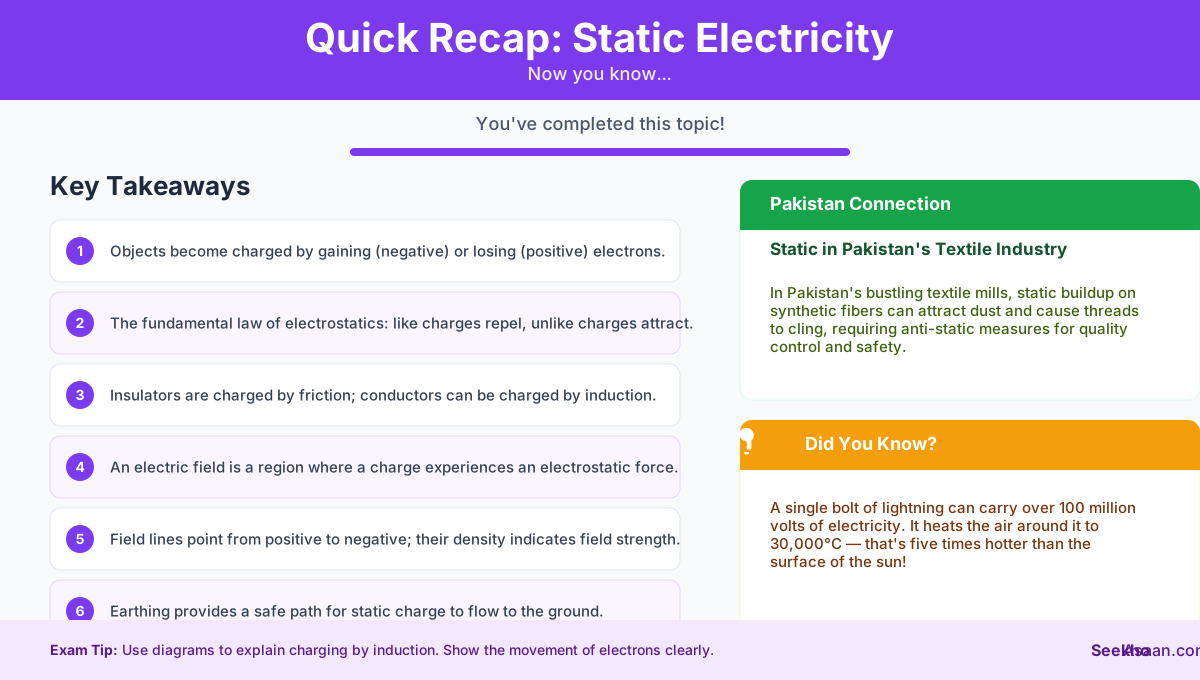
Quick revision infographic
Physics · Quick revision
Static Electricity
Key concepts
- 01Objects become electrically charged by gaining (negative) or losing (positive) electrons.
- 02The fundamental law of electrostatics is that like charges repel and unlike charges attract.
- 03Insulators are charged by friction, while conductors can be charged by induction.
- 04An electric field is a region where a charge experiences a force, visualized by field lines.
- 05Electric field lines point from positive to negative and their density indicates field strength.
- 06Earthing provides a path for static charge to flow safely to the ground, preventing dangerous sparks.
In Pakistan's large textile industry, the rapid movement and friction of threads and fabrics in spinning and weaving machines cause a significant build-up of static electricity. This static charge can cause problems like attracting dust and lint, which lowers fabric quality, and causing threads to repel each other, leading to breaks and production stops. It can also create an uncomfortable or even hazardous environment for workers due to electric shocks. In mills where fine dust is present, a static spark could potentially ignite the dust, posing a fire risk. To manage this, factories often use humidifiers to make the air more conductive, and install static eliminator bars that ionize the air to neutralize the charges on the materials.
Test your knowledge.
5 explained questions. Har answer ke baad reasoning foran milegi.