Study path
Learn it, recall it, then prove it
Read the explanation and work through each example.
Close the notes and explain the main idea yourself.
Attempt the quiz, then revisit only missed concepts.
Stage 1 · Topic introduction video
Start with a quick definition, relevance, and learning outcomes before the full lesson.
Hook the learner with a simple definition, relevance, and learning outcomes. · 0:51 video · Beginning of the topic journey

1. Introduction & Core Concept
Assalam-o-Alaikum, my dear students. Welcome to this SeekhoAsaan lesson.
Imagine you are travelling with your family on the M-2 Motorway from Lahore to Islamabad. Your father is driving, and your younger sibling asks, "Abbu, are we there yet?" Your father, glancing at the speedometer which reads 120 km/h, replies, "Insha'Allah, we will be there in about two more hours."
In that simple, everyday exchange, you have just witnessed the fundamental concepts of physics in action: speed (120 km/h), distance (the remaining journey to Islamabad), and time (two hours). This chapter is the very bedrock of kinematics — the branch of physics that describes motion.
Why is this important? It's not just about passing your Cambridge exams. Understanding the relationship between speed, distance, and time is crucial for everything from a pilot landing a PIA jet at Jinnah International Airport, to a civil engineer designing the route for the Karachi Metro Bus, to Shaheen Shah Afridi calculating his run-up to deliver a match-winning yorker.
Our mental model for this topic is simple: We are learning the language to describe how things move. We are not yet concerned with why they move (that's a topic called Dynamics, where we discuss forces, and we will get to it later). For now, we are observers, like commentators at a cricket match, describing the motion of the ball and the players with precision and clarity using the tools of distance, time, speed, and their graphical representations.
By the end of this lesson, you will not only be able to solve complex exam problems but will also see the world around you — from the bustling traffic in Anarkali Bazaar to the slow, majestic flow of the Indus River — through the sharp, analytical eyes of a physicist.
2. Theoretical Foundation
To master this topic, we must build our understanding brick by brick, ensuring our foundation is solid. Let's dissect the core ideas with the precision they deserve.
Distance vs. Displacement: The Anarkali Bazaar Problem
Imagine you are at the entrance of Anarkali Bazaar in Lahore. You walk 100 metres deep into the winding lanes to buy some khussas, and then you walk the same 100 metres back to the entrance to meet your family.
- Distance: This is the total path you have covered. You walked 100 m in and 100 m out. So, your total distance travelled is
100 m + 100 m = 200 m. Distance is a scalar quantity. A scalar only has magnitude (a size or number). It doesn't care about direction. It just adds up the entire length of the journey, no matter how many twists and turns you take.
- Displacement: This is the shortest straight-line distance from your starting point to your finishing point, in a specific direction. You started at the entrance and you finished at the entrance. Your final position is the same as your initial position. Therefore, your displacement is zero metres. Displacement is a vector quantity. A vector has both magnitude and direction. Since you ended up where you started, your overall change in position is zero.
Why does this distinction matter? Because it leads directly to our next crucial pair of concepts.
Speed vs. Velocity: The Motorway vs. The Racetrack
- Speed: This is how fast you are covering distance. It is the rate of change of distance. Since distance is a scalar, speed is also a scalar quantity. When your car's speedometer shows 120 km/h, it's telling you your speed. It doesn't tell you if you're going towards Islamabad or back to Lahore.
- Formula Derivation: The very definition, "distance per unit time," translates directly into the formula. If you travel a distance
din a timet, your speedvisv = d / t.
- Velocity: This is the rate of change of displacement. Since displacement is a vector, velocity is also a vector quantity. It tells you how fast you're going and in which direction. To state a velocity, you must give both a speed and a direction, for example, "120 km/h due North."
Consider a car on a circular racetrack travelling at a perfectly constant 150 km/h.
- Its speed is constant because the number on the speedometer isn't changing.
- Its velocity, however, is constantly changing. Why? Because its direction is always changing as it moves around the curve. A change in direction, even at a constant speed, is a change in velocity.
Average Speed vs. Instantaneous Speed
Let's go back to our M-2 Motorway trip. The total distance from the Lahore toll plaza to the Islamabad toll plaza is about 360 km. If the journey takes 3 hours, the average speed is calculated using the total journey. Average Speed = Total Distance / Total Time = 360 km / 3 h = 120 km/h.
However, during the journey, did the car stay at exactly 120 km/h? Of course not. Sometimes it slowed down to 100 km/h for a slower vehicle, sometimes it stopped for 15 minutes at the Bhera service area, and sometimes it might have touched 125 km/h. The speed shown on the speedometer at any given moment is the instantaneous speed — the speed at that precise instant in time.
The formula v = d / t is most accurately used for calculating average speed over a journey, or for situations where the speed is perfectly constant.
Acceleration: The Engine of Change
In the real world, objects rarely move at a constant velocity. They speed up, they slow down, they change direction. This change in velocity is what we call acceleration.
- Acceleration is the rate of change of velocity.
- Since velocity is a vector, acceleration is also a vector quantity.
You are accelerating if:
- You are speeding up (e.g., a Careem driver pressing the accelerator). This is positive acceleration.
- You are slowing down (e.g., applying the brakes as you approach a traffic signal). This is negative acceleration, also known as deceleration or retardation.
- You are changing direction (e.g., turning a corner, even at a constant speed).
- Formula Derivation: Acceleration is the change in velocity (
final velocity - initial velocity) divided by the time it takes for that change to happen.
    Let `u` be the initial velocity.
    Let `v` be the final velocity.
    Let `t` be the time taken for the change.
    The change in velocity is `v - u`.
    The rate of change is `(v - u) / t`.
    So, the formula for acceleration `a` is `a = (v - u) / t`.
An acceleration of 2 m/s² (metres per second squared) means that for every second that passes, the object's velocity increases by 2 m/s.
3. Key Definitions & Formulae
Here is a summary of the essential definitions and equations you must know. Treat this section as your reference sheet.
| Quantity | Symbol | Definition | Formula | SI Unit | Type |
|---|---|---|---|---|---|
| Distance | d | The total length of the path travelled. | - | metre (m) | Scalar |
| Displacement | s | The straight-line distance and direction from start to end. | - | metre (m) | Vector |
| Speed | v | The rate of change of distance. | v = d / t | metre/second (m/s) | Scalar |
| Velocity | v | The rate of change of displacement. | v = Δs / Δt | metre/second (m/s) | Vector |
| Average Speed | v_avg | The total distance divided by the total time taken. | v_avg = Total d / Total t | metre/second (m/s) | Scalar |
| Acceleration | a | The rate of change of velocity. | a = (v - u) / t | metre/second² (m/s²) | Vector |
Key Symbols:
d= distances= displacementt= timev= final speed/velocity (sometimes just speed/velocity if constant)u= initial speed/velocitya= accelerationΔ(Delta) = "change in"
Dimensional Analysis (A* Level Insight): Let's check if the units for acceleration make sense. a = (v - u) / t The units are: (m/s) / s This can be written as m/s × 1/s, which equals m/s². The units are consistent with the formula, which is a beautiful feature of physics.
Important Unit Conversions: To convert from km/h to m/s: Multiply by 1000 / 3600 (or simply divide by 3.6).
- Why? 1 km = 1000 m, and 1 hour = 3600 s.
To convert from m/s to km/h: Multiply by 3600 / 1000 (or simply multiply by 3.6).
4. Worked Examples
Theory is one thing; applying it is another. Let's solve some problems, showing every step as you should in your exam.
Example 1: A PIA Flight
A Pakistan International Airlines (PIA) flight travels the 2100 km distance from Karachi's Jinnah International Airport to Dubai. The flight takes 3 hours. Calculate its average speed in (a) km/h and (b) m/s.
Solution:
(a) Calculate average speed in km/h
- Step 1: Identify the knowns.
- Distance,
d = 2100 km - Time,
t = 3 h
- Step 2: State the formula.
- Average speed
v = d / t
- Step 3: Substitute the values.
v = 2100 km / 3 h
- Step 4: Calculate the answer with units.
v = 700 km/h
(b) Convert the speed to m/s
- Step 1: Recall the conversion factor.
- To convert km/h to m/s, we divide by 3.6 (or multiply by 1000/3600).
- Step 2: Apply the conversion.
v = 700 / 3.6
- Step 3: Calculate the final answer.
v ≈ 194.4 m/s- (In an exam, giving the answer to 2 or 3 significant figures is usually best, so 194 m/s would be perfect).
Example 2: A Rickshaw Journey in Lahore
A rickshaw driver, Bashir, takes a student from his home in Gulberg to his college in Garden Town. The journey has two parts:
- He travels the first 3 km in 10 minutes through heavy traffic.
- He then travels the next 5 km in 8 minutes on a clear road.
Calculate Bashir's average speed for the entire journey in km/h.
Solution:
- Step 1: Find the total distance travelled.
- Total Distance = Distance of part 1 + Distance of part 2
d_total = 3 km + 5 km = 8 km
- Step 2: Find the total time taken.
- Total Time = Time of part 1 + Time of part 2
t_total = 10 min + 8 min = 18 min
- Step 3: Convert the total time to hours (since we need the answer in km/h).
- There are 60 minutes in an hour.
t_total = 18 / 60 h = 0.3 h
- Step 4: State the formula for average speed.
- Average Speed = Total Distance / Total Time
- Step 5: Substitute the total values and calculate.
Average Speed = 8 km / 0.3 hAverage Speed ≈ 26.7 km/h
(Notice: We did NOT calculate the speed for each part and then average them. That is a common mistake and would give the wrong answer.)
Example 3: Interpreting a Distance-Time Graph
The graph below shows the journey of a girl, Sadia, walking from her home to a local dukaan (shop) and back.
(Imagine a graph with axes: y-axis is "Distance from home (m)" from 0 to 200. x-axis is "Time (s)" from 0 to 120.)
- A straight line from (0,0) to (40s, 200m).
- A horizontal line from (40s, 200m) to (60s, 200m).
- A straight line from (60s, 200m) back to (120s, 0m).
(a) Describe Sadia's motion between 40s and 60s.
(b) Calculate Sadia's speed on her way to the shop (0s to 40s).
(c) Calculate Sadia's speed on her way back home (60s to 120s).
Solution:
(a) Description of motion (40s to 60s):
- The line on the distance-time graph is horizontal. This means the distance from home is not changing.
- Therefore, Sadia is stationary or at rest. She is likely at the shop.
(b) Speed on the way to the shop (0s to 40s):
- On a distance-time graph, speed is the gradient.
Gradient = rise / run = (change in distance) / (change in time)Speed = (200 m - 0 m) / (40 s - 0 s)Speed = 200 / 40Speed = 5 m/s
(c) Speed on the way back home (60s to 120s):
- Again, speed is the gradient. We can ignore the negative sign for speed as it's a scalar, but the negative sign indicates the direction is back towards the start.
Speed = (change in distance) / (change in time)Speed = (200 m - 0 m) / (120 s - 60 s)(Note: we take the magnitude of distance change)Speed = 200 m / 60 sSpeed ≈ 3.33 m/s- Sadia walked slower on her way back.
5. Visual Mental Models
Your brain processes images far better than just text. Let's build some powerful visual models for motion graphs.
1. The Distance-Time Graph
Think of this graph as a story of a journey. The y-axis is "how far from the start," and the x-axis is "how long it took."
- The Gradient (Steepness) is SPEED.
- A steep line means high speed.
- A shallow line means low speed.
- A flat (horizontal) line means zero speed (the object is stationary).
  Distance |        /
           |       /  <-- Constant, fast speed
           |      /
           |     . . . .  <-- Stationary (at rest)
           |    /
           |   /   <-- Constant, slow speed
           |  /
           +------------------
                  Time
- A curved line means the speed is changing (acceleration).
- A curve getting steeper (like a
J) means speeding up (accelerating). - A curve getting flatter (like an
n) means slowing down (decelerating).
2. The Speed-Time (or Velocity-Time) Graph
This graph tells a different story. The y-axis is "how fast," and the x-axis is "how long."
- The Gradient is ACCELERATION.
- A line sloping up means positive acceleration (speeding up).
- A horizontal line means zero acceleration (constant speed).
- A line sloping down means negative acceleration (decelerating).
   Speed   |      /
           |     /   <-- Constant acceleration
           |    /
           | . . . .  <-- Constant speed (zero acceleration)
           |
           |        \
           |         \  <-- Constant deceleration
           +------------------
                  Time
- The Area Under the Graph is DISTANCE TRAVELLED.
- This is a profoundly important concept. To find the distance, you calculate the area between the line and the time axis.
- If the graph section is a rectangle:
Area = length × width = speed × time. - If the graph section is a triangle:
Area = ½ × base × height = ½ × time × (change in speed).
6. Common Mistakes & Misconceptions
Exams are designed to test true understanding, and they often do this by setting traps based on common errors. Let's disarm them.
- Mistake: Confusing distance-time and speed-time graphs.
- Why it's wrong: A horizontal line on a distance-time graph means stationary. A horizontal line on a speed-time graph means constant speed. This is perhaps the most common trap in the entire topic.
- Correct Thinking: Always read the y-axis label first! Ask yourself, "What does a flat line mean on this specific type of graph?"
- Mistake: Calculating average speed by averaging the speeds (
(v1 + v2) / 2).
- Why it's wrong: This only works in the very specific case where an object travels for an equal amount of time at two different speeds. Journeys are almost never this simple.
- Correct Thinking: The golden rule is unbreakable: Average Speed = TOTAL Distance / TOTAL Time. Always calculate the totals first, as we did in the Bashir the rickshaw driver example.
- Mistake: Forgetting to convert units.
- Why it's wrong: You cannot use
d = v × tifdis in km,vis in m/s, andtis in minutes. The units will be inconsistent and your answer will be meaningless. - Correct Thinking: Before any calculation, convert all quantities to a consistent set of units. The safest bet is always to convert to SI units: distance in metres (m), time in seconds (s), and speed in m/s.
- Mistake: Believing acceleration is only "speeding up."
- Why it's wrong: Acceleration is the rate of change of velocity. Since velocity is a vector, changing its magnitude (speed) OR its direction results in acceleration.
- Correct Thinking: Slowing down is a negative acceleration (deceleration). A satellite in a circular orbit around Earth may have a constant speed, but it is continuously accelerating because its direction is always changing.
- Mistake: Confusing "zero velocity" with "zero acceleration."
- Why it's wrong: If a car is stationary at a traffic light, its velocity is zero and its acceleration is zero. But, if you throw a cricket ball straight up in the air, at the very peak of its flight, its instantaneous velocity is zero, but its acceleration is still 9.8 m/s² downwards (due to gravity).
- Correct Thinking: Acceleration is about the change in velocity. At the peak, the ball's velocity is changing (from going up to going down), so it is accelerating.
- Mistake: Stating that speed is negative.
- Why it's wrong: Speed is a scalar quantity and cannot be negative. It only tells you "how fast." Velocity, being a vector, can be negative to indicate direction (e.g., +10 m/s for moving right, -10 m/s for moving left).
- Correct Thinking: If you calculate a gradient on a distance-time graph for a return journey, you might get a negative value. This represents the velocity. The speed is the positive magnitude of that value.
7. Exam Technique & Mark Scheme Tips
Let's think like a Cambridge examiner. What are they looking for? How can you secure every possible mark?
- Understand Command Words:
State: Write down a fact, formula, or definition. No explanation. E.g., "State the SI unit for acceleration." Answer: "m/s²". (1 mark)Describe: Give a step-by-step account. For a graph, talk about what happens in each section. E.g., "Describe the motion from A to B." Answer: "The object moves at a constant speed of 5 m/s."Explain: Give the "why". Use scientific principles. E.g., "Explain why the velocity is changing." Answer: "Because the object is changing direction, and velocity is a vector quantity that depends on both speed and direction."Calculate: This is your cue to show full working.
- The "FSAU" Method for Calculations:
    Examiners award marks for method, not just the final answer. A wrong answer with correct working can still earn most of the marks!
    *   **F**ormula: Write down the relevant equation (e.g., `v = d / t`). (1 mark)
    *   **S**ubstitution: Substitute the correct values from the question into the formula. (1 mark)
    *   **A**nswer: Write down the final calculated answer, usually to 2 or 3 significant figures. (1 mark)
    *   **U**nit: Always, always include the correct unit (e.g., m/s, km/h). (1 mark)
    Losing the unit mark on every calculation question can be the difference between an A and a B.
- Graph Skills are Crucial:
- Calculating Gradient: When asked to find the gradient, draw a large triangle on the graph itself. Choose two points on the line that are as far apart as possible. This minimizes reading errors. Write down the coordinates of the points you have chosen.
- Calculating Area: For a speed-time graph, clearly split the area under the graph into simple shapes (rectangles, triangles, trapeziums). Calculate the area of each shape separately and then add them up. Show your working for each shape.
- Examiner Traps to Watch For:
- Mixed Units: A question might give distance in km and time in minutes. Be vigilant and convert before you calculate.
- "Rest" Periods: In a multi-part journey, there might be a period where the object is stationary. Remember to include this time in the total time for calculating the average speed.
- Excess Information: Sometimes a question will give you more data than you need. The skill is to identify which pieces of information are relevant to the formula you are using.
8. Memory Tricks & Mnemonics
Your brain loves shortcuts. Here are a few to help these concepts stick.
- The Formula Triangle (The "DST" Triangle):
    A classic for a reason. Draw a triangle and divide it into three parts. Put `d` at the top, and `v` and `t` at the bottom.
        /d\
       /---\
      /v | t\
    *   To find distance (`d`): Cover `d`. You are left with `v` next to `t`. So, `d = v × t`.
    *   To find speed (`v`): Cover `v`. You are left with `d` over `t`. So, `v = d / t`.
    *   To find time (`t`): Cover `t`. You are left with `d` over `v`. So, `t = d / v`.
- Graph Interpretation Rhyme:
- "The slope of D-T gives you V,"
- "The slope of V-T gives you A,"
- "The Area of V-T is how far you stray!" (i.e., distance)
- Vectors have Direction:
Think of the 'V' in **V**ector and **V**elocity. They both need a direction. **S**peed and **S**calar both start with 'S' and they don't care about direction.
9. Pakistan & Everyday Connections
Connecting physics to our daily lives in Pakistan makes it more intuitive and memorable.
- The Karachi-Hyderabad M-9 Motorway: This motorway is 136 km long. The speed limit is 120 km/h. You can calculate the minimum possible legal travel time (
t = d/v = 136/120 ≈ 1.13 hours). This shows you why, with a stop for chai or a tyre check, the journey almost always takes closer to 1.5 or 2 hours, giving you a real-world sense of average vs. maximum speed.
- Shaheen Afridi's Bowling Speed: When the speed gun flashes "145 km/h" after a delivery, that is the ball's instantaneous speed as it leaves his hand. The length of a cricket pitch is about 20 metres. You can calculate the time the batsman has to react: First, convert 145 km/h to m/s (
145 / 3.6 ≈ 40.3 m/s). Then,t = d/v = 20 m / 40.3 m/s ≈ 0.49 seconds. This tiny number explains why fast bowling is so difficult to play!
- The Flow of the Indus River: In flood season, hydrologists at WAPDA measure the velocity of the water. They might report it as 3 m/s. This allows them to predict how long it will take for a surge of water to travel from the Tarbela Dam to the Guddu Barrage, hundreds of kilometres downstream, helping to issue timely warnings. This is a large-scale, real-world application of
t = d/v.
10. Practice Problems
Now it's your turn to be the physicist. Attempt these exam-style questions.
Question 1 (Definitions): Distinguish between displacement and distance. Use a numerical example to support your answer.
Answer Outline:
- Define distance as total path length (scalar).
- Define displacement as straight-line change in position with direction (vector).
- Example: Walking 5m East then 5m West. Distance = 10m, Displacement = 0m.
Question 2 (Calculation with Unit Conversion): A PTCL van travels at a constant speed of 72 km/h. How far, in metres, does it travel in 15 seconds?
Answer Outline:
- Convert speed to m/s:
72 km/h / 3.6 = 20 m/s. - Use
d = v × t. d = 20 m/s × 15 s = 300 m.
Question 3 (Graph Analysis): The speed-time graph below shows the motion of a motorbike. (Imagine a graph: A line from (0,0) to (5s, 15m/s). A horizontal line from (5s, 15m/s) to (15s, 15m/s). A line from (15s, 15m/s) down to (20s, 0m/s)). (a) Calculate the acceleration of the motorbike in the first 5 seconds. (b) Calculate the total distance travelled by the motorbike.
Answer Outline:
- (a) Acceleration is the gradient of the first section:
a = (15 - 0) / (5 - 0) = 3 m/s². - (b) Total distance is the total area under the graph.
- Area of first triangle:
½ × 5 × 15 = 37.5 m. - Area of middle rectangle:
(15 - 5) × 15 = 10 × 15 = 150 m. - Area of final triangle:
½ × (20 - 15) × 15 = ½ × 5 × 15 = 37.5 m. - Total distance =
37.5 + 150 + 37.5 = 225 m.
Question 4 (Challenging Application): Ahmed runs exactly one lap around a circular 400 m running track in 80 seconds and finishes at his exact starting point. (a) Calculate his average speed. (b) Determine his average velocity.
Answer Outline:
- (a) Average speed = Total distance / Total time =
400 m / 80 s = 5 m/s. - (b) Since he finishes at his starting point, his total displacement is 0 m.
- Average velocity = Total displacement / Total time =
0 m / 80 s = 0 m/s. This is a classic trick question to test your understanding of vector vs. scalar quantities.
Keep practicing, stay curious, and you will master the physics of motion. Good luck
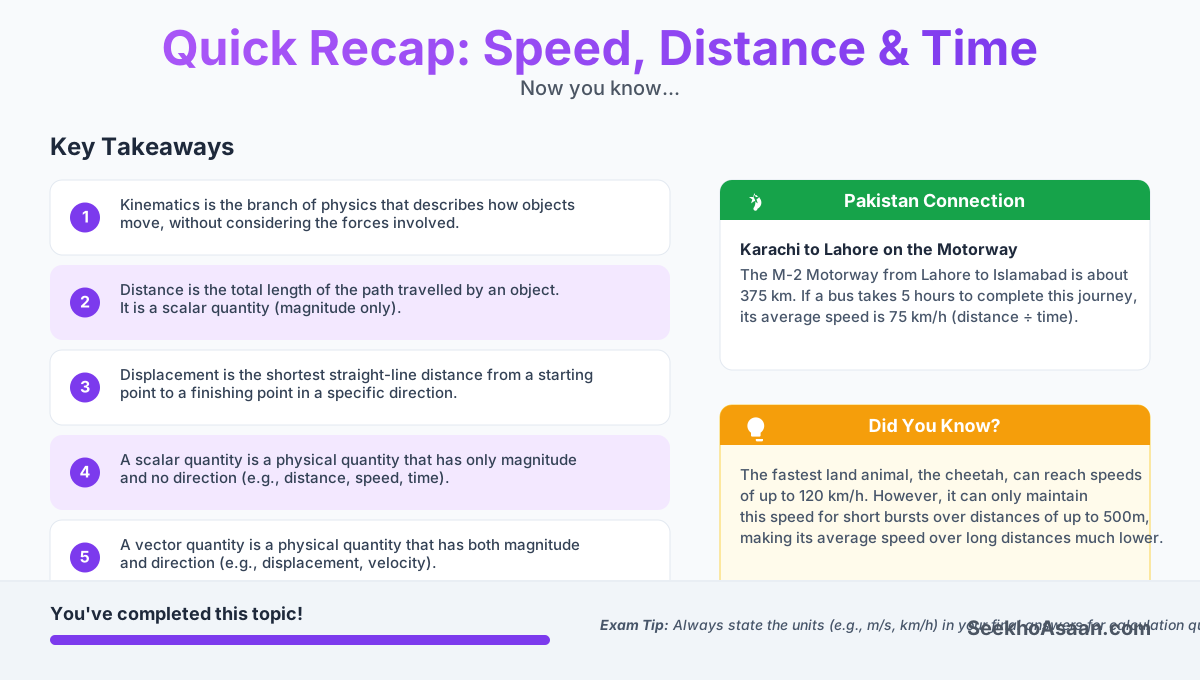
Quick revision infographic
Physics · Quick revision
Speed, Distance & Time
Key concepts
- 01Kinematics is the branch of physics that describes how objects move, without considering the forces involved.
- 02Distance is the total length of the path travelled by an object.
- 03Distance is a scalar quantity, meaning it is defined by magnitude only.
- 04Displacement is the shortest straight-line distance from a starting point to a finishing point in a specific direction.
- 05Displacement is a vector quantity, meaning it is defined by both magnitude and direction.
- 06A scalar quantity is a physical quantity that has only magnitude and no direction.
The M-2 Motorway from Lahore to Islamabad is about 375 km. If a bus takes 5 hours to complete this journey, its average speed is 375/5 = 75 km/h. But the bus doesn't travel at exactly 75 km/h the whole time — it speeds up, slows down at toll plazas, and sometimes goes faster on empty stretches. The speedometer shows instantaneous speed, while 75 km/h is the average speed.
Test your knowledge.
30 explained questions. Har answer ke baad reasoning foran milegi.